

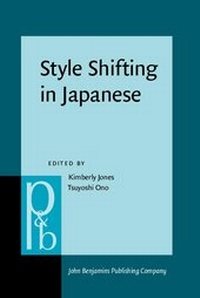
Style Shifting in Japanese
1st Edition
Published on 17. December 2008
VII, 335 pages
978-90-272-8966-7 (ISBN)
Description

This innovative and interdisciplinary book on style shifting in Japanese brings together a wide range of perspectives and methodologies-including discourse analysis, sociolinguistics, cognitive linguistics, and functional linguistics-to look at a variety of types of style shifting in both spoken and written Japanese discourse. Though diverse in approach, the contributions all reflect the belief that language use is inextricably linked to both context and language structure in mutually constitutive relationships. Topics covered include shifting between "polite" and "plain" styles, the emergence of a "semi-polite" style, speakers' strategic use of gendered styles or regional dialects, shifting between different deictic expressions, and prosodic shifting. This careful and detailed examination advances our understanding of the complex phenomenon of style shifting not only in Japanese, but also more generally, and will be of interest to researchers and students in fields such as linguistics, linguistic anthropology, communication studies, and second language acquisition and teaching.
More details
Other editions
Additional editions
Kimberly Jones | Tsuyoshi Ono
Style Shifting in Japanese
Book
12/2008
John Benjamins Publishing Co
€104.94
Shipment within 10-15 days
Persons
Content
- Style Shifting in Japanese
- Editorial page
- Title page
- LCC data
- Table of contents
- Acknowledgements
- The messy reality of style shifting
- References
- Style shifts in Japanese academic consultations
- 1. Introduction: style shifts
- 2. Shifts between the Japanese masu and plain forms
- 2.1 The masu and plain forms
- 2.2 Is the masu form a polite form?
- 3. Data
- 4. Analysis of academic consultation sessions
- 4.1 Presentation of "professional self":
- 4.2 Hierarchical relationship
- 4.3 Two attributes of the professor's social identity
- 4.4 Students' shifts to the plain form
- 4.4.1 Soliloquy-like remarks
- 4.4.2 The content of academic subjects
- 4.5 Students' strategies for avoiding a power relationship
- 4.5.1 Avoidance of marking
- 4.5.2 Co-construction
- 5. Discussion
- 6. Conclusion
- References
- Appendix: Transcription conventions
- Interpersonal functions of style shift: The use of plain and masu forms in faculty
- 1. Introduction
- 2. Politeness studies and the social context of the two forms
- 3. Motivation for style shifts: discourse-based studies
- 4. Method
- 5. Overall characteristics
- 6. Individual differences
- 7. Plain form as solidarity marker
- 8. Plain form as mitigation
- 8.1 Plain form use in expressing noncompliance
- 8.2 Plain form in self-qualification
- 9. Masu form as deference marker
- 10. Use of masu form to impersonalize the speaker
- 11. Masu form as official frame
- 12. Masu form as solidarity marker
- 13. Conclusion
- References
- Appendix
- Speech style shift as an interactional discourse strategy
- 1. Introduction
- 2. Data
- 3. Interviews as collaborative discourse
- 4. Style shift as a device for mitigating a face-threat
- 4.1 Undertaking a listening/understanding check in a subspace
- 4.2 Instigating more information in a subspace
- 4.3 Making a challenge in a subspace
- 4.4 Standing in for the interviewee in a subspace
- 5. Conclusion
- References
- Appendix
- Playing with multiple voices
- 1. Introduction
- 2. Background
- 3. Styles in written Japanese
- 4. Emotivity
- 4.1 Addressing emotivity
- 4.2 Revealing emotivity in discourse
- 4.3 Incorporating emotivity within a sentence
- 5. Creativity
- 5.1 Echoing ironical voices
- 5.2 Borrowing others' voices
- 5.3 Introducing imagined voices
- 6. Playing with multiple voices
- 7. Reflections
- References
- Data references
- Riyuu 'Reason' for Nai Desu and Other Semi-Polite Forms
- 1. Introduction
- 2. Desu and nai desu
- 2.1 Historical overview
- 2.2 Kindaichi
- 2.3 Tokieda
- 2.4 Martin
- 2.5. Teramura
- 2.6 Inoue
- 2.7 Summary
- 3. Previous studies
- 3.1 Tanomura
- 3.2 Public opinion polls, 1997 and 1999
- 3.3 Fukushima and Uehara
- 4. The novel Riyuu 'Reason': the data and results
- 4.1 Data collection and examples
- 4.2 Results
- 4.3 Summary
- 5. Analysis
- 5.1 Nature and functions of semi-polite style
- 5.2 Effects of social variables on semi-polite style
- 5.3. Summary
- 6. Conclusions and future directions
- References
- Masen or Nai Desu - That is the question
- 1. Introduction
- 2. Previous approaches to the problem and the current study
- 2.1 Grammar descriptions
- 2.2 Japanese language textbooks
- 2.3 Public opinion poll
- 2.4 Approach in the current analysis
- 3. Data
- 4. Analysis of Data I
- 4.1 Results
- 4.2 Discussion of Data 1
- 5. Analysis of Data I + Data II
- 5.1 Analyses of contextual factors
- 5.1.1 Appearance orders
- 5.1.2 Other related factors
- 5.2 Summary and discussion
- 6. Conclusion
- References
- The power of femininity
- 1. Introduction
- 2. Japanese gender variations
- 3. "Super-feminine" forms, womanhood, and power
- 3.1 A mother-daughter conversation
- 3.2 A mixed-sex friends' conversation
- 3.3 The power of womanhood
- 4. "Super-feminine" forms, femininities, and power
- 4.1 Tea ceremony lessons
- 4.2 The power of femininity
- 5. Contextualization for another dimension
- 6. Conclusion
- References
- Appendix
- Tuning speech style and persona
- 1. Introduction
- 2. Gender, stance and speech styles
- 3. Style shifting in conversations
- 4. Conclusion
- References
- Speech style and the use of regional (yamaguchi) and standard Japanese in conversations
- 1. Introduction
- 2. Method
- 3. Results and discussion
- 3.1 Inter- and intra-speaker variation in the use of YD and SJ variants
- 3.2 Code-switching or variant choice?
- 3.3 Style management: Interface between regionality and formality
- 3.4 Variant choice and style management: Negotiating competing motivations
- 4. Conclusion
- References
- "Involved" Speech Style and Deictic Management of Spatio-Temporal and Textual Reference
- 1. Introduction
- 1.1 Involvement strategies in narrative
- 1.2 Japanese deixis
- 1.3 Discourse functions of deixis
- 1.4 Purpose of the study
- 1.5 Participants and data
- 2. Analysis of monologues - Describing rock-climbing routes
- 2.1 Route I
- 2.2 Route II
- 2.3 Route III
- 2.4 Overall tendency of ko/so-occurrences
- 2.5 Ko-so conversion and the "figure-ground" relationship
- 2.6 Ima 'now' as temporal ko-deictic
- 3. Discussion and conclusion
- References
- Variation in prosodic focus of the Japanese negative nai
- 1. Introduction
- 2. Previous work on variables in focal prominence
- 3. Prosodic focus on negation and issues of style and register
- 4. Data
- 5. Analytical approach
- 5.1 The domain and criteria for prosodic prominence
- 5.2 Hypothesis of potential constraints and the analytical program
- 6. Sociolinguistic grammar of prosodic focus on the negative nai
- 6.1 Variability linked to social situations
- 6.2 Internal structures of the intonation phrase as the constraint
- 6.3 Information structure and focal prominence
- 6.4 Interactive parameters
- 7. Summary and conclusion
- References
- Name index
- Subject index
- The series Pragmatics & Beyond New Series
