

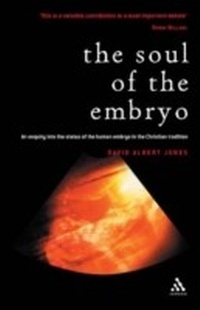
Soul of the Embryo
Christianity and the Human Embryo
1st Edition
Published on 1. December 2004
272 pages
978-1-4411-5976-2 (ISBN)
Description

We are delighted to announce that this book has been short listed for the prestigious Michael Ramsey prize for the best in theological writing. For more information please visit: www.michaelramseyprize.org.uk
A radical examination of the Christian tradition relating to the human embryo and how this relates to the debate today.In recent years, the moral status of the human embryo has come to the fore as a vital issue for a range of contemporary ethical debates: concerning the over-production, freezing and discarding of embryos in IVF; concerning the use of 'spare' embryos for scientific experimentation; and finally, concerning the prospect of producing clone embryos. These debates have involved not only general philosophical arguments, but also specifically religious arguments. Many participants have attempted to find precedent from the Christian tradition for the positions they wish to defend.It is therefore extraordinary that until The Soul of the Embryo there has been no significant work on the history of Christian reflection on the human embryo. Here, David Albert Jones seeks to tell the story of this unfolding tradition - a story that encompasses many different medical, moral, philosophical and theological themes. He starts by examining the understanding of the embryo in the Hebrew Scritpures, then moves through early Christianity and the Middle Ages to the Reformation and beyond. Finally, Albert Jones considers the application of this developed tradition to contemporary situation and questions which contemporary Christian view or views are best regarded as authentic developments of the tradition and which should be regarded as alien to the tradition.
A radical examination of the Christian tradition relating to the human embryo and how this relates to the debate today.In recent years, the moral status of the human embryo has come to the fore as a vital issue for a range of contemporary ethical debates: concerning the over-production, freezing and discarding of embryos in IVF; concerning the use of 'spare' embryos for scientific experimentation; and finally, concerning the prospect of producing clone embryos. These debates have involved not only general philosophical arguments, but also specifically religious arguments. Many participants have attempted to find precedent from the Christian tradition for the positions they wish to defend.It is therefore extraordinary that until The Soul of the Embryo there has been no significant work on the history of Christian reflection on the human embryo. Here, David Albert Jones seeks to tell the story of this unfolding tradition - a story that encompasses many different medical, moral, philosophical and theological themes. He starts by examining the understanding of the embryo in the Hebrew Scritpures, then moves through early Christianity and the Middle Ages to the Reformation and beyond. Finally, Albert Jones considers the application of this developed tradition to contemporary situation and questions which contemporary Christian view or views are best regarded as authentic developments of the tradition and which should be regarded as alien to the tradition.
Reviews / Votes
"...a fascinating historical study of what people have thought, from the earliest biblical times, about the human soul before birth". -- The Daily Telegraph "The book presents a scholarly yet accessible interdisciplinary analysis of the tradition of the Christian thinking on the status of the embryo, and a careful, powerful and fair theological and philosophical case against the destruction of the human embryo from conception. It is to be highly recommended." -Tablet, John Keown, 5th February 2005 'Archbishop Rowan Williams describes the book as 'a valuable contribution to a mist important debate'. Quite so. It is to be highly recommended.' - Adapted from a Tablet review by John Keown, Rose Kennedy Professor of Christian Ethics at Georgetown University, in Triple Helix 'In providing a systematic historical account of Christian and other approaches to the embryo, David Jones offers some fascinating material for reflection.' '...this book provides valuable material for a principled rather than merely pragmatic reflection on our attitude to this most vulnerable phase of life.' 'The scope of his work is impressive and the topic extraordinarily significant, He deals carefully with a wide variety of primary sources, and he reflects insightfully on these sources and their theological and ethical implications...[an] important book.'~ Michael J. Gorman, Studies in Christian Ethics, Vol 19, No. 1 "David Jones (Professor of Bioethics, St Mary's College, Twickenham) has provided a scholarly and insightful contribution to this field, with its complex intersection of theology, philosophy, ethics, jurisprudence and science." - Reformed Theological Review 'A scholarly contribution to the history, background and detail of the human embryo in medical, theological and moral terms. It deserves to be studied both in itself and in the important reminder of our essential human being, where we come from, what we are and what significance we have and share in this world and in eternity' * Theology *More details
Edition
1. Auflage
Language
English
Place of publication
New York
United States
ISBN-13
978-1-4411-5976-2 (9781441159762)
Copyright in bibliographic data and cover images is held by Nielsen Book Services Limited or by the publishers or by their respective licensors: all rights reserved.
Schweitzer Classification
Other editions
Additional editions
Book
12/2004
Continuum International Publishing Group Ltd.
€62.80
Shipment within 15-20 days
Person
David Albert Jones is Director of the Anscombe Bioethics Centre, Oxford, and Visiting Professor of Bioethics at St Mary's University College, London, UK.
Content
- Cover
- Contents
- Abbreviations
- Foreword
- Introduction
- 1 Moulded in the Earth: The embryo in the Hebrew Scriptures: creation, providence, calling
- 2 Curdled Like Cheese: Ancient embryology: Hippocrates and Aristotle
- 3 Discarded Children: Exposure, infanticide and abortion in ancient Greece and Rome
- 4 Grieving in Ramah: Jewish attitudes to infanticide and abortion
- 5 Medicinal Penalties: Early Christianity and abortion: Celtic/Anglo-Saxon penances, Greek/Latin canons
- 6 Soul Talk: Soul as the principle of life, body and soul, the spiritual soul
- 7 Whence the Soul? The Church Fathers on the origin of the soul: pre-existence, traducianism, creationism
- 8 The Timing of Ensoulment: Immediate and delayed animation from the Fathers to Thomas Aquinas
- 9 The Embryonic Christ: The conception of Jesus, Chalcedon, Maximus the Confessor on the embryo
- 10 Imputed Dignity: Luther, Calvin and Barth: from essential to relational categories
- 11 Embryology through the Looking-glass: Ovists and animalculists, preformation, epigenesis, embryology and ensoulment
- 12 Probable Sins and Indirect Exceptions: Casuistry, therapeutic abortion, probabilism, application to the embryo
- 13 The Justice of Miscarriage: Abortion law from the Middle Ages to the twentieth century
- 14 The Embryo in Isolation: In vitro fertilization, personhood, identical twins, stem cell research
- 15 The Least of these Little Ones: The theological status of the embryo
- Bibliography
- Indexes
- A
- B
- C
- D
- E
- F
- G
- H
- I
- J
- K
- L
- M
- N
- O
- P
- R
- S
- T
- U
- V
- W
- Z
- Scripture Index
