

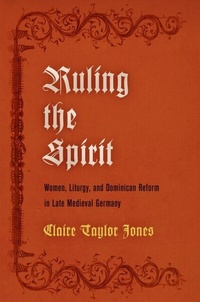
Ruling the Spirit
Women, Liturgy, and Dominican Reform in Late Medieval Germany
1st Edition
Published on 28. August 2017
232 pages
978-0-8122-9446-0 (ISBN)
Description

Histories of the German Dominican order have long presented a grand narrative of its origin, fall, and renewal: a Golden Age at the order's founding in the thirteenth century, a decline of Dominican learning and spirituality in the fourteenth, and a vibrant renewal of monastic devotion by Dominican "Observants" in the fifteenth. Dominican nuns are presumed to have moved through a parallel arc, losing their high level of literacy in Latin over the course of the fourteenth century. However, unlike the male Dominican friars, the nuns are thought never to have regained their Latinity, instead channeling their spiritual renewal into mystical experiences and vernacular devotional literature. In Ruling the Spirit, CJ Jones revises this conventional narrative by arguing for a continuous history of the nuns' liturgical piety. Dominican women did not lose their piety and literacy in the fifteenth century, as is commonly believed, but instead were urged to reframe their devotion around the observance of the Divine Office.
Jones grounds her research in the fifteenth-century liturgical library of St. Katherine's in Nuremberg, which was reformed to Observance in 1428 and grew to be one of the most significant convents in Germany, not least for its library. Many of the manuscripts owned by the convent are didactic texts, written by friars for Dominican sisters from the fourteenth through the fifteenth century. With remarkable continuity across genres and centuries, this literature urges the Dominican nuns to resume enclosure in their convents and the strict observance of the Divine Office, and posits ecstatic experience as an incentive for such devotion. Jones thus rereads the "sisterbooks," vernacular narratives of Dominican women, long interpreted as evidence of mystical hysteria, as encouragement for nuns to maintain obedience to liturgical practice. She concludes that Observant friars viewed the Divine Office as the means by which Observant women would define their communities, reform the terms of Observant devotion, and carry the order into the future.
Jones grounds her research in the fifteenth-century liturgical library of St. Katherine's in Nuremberg, which was reformed to Observance in 1428 and grew to be one of the most significant convents in Germany, not least for its library. Many of the manuscripts owned by the convent are didactic texts, written by friars for Dominican sisters from the fourteenth through the fifteenth century. With remarkable continuity across genres and centuries, this literature urges the Dominican nuns to resume enclosure in their convents and the strict observance of the Divine Office, and posits ecstatic experience as an incentive for such devotion. Jones thus rereads the "sisterbooks," vernacular narratives of Dominican women, long interpreted as evidence of mystical hysteria, as encouragement for nuns to maintain obedience to liturgical practice. She concludes that Observant friars viewed the Divine Office as the means by which Observant women would define their communities, reform the terms of Observant devotion, and carry the order into the future.
Reviews / Votes
"In this erudite and original study, CJ Jones shows convincingly the changing and often surprisingly imaginative role of the Office in the spiritual and institutional lives of Dominican nuns. . . . The archive on which Ruling the Spirit draws is a remarkable testament in itself to Jones's achievement in this book, which blazes new ground in the study of the liturgical cultures of the medieval West." (The Medieval Review) "[A] very impressive achievement that will demand to be taken into consideration in further studies of the region and women's religious life within it." (Reviews in History) "At the focus of CJ Jones's Ruling the Spirit are not works written by German Dominican nuns but rather texts for these women penned primarily by friars from the early fourteenth to late fifteenth centuries . . . [B]y assuredly emphasising the uniformity of message which underlined these writings, the author shows their vital importance for understanding women's spirituality and notions of reform in the later Middle Ages." (German History) "This important study of medieval liturgical culture focuses on a particular setting but has broad implications for our understanding of liturgy and mysticism, connections between those phenomena, relations between religious women and the men charged with their service and oversight, and pre-Reformation conceptions of reform. It makes a powerful revisionist argument that should lead to discussion in and beyond the study of medieval religion." (The Journal of Religion) "Jones has accomplished a comprehensive and exciting account of women's devotional life under the Dominican rule in late medieval Germany. The book is delightfully written; not despite but because of its intensity, it is a pleasure to read, and it is worthwhile for the expert and layperson alike." (Seminar) "Jones approaches her texts throughout with analytic rigour and sensitivity. Ruling the Spirit makes a valuable contribution to recent scholarship on late medieval religious reform, challenging assumptions about spiritual decline to argue instead for a continuous tradition of devotion to the liturgy as a deep source of spiritual inspiration. Her insights have wider implications for our understanding of the complex negotiations between the friars and the sisters, and enlarge our knowledge of the rich and expressive creativity of late medieval liturgical cultures." (Journal of Religious History) "CJ Jones has written a sure-footed, authoritative account of the Divine Office and its importance in Dominican spirituality, especially for German Observant women. Anyone interested in the history of medieval liturgy, the Dominican Order, Observant reform, or more broadly, women's spirituality and mysticism, should read her book." (Barbara Newman, Northwestern University)More details
Series
Language
English
Place of publication
Pennsylvania
United States
Target group
College/higher education
File size
2,60 MB
ISBN-13
978-0-8122-9446-0 (9780812294460)
Copyright in bibliographic data and cover images is held by Nielsen Book Services Limited or by the publishers or by their respective licensors: all rights reserved.
Schweitzer Classification
Other editions
Additional editions
Book
10/2017
University of Pennsylvania Press
€78.50
Shipment within 10-20 days
Person
CJ Jones is William Payden Associate Professor of German at the University of Notre Dame and author of Fixing the Liturgy: Friars, Sisters, and the Dominican Rite, 1256-1516, also available from the University of Pennsylvania Press.
Content
List of Abbreviations
Introduction
Chapter 1. The Office in Dominican Legislation, 1216-1303
Chapter 2. Detachment, Order, and Observance in Johannes Tauler and Heinrich Seuse
Chapter 3. Liturgical Devotion and Visionary Order in the Fourteenth-Century Sisterbooks
Chapter 4. The Office in Dominican Legislation, 1388-1475
Chapter 5. Contemplative Visualization Versus Liturgical Piety in Johannes Nider
Chapter 6. Liturgical Community and Observant Spirituality in the Work of Johannes Meyer
Notes
Bibliography
Index
Acknowledgments
Introduction
Chapter 1. The Office in Dominican Legislation, 1216-1303
Chapter 2. Detachment, Order, and Observance in Johannes Tauler and Heinrich Seuse
Chapter 3. Liturgical Devotion and Visionary Order in the Fourteenth-Century Sisterbooks
Chapter 4. The Office in Dominican Legislation, 1388-1475
Chapter 5. Contemplative Visualization Versus Liturgical Piety in Johannes Nider
Chapter 6. Liturgical Community and Observant Spirituality in the Work of Johannes Meyer
Notes
Bibliography
Index
Acknowledgments
