

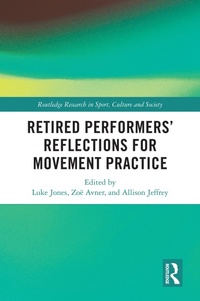
Retired Performers' Reflections for Movement Practice
1st Edition
Published on 8. April 2026
216 pages
978-1-040-65042-4 (ISBN)
Description

Ethical Practices for Skilled Movement Behaviour presents the first collection of original contributions that focus on how the retirement experiences of skilled movement performers influence how they choose to provide and orient themselves towards current performers under their tutelage, how the retirement experiences of skilled movement performers - turned coaches/instructors/practitioners influence their current practice.
The value of this cutting-edge book lies in its theoretical breadth and accessibility. Authors will draw upon contemporary social theorists from a range of anti-positivist paradigmatic perspectives. This edited collection is the first of its kind to consider how sociologically informed accounts of the complex experiences and implications of retirement for the post-performance instructional practices of former skilled movement performers. The invited contributions embrace a marriage of creative narrative writing practices with their own chosen social theory to communicate their experiences of retirement, exercise, and wellbeing and how these experiences have influenced their thoughts about the production of performers.
Ethical Practices for Skilled Movement Behaviour provides a progressive and accessible means of representation to provide a sensitive, enjoyable, and expressive account of the residual impact of a skilled movement performance career, particularly as it relates to their ongoing orientation and will be of key interest to scholars, researchers and students in the area of Sport Transition and Retirement, Sport Sociology and Sport Coaching.
The value of this cutting-edge book lies in its theoretical breadth and accessibility. Authors will draw upon contemporary social theorists from a range of anti-positivist paradigmatic perspectives. This edited collection is the first of its kind to consider how sociologically informed accounts of the complex experiences and implications of retirement for the post-performance instructional practices of former skilled movement performers. The invited contributions embrace a marriage of creative narrative writing practices with their own chosen social theory to communicate their experiences of retirement, exercise, and wellbeing and how these experiences have influenced their thoughts about the production of performers.
Ethical Practices for Skilled Movement Behaviour provides a progressive and accessible means of representation to provide a sensitive, enjoyable, and expressive account of the residual impact of a skilled movement performance career, particularly as it relates to their ongoing orientation and will be of key interest to scholars, researchers and students in the area of Sport Transition and Retirement, Sport Sociology and Sport Coaching.
More details
Series
Edition
1. Auflage
Language
English
Place of publication
London
United Kingdom
Publishing group
Taylor & Francis Ltd
Target group
College/higher education
Professional and scholarly
Product notice
Reflowable
Illustrations
2 Line drawings, black and white; 2 Illustrations, black and white
File size
1,13 MB
ISBN-13
978-1-040-65042-4 (9781040650424)
Copyright in bibliographic data and cover images is held by Nielsen Book Services Limited or by the publishers or by their respective licensors: all rights reserved.
Schweitzer Classification
Other editions
Additional editions
Luke Jones | Zoe Avner | Allison Jeffrey
Retired Performers' Reflections for Movement Practice
Book
04/2026
1st Edition
Routledge
€230.27
Shipment within 10-20 days
Persons
Dr Luke Jones is a Lecturer in sport coaching at the University of Bath, UK, and a former youth international and semi-professional footballer. Luke's doctoral research and subsequent research programme has focussed upon exploring retirement from sport using a socio-cultural perspective including how former athletes relate to their own exercise. He has also published in leading socio-cultural journals including (but not limited to) the International Review for Sociology of Sport, Sport, Education and Society, Leisure Studies, and Sports Coaching Review. Luke has also co-edited a special edition of Sports Coaching Review.
Dr Zoe Avner is a Lecturer in Sports Coaching at Deakin University, Australia and a former French youth international and semi-professional footballer. Her research draws on poststructuralist and feminist methodologies to explore athlete and coach learning, power and coaching, and coaching ethics. Broadly, her work seeks to support the development of more ethical coaching practices and more diverse, equitable, and inclusive physical cultures both within traditional mainstream and emerging alternative lifestyle sporting contexts. She has published in a number of high-profile journals such as Quest, Sports Coaching Review, and Sport, Education and Society.
Dr Allison Jeffrey is an Assistant Professor in the Department of Experiential Studies in Community and Sport at Cape Breton University, Canada. Her research engages theoretical frameworks of posthumanisms in attempts towards expanding understandings of moving bodies. Her work considers the human/nonhuman influences that are present in movement contexts and she has been involved in a number of projects focusing on ageing movement practitioners. Dr Jeffrey's previous research prioritized yoga and dance communities, while her current research addresses outdoor movement facilitation. She has published in a range of high-profile journals including, the Sociology of Sport Journal, Frontiers, and Leisure Studies.
Dr Zoe Avner is a Lecturer in Sports Coaching at Deakin University, Australia and a former French youth international and semi-professional footballer. Her research draws on poststructuralist and feminist methodologies to explore athlete and coach learning, power and coaching, and coaching ethics. Broadly, her work seeks to support the development of more ethical coaching practices and more diverse, equitable, and inclusive physical cultures both within traditional mainstream and emerging alternative lifestyle sporting contexts. She has published in a number of high-profile journals such as Quest, Sports Coaching Review, and Sport, Education and Society.
Dr Allison Jeffrey is an Assistant Professor in the Department of Experiential Studies in Community and Sport at Cape Breton University, Canada. Her research engages theoretical frameworks of posthumanisms in attempts towards expanding understandings of moving bodies. Her work considers the human/nonhuman influences that are present in movement contexts and she has been involved in a number of projects focusing on ageing movement practitioners. Dr Jeffrey's previous research prioritized yoga and dance communities, while her current research addresses outdoor movement facilitation. She has published in a range of high-profile journals including, the Sociology of Sport Journal, Frontiers, and Leisure Studies.
Content
List of Tables and Figures
Foreword
Preface
Chapter 1: Introduction. Luke Jones, Zoe Avner & Dr Allison Jeffrey.
Chapter 2: Territorialising and Re-Territorialising Coaching Practice. Christian Bjorndahl.
Chapter 3: Relations With Environments: A Shared Critical Autoethnography on Becoming-With Mountains. Nida Ahmad & Allison Jeffrey.
Chapter 4: Interrogating Moving Histories as Part of Care-Ful Pedagogical Practice: Enlisting New Materialisms to Navigate the Kinesiology Classroom. Marianne Clark.
Chapter 5: Towards More Ethical and Sustainable Sporting and Coaching Practices. Goeran Gerdin.
Chapter 6: Permeating Change Post Retirement: From Disciplined to Foucauldian Post-Structural Coach Developer. Clayton Kuklick And Gonzalo Obando.
Chapter 7: Mapping The Materialized Body in Motion. Pirkko Markula.
Chapter 8: 'Train Don't Strain!': Mastering Frailty in An Aging Running Body. P. David Howe.
Chapter 9: Illuminating The Ties That Bind: Ballet Teaching Methods Re Envisioned for Longevity of Student Engagement. Emily Noton.
Chapter 10: When Football Is Not the Priority: The Relational Challenges of Coaching in Semi-Professional Football. Darryn Stamp.
Chapter 11: When Our Survival Is Not Given: The Arts and Athletics of Remaining Alive. Danielle Peers & Nathan Fawaz.
Chapter 12: Arlene and the Body Machines. Joseph Mills.
Chapter 13: Conditioned Spaces, Conditioned Thoughts? Reflecting On How the Architectures of Space Mediate Reflexivity and Action in Performance Sport. Simon Phelan.
Chapter 14: Conclusion. Luke Jones, Zoe Avner & Allison Jeffrey.
References
Index
Foreword
Preface
Chapter 1: Introduction. Luke Jones, Zoe Avner & Dr Allison Jeffrey.
Chapter 2: Territorialising and Re-Territorialising Coaching Practice. Christian Bjorndahl.
Chapter 3: Relations With Environments: A Shared Critical Autoethnography on Becoming-With Mountains. Nida Ahmad & Allison Jeffrey.
Chapter 4: Interrogating Moving Histories as Part of Care-Ful Pedagogical Practice: Enlisting New Materialisms to Navigate the Kinesiology Classroom. Marianne Clark.
Chapter 5: Towards More Ethical and Sustainable Sporting and Coaching Practices. Goeran Gerdin.
Chapter 6: Permeating Change Post Retirement: From Disciplined to Foucauldian Post-Structural Coach Developer. Clayton Kuklick And Gonzalo Obando.
Chapter 7: Mapping The Materialized Body in Motion. Pirkko Markula.
Chapter 8: 'Train Don't Strain!': Mastering Frailty in An Aging Running Body. P. David Howe.
Chapter 9: Illuminating The Ties That Bind: Ballet Teaching Methods Re Envisioned for Longevity of Student Engagement. Emily Noton.
Chapter 10: When Football Is Not the Priority: The Relational Challenges of Coaching in Semi-Professional Football. Darryn Stamp.
Chapter 11: When Our Survival Is Not Given: The Arts and Athletics of Remaining Alive. Danielle Peers & Nathan Fawaz.
Chapter 12: Arlene and the Body Machines. Joseph Mills.
Chapter 13: Conditioned Spaces, Conditioned Thoughts? Reflecting On How the Architectures of Space Mediate Reflexivity and Action in Performance Sport. Simon Phelan.
Chapter 14: Conclusion. Luke Jones, Zoe Avner & Allison Jeffrey.
References
Index
