

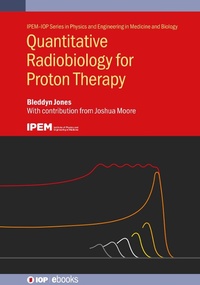
Quantitative Radiobiology for Proton Therapy
Description

Proton therapy is a type of radiation therapy that uses protons rather than X-rays to treat cancers. Due to the heightened emphasis on quantitative methods and new material, this book is an extension and major update of the author's previous work, titled, "Practical Radiobiology for Proton Therapy Planning" (IOP 2018).
This book informs readers of the relative biological effectiveness (RBE) issues within proton therapy and advises on how to use a variable RBE within treatment planning and dose prescription. The physical and biological interactions are described in qualitative and quantitative terms, using extensions of the linear quadratic model and its associated biological effective dose concept. Methods for safer retreatments, treatment interruption compensations, FLASH dose rates and the persistence of high RBE values in scanned pencil beams relative to passively scattered beams for deeper situated targets are covered.
This book is intended for those who already have basic knowledge of radiotherapy and radiobiology, although there is guidance through the fundamental principles for those who are 'discipline crossing'. In this way, biologists (molecular, cellular and tissue oriented), physicists (particle and medical physicists), technicians and clinicians may benefit from knowing more about the key features beyond their own discipline which can influence proton therapy outcomes. This is enhanced through the incorporation of case studies and end-of-chapter summaries.
More details
Other editions
Additional editions

Person
Bleddyn Jones, MD ScD FRCR, is an Emeritus Professor of Clinical Radiation Biology, University of Oxford. He has had over 40 years of interest and high impact research in neutron, proton and ion beam therapy and its associated radiobiology. He has made extensive contributions to the quantitative understanding of the relative biological effectiveness (RBE) of particle therapy from the ballistic properties to their cellular and tissue effects. This includes many practical applications based on specific clinical situations, to guide proton therapy to safer and more effective outcomes.
Joshua Moore graduated in Mathematics at Cardiff University followed by a PhD in applied mathematics supervised by Dr Thomas E. Woolley primarily focusing on developing multiscale mathematical models to investigate organoid formation. His additional research interests are in applying mathematics in biological areas of sub-cellular dynamics, pattern formation, virology and oncology. Subsequently he has been appointed as a post-doctorate Research Associate in the Mathematical Institute at the University of Oxford.
Content
- Intro
- Acknowledgements
- Author biographies
- Bleddyn Jones
- Joshua Moore
- Glossary of the main terms and symbols used (some others are given in specific chapters)
- Chapter Particle physics for biological interactions
- 1.1 Physical beam parameters, essential dosimetry and reference (or control) radiation requirements for RBE studies
- 1.1.1 Straggling and fragmentation
- 1.1.2 Separation of charged particles with increasing tissue depth
- 1.1.3 Particle accelerators
- 1.1.4 Proton range uncertainties
- 1.2 Physics interacting with biology
- 1.2.1 Relative biological effect
- 1.2.2 Choice of the control (or reference) radiation source
- 1.2.3 Can RBE reduce with the depth of the SOBP placement in the case of passively scattered but not pencil scanned beams?
- References
- Chapter The essential radiobiology background
- 2.1 Introduction
- 2.2 Background and models
- 2.2.1 The linear quadratic model
- 2.2.2 Model variants
- 2.2.3 Biological effective dose
- 2.2.4 Repopulation allowances
- 2.2.5 Biological effective dose and repopulation
- 2.2.6 BED expression of high-LET radiation
- 2.2.7 Dose rate, total fraction treatment time and incomplete repair between treatment fields
- 2.2.8 Closely spaced fractions
- 2.2.9 Hypoxia
- 2.2.10 Very low doses
- 2.2.11 Higher doses per fraction
- 2.3 The a/ß ratio and its choice for modelling particle therapies
- 2.3.1 The a/ß ratio
- 2.3.2 Applications of BED equations
- 2.3.3 Special considerations for particle therapy
- 2.4 The design of experiments for RBE determination and other purposes
- References
- Chapter Medical and surgical considerations that influence radiation tolerances, including interpretation of clinical trials
- 3.1 Introduction
- 3.2 Surgery
- 3.3 Cytotoxic chemotherapies
- 3.4 Age and other medical conditions
- 3.5 Reductions in prescribed dose
- 3.6 Interpretation of the case histories and literature
- 3.7 Clinical trials
- 3.8 Ethical issues
- 3.9 Mixed end points
- 3.10 The importance of follow-up
- 3.11 Publication bias
- References
- Chapter Treatment planning and further medical perspectives
- 4.1 Introduction
- 4.1.1 Treatment-planning processes
- 4.1.2 The important interaction of RBE issues with the marginal target volumes
- 4.1.3 Comparative planning studies
- 4.1.4 Trade-off situations in comparative treatment planning
- 4.1.5 How to accommodate assumed errors in RBE
- 4.1.6 The product of LET and dose
- 4.1.7 Some final caveats and suggestions
- References
- Chapter Historical development of radiotherapy: what was learned from fast neutrons including their linkage with proton relative biological effect
- 5.1 Introduction
- 5.2 A brief synopsis
- 5.3 Neutron therapy
- 5.4 More recent developments based on neutron studies
- 5.5 Estimation of neutron RBE from neutron energy
- 5.6 Some important conclusions
- Appendix A
- Appendix B
- References
- Chapter Fractionation modelling
- 6.1 Introduction and background radiobiology
- 6.2 A brief history of fractionation
- 6.2.1 Radiobiology
- 6.2.2 A synopsis of clinical fractionation
- 6.3 Modelling of fractionation
- 6.3.1 LQ modelling of fractionation in high-LET radiations with inclusion of RBE
- 6.3.2 BED equations
- 6.3.3 Converting a specific low-LET BED fractionation to that for high LET, when the low-LET a/ß ratio is known, but with no change in overall treatment time
- 6.3.4 Overall fractionation differences between low- and high-LET radiations
- 6.3.5 Boost doses
- 6.3.6 Converting a specific low-LET BED fractionation to that for high LET, when the low-LET a/ß ratio is known, but with a change in overall treatment time
- 6.3.7 Alternative approach for isoeffect calculations in the case of two high-LET schedules
- 6.3.8 Differences in exposure times
- 6.3.9 RBE and dose per fraction: clinical implications
- 6.3.10 Effects of regions of higher and lower dose per fraction relative to the prescribed dose for different fractionation patterns
- 6.3.11 Taking RBE uncertainty into account in fractionation
- 6.4 The use of the linear quadratic model with large fraction sizes
- 6.5 Optimisation of fractionation using calculus methods
- 6.6 Other contributions to fractionation
- 6.7 Summary
- References
- Chapter The scientific case for using a variable proton RBE rather than a constant RBE
- 7.1 Introduction
- 7.1.1 Arguments to preserve the status quo or avoid using RBE
- 7.1.2 Justification of a variable RBE
- 7.2 Discussion
- 7.2.1 Inclusion of flexible RBEs in treatment plans
- References
- Chapter A general RBE linear energy-efficiency model for protons and light ions
- 8.1 Introduction
- 8.2 The available experimental data and its important limitations
- 8.3 Description of the Z-specific model
- 8.3.1 The relationship between Z and LETU
- 8.3.2 Changes in the radiosensitivities with LET
- 8.3.3 Obtaining aH and ßH values
- 8.3.4 An alternative method which does not use LETU but the slope of the radiosensitivity or measured RBE increments with increasing LET (up to the turnover point)
- 8.3.5 The RBE at any specified dose per fraction
- 8.4 The graphical results
- 8.4.1 Radiosensitivity data
- 8.4.2 Fits to experimental RBE data sets
- 8.4.3 Applications of the model to clinical radiobiology
- 8.5 Further investigations: properties of LETU
- 8.6 Conclusions and what remains to be done
- References
- Chapter Inclusion of the energy-efficiency LET and RBE model in proton therapy
- 9.1 Introduction
- 9.2 RBE uncertainties
- 9.3 Description of the quantitative model
- 9.4 RBE graphical examples
- 9.5 Some comparisons with experimental data sets
- 9.6 Two clinical examples where PBT could be sub-optimal
- 9.6.1 Prostate cancer
- 9.6.2 Paediatric cancers and other radiosensitive tumours such as lymphomas
- 9.7 Prediction of tumour response from the RBE increment
- 9.8 Intensification of dose rates
- 9.9 Concluding discussion
- References
- Chapter Proton therapy risk assessment using small increments in RBE in the central nervous system and estimation of remission times
- 10.1 Introduction
- 10.2 Methods
- 10.3 Results
- 10.3.1 Remission duration considerations
- 10.4 Discussion
- 10.5 Conclusions
- References
- Chapter Radiobiological interpretation of the finding of RBE changes within similar SOBPs placed at superficial and deep locations in passively scattered beams but not in scanned pencil beams
- 11.1 Introduction
- 11.2 Methods
- 11.2.1 Linear quadratic model base equations
- 11.2.2 The modelling method
- 11.3 Results
- 11.4 Discussion
- 11.5 Conclusions
- References
- Chapter Particle therapy dose-time compensations in unintended interruptions and re-treatments
- 12.1 Introduction
- 12.2 Unintended treatment interruptions
- 12.2.1 Background
- 12.2.2 Treatment delays
- 12.2.3 Calculations for compensation of treatment interruptions
- 12.2.4 Calculations using a variable RBE value
- 12.2.5 Comparison of the two methods
- 12.2.6 Summary for unintended treatment gap corrections
- 12.3 Re-treatments
- 12.3.1 Background
- References
- Chapter Errors of Bragg peak positioning and their radio-biological correction
- 13.1 Introduction
- 13.1.1 Further abbreviations and definitions
- 13.1.2 Background considerations
- 13.1.3 Brief description of methods
- 13.2 Model description
- 13.2.1 Biological effective dose equations
- 13.2.2 Assessment of BED changes after an error
- 13.2.3 Worked examples of errors and their correction
- 13.2.4 The potential impact of erroneous fractions on tumour control
- 13.3 Conclusions
- References
- Chapter What remains to be done: including FLASH dose rates and conclusions
- 14.1 Introduction
- 14.2 Dose escalation where circumstances permit
- 14.3 Simultaneous 'sensitisation' effects by new therapies
- 14.4 Sensitivity analysis of the energy-efficiency model
- 14.5 What could be achieved in a single international laboratory dedicated to high-LET radiobiology
- 14.5.1 Simulated experiments
- 14.5.2 Uniqueness of LETU for each ion species
- 14.5.3 Priority in radiobiological experiments
- 14.6 Some untested situations
- 14.7 Conclusions
- References
