

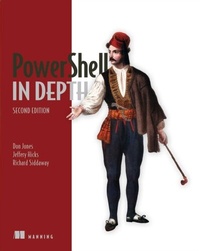
PowerShell in Depth
1st Edition
Published on 31. October 2014
744 pages
978-1-63835-329-4 (ISBN)
Description

Summary
PowerShell in Depth, Second Edition is the go-to reference for administrators working with Windows PowerShell. Every major technique, technology, and tactic is carefully explained and demonstrated, providing a hands-on guide to almost everything an admin would do in the shell. Written by three experienced authors and PowerShell MVPs, this is the PowerShell book you'll keep next to your monitor?not on your bookshelf!
Purchase of the print book includes a free eBook in PDF, Kindle, and ePub formats from Manning Publications.
About the Book
A Windows admin using PowerShell every day may not have the time to search the net every time he or she hits a snag. Wouldn't it be great to have a team of seasoned PowerShell experts ready to answer even the toughest questions? That's what you get with this book.
PowerShell in Depth, Second Edition is the go-to reference for administrators working with Windows PowerShell. Every major technique, technology, and tactic is carefully explained and demonstrated, providing a hands-on guide to almost everything an admin would do in the shell. Written by PowerShell MVPs Don Jones, Jeffrey Hicks, and Richard Siddaway, each valuable technique was developed and thoroughly tested, so you'll be able to consistently write production-quality, maintainable scripts while saving hours of time and effort.
This book assumes you know the basics of PowerShell.
What's Inside
About the Authors
Don Jones, Jeffery Hicks, and Richard Siddaway are Microsoft MVPs, trainers, and administrators. Collectively, they've authored nearly three dozen books on PowerShell and Windows administration.
Table of Contents
PowerShell in Depth, Second Edition is the go-to reference for administrators working with Windows PowerShell. Every major technique, technology, and tactic is carefully explained and demonstrated, providing a hands-on guide to almost everything an admin would do in the shell. Written by three experienced authors and PowerShell MVPs, this is the PowerShell book you'll keep next to your monitor?not on your bookshelf!
Purchase of the print book includes a free eBook in PDF, Kindle, and ePub formats from Manning Publications.
About the Book
A Windows admin using PowerShell every day may not have the time to search the net every time he or she hits a snag. Wouldn't it be great to have a team of seasoned PowerShell experts ready to answer even the toughest questions? That's what you get with this book.
PowerShell in Depth, Second Edition is the go-to reference for administrators working with Windows PowerShell. Every major technique, technology, and tactic is carefully explained and demonstrated, providing a hands-on guide to almost everything an admin would do in the shell. Written by PowerShell MVPs Don Jones, Jeffrey Hicks, and Richard Siddaway, each valuable technique was developed and thoroughly tested, so you'll be able to consistently write production-quality, maintainable scripts while saving hours of time and effort.
This book assumes you know the basics of PowerShell.
What's Inside
- Automating tasks
- Packaging and deploying scripts
- Introduction to Desired State Configuration
- PowerShell security
- Covers PowerShell version 3 and later
About the Authors
Don Jones, Jeffery Hicks, and Richard Siddaway are Microsoft MVPs, trainers, and administrators. Collectively, they've authored nearly three dozen books on PowerShell and Windows administration.
Table of Contents
- Introduction
- PowerShell hosts
- Using the PowerShell help system
- The basics of PowerShell syntax
- Working with PSSnapins and modules
- Operators
- Working with objects
- The PowerShell pipeline
- Formatting
- PowerShell Remoting
- Background jobs and scheduling
- Working with credentials
- Regular expressions
- Working with HTML and XML data
- PSDrives and PSProviders
- Variables, arrays, hash tables, and script blocks
- PowerShell security
- Advanced PowerShell syntax
- PowerShell's scripting language
- Basic scripts and functions
- Creating objects for output
- Scope
- PowerShell workflows
- Advanced syntax for scripts and functions
- Script modules and manifest modules
- Custom formatting views
- Custom type extensions
- Data language and internationalization
- Writing help
- Error handling techniques
- Debugging tools and techniques
- Functions that work like cmdlets
- Tips and tricks for creating reports
- Working with the Component Object Model (COM)
- Working with .NET Framework objects
- Accessing databases
- Proxy functions
- Building a GUI
- WMI and CIM
- Working with the web
- Desired State Configuration
More details
Other editions
Additional editions
Don Jones | Jeffrey Hicks | Richard Siddaway
PowerShell in Depth
Book
11/2014
2nd Edition
Manning Publications
€56.00
Shipment within 10-20 days
Persons
Don Jones is a PowerShell MVP, speaker, and trainer. He developed the Microsoft PowerShell courseware and has taught PowerShell to more than 20,000 IT pros. Don writes the PowerShell column for TechNet Magazine and blogs about PowerShell at PowerShell.com. Ask Don your PowerShell questions at http://bit.ly/AskDon.
Jeffery Hicks is a PowerShell MVP with 20 years of IT experience. Jeff works as an independent consultant, trainer, and author and he has taught PowerShell to IT Professionals all over the world. He writes the popular Prof.PowerShell column for MCPMag.com and is a weekly contributor to the Petri IT Knowledgebase. Jeff blogs frequently on PowerShell related topics at http://jdhitsolutions.com/blog.
Richard Siddaway is a multi-year PowerShell MVP, author, speaker and blogger with many years of experience using PowerShell.
Jeffery Hicks is a PowerShell MVP with 20 years of IT experience. Jeff works as an independent consultant, trainer, and author and he has taught PowerShell to IT Professionals all over the world. He writes the popular Prof.PowerShell column for MCPMag.com and is a weekly contributor to the Petri IT Knowledgebase. Jeff blogs frequently on PowerShell related topics at http://jdhitsolutions.com/blog.
Richard Siddaway is a multi-year PowerShell MVP, author, speaker and blogger with many years of experience using PowerShell.
Content
- Intro
- Copyright
- Brief Table of Contents
- Table of Contents
- Praise for the First Edition
- Preface
- Acknowledgments
- About this Book
- Part 1. PowerShell fundamentals
- Chapter 1. Introduction
- Chapter 2. PowerShell hosts
- Chapter 3. Using the PowerShell help system
- Chapter 4. The basics of PowerShell syntax
- Chapter 5. Working with PSSnapins and modules
- Chapter 6. Operators
- Chapter 7. Working with objects
- Chapter 8. The PowerShell pipeline
- Chapter 9. Formatting
- Part 2. PowerShell management
- Chapter 10. PowerShell Remoting
- Chapter 11. Background jobs and scheduling
- Chapter 12. Working with credentials
- Chapter 13. Regular expressions
- Chapter 14. Working with HTML and XML data
- Chapter 15. PSDrives and PSProviders
- Chapter 16. Variables, arrays, hash tables, and script blocks
- Chapter 17. PowerShell security
- Chapter 18. Advanced PowerShell syntax
- Part 3. PowerShell scripting and automation
- Chapter 19. PowerShell's scripting language
- Chapter 20. Basic scripts and functions
- Chapter 21. Creating objects for output
- Chapter 22. Scope
- Chapter 23. PowerShell workflows
- Chapter 24. Advanced syntax for scripts and functions
- Chapter 25. Script modules and manifest modules
- Chapter 26. Custom formatting views
- Chapter 27. Custom type extensions
- Chapter 28. Data language and internationalization
- Chapter 29. Writing help
- Chapter 30. Error handling techniques
- Chapter 31. Debugging tools and techniques
- Chapter 32. Functions that work like cmdlets
- Chapter 33. Tips and tricks for creating reports
- Part 4. Advanced PowerShell
- Chapter 34. Working with the Component Object Model (COM)
- Chapter 35. Working with .NET Framework objects
- Chapter 36. Accessing databases
- Chapter 37. Proxy functions
- Chapter 38. Building a GUI
- Chapter 39. WMI and CIM
- Chapter 40. Working with the web
- Chapter 41. Desired State Configuration
- Appendix A. Best practices
- Appendix B. PowerShell Web Access
- Appendix C. PowerShell versions
- Index
- List of Figures
- List of Tables
- List of Listings
