

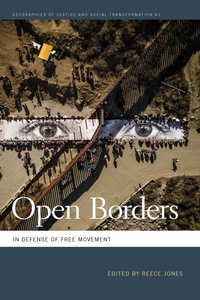
Open Borders
Description

Border control continues to be a highly contested and politically charged subject around the world. This collection of essays challenges reactionary nationalism by making the positive case for the benefits of free movement for countries on both ends of the exchange. Open Borders counters the knee-jerk reaction to build walls and close borders by arguing that there is not a moral, legal, philosophical, or economic case for limiting the movement of human beings at borders. The volume brings together essays by theorists in anthropology, geography, international relations, and other fields who argue for open borders with writings by activists who are working to make safe passage a reality on the ground. It puts forward a clear, concise, and convincing case for a world without movement restrictions at borders.
The essays in the first part of the volume make a theoretical case for free movement by analyzing philosophical, legal, and moral arguments for opening borders. In doing so, they articulate a sustained critique of the dominant idea that states should favor the rights of their own citizens over the rights of all human beings. The second part sketches out the current situation in the European Union, in states that have erected border walls, in states that have adopted a policy of inclusion such as Germany and Uganda, and elsewhere in the world to demonstrate the consequences of the current regime of movement restrictions at borders. The third part creates a dialogue between theorists and activists, examining the work of Calais Migrant Solidarity, No Borders Morocco, activists in sanctuary cities, and others who contest border restrictions on the ground.
More details
Other editions
Additional editions

Person
Content
- Cover
- Half Title
- Title
- Copyright
- Contents
- List of Illustrations
- Acknowledgments
- Introduction
- PART 1: Why Borders Should Be Open
- CHAPTER 1 Sanctuary, Solidarity, Status!
- CHAPTER 2 In Defense of Illegal Immigration
- CHAPTER 3 Toward a Politics of Freedom of Movement
- CHAPTER 4 Dispossessing Citizenship
- CHAPTER 5 Prison Abolitionist Perspectives on No Borders
- CHAPTER 6 Habeas Corpus and the New Abolitionism
- PART 2: The Problem with Borders
- CHAPTER 7 Migration as Reparations
- CHAPTER 8 Médecins Sans Frontières and the Practice of Universalist Humanitarianism
- CHAPTER 9 Border Walls and the Illusion of Deterrence
- CHAPTER 10 Open Internal Borders and Closed External Borders in the EU
- CHAPTER 11 Crumbling Walls and Mass Migration in the Twenty- First Century
- PART 3: Activism for Free Movement
- CHAPTER 12 Asylum Reporting as a Site of Anxiety, Detention, and Solidarity
- CHAPTER 13 Radical Migrant Solidarity in Calais
- CHAPTER 14 Violence, Resistance, and Bozas at the Spanish- Moroccan Border
- CHAPTER 15 Comunicados desde Chicagoiguala
- CHAPTER 16 Sanctuary Cities and Sanctuary Power
- CONCLUSION In Defense of Free Movement
- Contributors
- Index
- A
- B
- C
- D
- E
- F
- G
- H
- I
- J
- K
- L
- M
- N
- O
- P
- R
- S
- T
- U
- V
- W
- Y
- Z
