

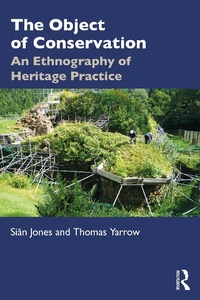
The Object of Conservation
An Ethnography of Heritage Practice
1st Edition
Published on 18. April 2022
262 pages
978-1-317-22285-9 (ISBN)
Description

The Object of Conservation examines how historic buildings, monuments and artefacts are cared for as valued embodiments of the past. It tells the fascinating story of the working lives of those involved in conservation through an ethnographic account of a national heritage agency.
How are conservation objects made? What is the moral purpose of that making and what practical consequences flow from this? Revealing the hidden labour of keeping things as they are, the book highlights the ethical commitments and dilemmas involved in trying to care well. In doing so, it reveals how conservation objects are made literally to matter. Taking debates in the interdisciplinary field of heritage studies forward in important new directions, the book engages with themes of broader interest within the arts, humanities and social sciences, shedding new light on time, authenticity, modernity, materiality, expert knowledge and the politics of care.
The Object of Conservation is a thought-provoking and engaging account that offers original insights for students, scholars, heritage professionals and others interested in the work of caring for the past.
How are conservation objects made? What is the moral purpose of that making and what practical consequences flow from this? Revealing the hidden labour of keeping things as they are, the book highlights the ethical commitments and dilemmas involved in trying to care well. In doing so, it reveals how conservation objects are made literally to matter. Taking debates in the interdisciplinary field of heritage studies forward in important new directions, the book engages with themes of broader interest within the arts, humanities and social sciences, shedding new light on time, authenticity, modernity, materiality, expert knowledge and the politics of care.
The Object of Conservation is a thought-provoking and engaging account that offers original insights for students, scholars, heritage professionals and others interested in the work of caring for the past.
Reviews / Votes
"Cultural heritage elicits strong reactions, from quasi-religious awe to dismissal as feel-good history, but these are rarely based on familiarity with the actual complexities of caring for the past. This thoughtfully crafted account takes a big step towards understanding the practice of conservation. It is a trailblazer in the ethnographic study of heritage conservation and will also inspire those interested in the anthropology of public bureaucracies, professional expertise and ethical virtue."~Christoph Brumann, Max Planck Institute for Social Anthropology, Germany.
"Conservation is a puzzle - riven with compromise, contingency, negotiation and uncertainty. In this remarkable book, the authors bring the reader along to stand next to conservation professionals and listen in as they go about their daily deliberations about how to care well. We gain a privileged understanding of the inside story, and the specific skills - from applied craft to policy interpretation - that go into producing the apparently stable objects we usually only know from the outside in."
~Caitlin DeSilvey, University of Exeter, UK.
"Through their ethnography, Jones and Yarrow explore the work of conservation - focusing simultaneously on the relations between differently situated actors and on how those different actors treat the material objects they are charged with curating. The Object of Conservation is exactly what's needed to get beyond the debate between positivist and relativist approaches to heritage."
~Richard Handler, University of Virginia, USA
"This is an insightful study of conservation and the various 'matters of concern' and 'matters of care' that emerge in its versatile webs of practice. Meticulous, ethnographically rich and analytically innovative, the book shows how conservation and heritage professionals shape conservation objects and how, in return, they get shaped by the profound engagements with these unpredictable and politically complex objects."
~Albena Yaneva, University of Manchester, UK
More details
Edition
1. Auflage
Language
English
Place of publication
London
United Kingdom
Publishing group
Taylor & Francis Ltd
Target group
College/higher education
Illustrations
10 Halftones, black and white; 10 Illustrations, black and white
ISBN-13
978-1-317-22285-9 (9781317222859)
Copyright in bibliographic data and cover images is held by Nielsen Book Services Limited or by the publishers or by their respective licensors: all rights reserved.
Schweitzer Classification
Other editions
Additional editions
Book
04/2022
1st Edition
Routledge
€61.80
Shipment within 10-20 days
Book
04/2022
1st Edition
Routledge
€206.50
Shipment within 10-20 days
Persons
Sian Jones is Professor of Heritage at the University of Stirling, UK.
Thomas Yarrow is Professor in Social Anthropology at Durham University, UK.
Thomas Yarrow is Professor in Social Anthropology at Durham University, UK.
Content
Introduction; Part I: People; 1. Present Pasts; 2. Working from the Past; 3. Organising Knowledge; 4. Subjects as Objects; 5. Life and Work; Part II: Things; 6. (Dis)Ordered Things; 7. Crafting Authenticity through Skilled Practice; 8. Material Transformation and Scientific Conservation; 9. Significance, Faith and Care; Conclusion: Working through the Past.
