

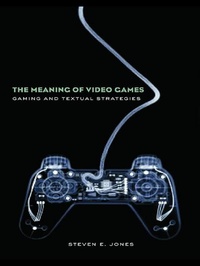
The Meaning of Video Games
Gaming and Textual Strategies
Published on 11. April 2008
208 pages
978-1-135-90218-6 (ISBN)
Description

The Meaning of Video Games takes a textual studies approach to an increasingly important form of expression in today's culture. It begins by assuming that video games are meaningful-not just as sociological or economic or cultural evidence, but in their own right, as cultural expressions worthy of scholarly attention. In this way, this book makes a contribution to the study of video games, but it also aims to enrich textual studies.
Early video game studies scholars were quick to point out that a game should never be reduced to merely its "story" or narrative content and they rightly insist on the importance of studying games as games. But here Steven E. Jones demonstrates that textual studies-which grows historically out of ancient questions of textual recension, multiple versions, production, reproduction, and reception-can fruitfully be applied to the study of video games. Citing specific examples such as Myst and Lost, Katamari Damacy, Halo, Facade, Nintendo's Wii, and Will Wright's Spore, the book explores the ways in which textual studies concepts-authorial intention, textual variability and performance, the paratext, publishing history and the social text-can shed light on video games as more than formal systems. It treats video games as cultural forms of expression that are received as they are played, out in the world, where their meanings get made.
Early video game studies scholars were quick to point out that a game should never be reduced to merely its "story" or narrative content and they rightly insist on the importance of studying games as games. But here Steven E. Jones demonstrates that textual studies-which grows historically out of ancient questions of textual recension, multiple versions, production, reproduction, and reception-can fruitfully be applied to the study of video games. Citing specific examples such as Myst and Lost, Katamari Damacy, Halo, Facade, Nintendo's Wii, and Will Wright's Spore, the book explores the ways in which textual studies concepts-authorial intention, textual variability and performance, the paratext, publishing history and the social text-can shed light on video games as more than formal systems. It treats video games as cultural forms of expression that are received as they are played, out in the world, where their meanings get made.
Reviews / Votes
"Steven E. Jones rolls his katamari through wonderful terrain, collecting insights about how video games relate to reality TV, otaku culture, British gift-book annuals, and our perspectives on outer space. The Meaning of Video Games draws on the methods of textual studies and on a solid understanding of games and how they are played. It is an enjoyable, edifying, next-generation book."-Nick Montfort, Massachusetts Institute of Technology
"In The Meaning of Video Games Steven E. Jones makes it look easy, effortlessly dissolving distinctions between media studies, game studies, and textual studies. Close readings become 'close playings' (and back again) as the book creates an interdisciplinary convergence culture every bit as mobile and networked as the objects of its study."
-Matthew G. Kirschenbaum, University of Maryland
"This is a perfect case of a book hitting the market exactly when we need it. While there have been individual academic accounts of specific types and modes of games before, Jones's book is the first scholarly (and 'popular') study of an increasingly pervasive element of contemporary culture, deftly integrating the phenomenology of game design and game playing with the general textuality in which Jones wisely chooses to discuss both the creation and reception of gaming. Avoiding the pitfalls of a straight historical narrative, the author selects certain emblematic moments in the growth of games and games studies (from Lost to Halo to the Wii-and 'platform studies' -to the forthcoming Spore). He sets these exempla against a wide array of other disciplines and approaches: media studies, psychology, textual studies, popular culture, sociology, anthropology, and even 'literature.' Whether Jones has provided the last word on the 'meaning' of video games remains to be seen, but it will certainly inspire others to continue the search for such 'meaning.'"
-David Greetham, City University of New York "Steven E. Jones rolls his katamari through wonderful terrain, collecting insights about how video games relate to reality TV, otaku culture, British gift-book annuals, and our perspectives on outer space. The Meaning of Video Games draws on the methods of textual studies and on a solid understanding of games and how they are played. It is an enjoyable, edifying, next-generation book."
-Nick Montfort, Massachusetts Institute of Technology
"In The Meaning of Video Games Steven E. Jones makes it look easy, effortlessly dissolving distinctions between media studies, game studies, and textual studies. Close readings become 'close playings' (and back again) as the book creates an interdisciplinary convergence culture every bit as mobile and networked as the objects of its study."
-Matthew G. Kirschenbaum, University of Maryland
"This is a perfect case of a book hitting the market exactly when we need it. While there have been individual academic accounts of specific types and modes of games before, Jones's book is the first scholarly (and 'popular') study of an increasingly pervasive element of contemporary culture, deftly integrating the phenomenology of game design and game playing with the general textuality in which Jones wisely chooses to discuss both the creation and reception of gaming. Avoiding the pitfalls of a straight historical narrative, the author selects certain emblematic moments in the growth of games and games studies (from Lost to Halo to the Wii-and 'platform studies' -to the forthcoming Spore). He sets these exempla against a wide array of other disciplines and approaches: media studies, psychology, textual studies, popular culture, sociology, anthropology, and even 'literature.' Whether Jones has provided the last word on the 'meaning' of video games remains to be seen, but it will certainly inspire others to continue the search for such 'meaning.'"
-David Greetham, City University of New York
"The meaning of video games - suggests Jones - is not intrinsic to the text, but is produced dynamically from the interaction between author and user, code and system, machine and human being. The pleasant digressions on otaku culture, reality TV shows and TV series such as Lost (which opens the volume) make reading The Meaning of Video Games pleasant, if not essential."
- Matteo Bittanti, Videoludica
"As his title promises, Jones successfully demonstrates strategies for understanding the meanings of video games. His six case studies present insightful analyses and exemplify how scholars might approach games using textual studies theories...Jones provides another fruitful contribution to the interdisciplinary network of game studies, offering close textual readings of specific game artifacts to illuminate how video games are the "quintessential social texts of our present cultural moment.""
-Cinema Journal Spring 2009 Issue
"Ultimately, Jones' contributions in this excellent collection of more or less stand-alone chapters sums up with a wonderful exposition of the ceaseless movement of significance in the paratextual character of the human engagement with videogames."
-New Media and Society 2009; 11; 641
More details
Language
English
Place of publication
London
United Kingdom
Publishing group
Taylor & Francis Ltd
Target group
College/higher education
Illustrations
7 s/w Photographien bzw. Rasterbilder
7 Halftones, black and white
File size
1,41 MB
ISBN-13
978-1-135-90218-6 (9781135902186)
Copyright in bibliographic data and cover images is held by Nielsen Book Services Limited or by the publishers or by their respective licensors: all rights reserved.
Schweitzer Classification
Other editions
Additional editions
Book
02/2008
1st Edition
Routledge
€206.20
Article not available at the moment
Book
02/2008
1st Edition
Routledge
€60.80
Shipment within 15-20 days
Person
Steven E. Jones is Professor of English at Loyola University in Chicago. He is author of Against Technology (Routledge, 2006) and Satire and Romanticism, and he is editor of The Satiric Eye: Forms of Satire in the Romantic Period.
Content
Introduction
1. The game of Lost
2. Collecting Katamari Damacy
3. The Halo universe
4. The game behind Facade
5. The Wii platform
6. Anticpating Spore
Notes
Selected Bibliography
Glossary
Index
1. The game of Lost
2. Collecting Katamari Damacy
3. The Halo universe
4. The game behind Facade
5. The Wii platform
6. Anticpating Spore
Notes
Selected Bibliography
Glossary
Index
