

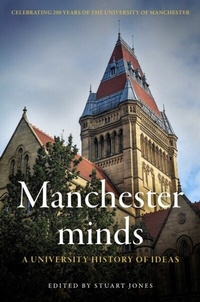
Manchester Minds
A University History of Ideas
1st Edition
Published on 3. September 2024
392 pages
978-1-5261-7633-2 (ISBN)
Description

A bicentennial celebration of brilliant thinkers from The University of Manchester's history.
The year 2024 marks two centuries since the establishment of The University of Manchester in its earliest form. The first of England's civic universities, Manchester has been home and host to a huge number of influential thinkers and generated world-changing ideas.
This book presents a rich account of the remarkable contribution that people associated with The University of Manchester have made to human knowledge. A who's who of Manchester greats, it presents fascinating snapshots of pioneering artists, scholars and scientists, from the poet and activist Eva Gore-Booth to the economist Arthur Lewis, the computer scientist Alan Turing and the physicist Brian Cox. -- .
The year 2024 marks two centuries since the establishment of The University of Manchester in its earliest form. The first of England's civic universities, Manchester has been home and host to a huge number of influential thinkers and generated world-changing ideas.
This book presents a rich account of the remarkable contribution that people associated with The University of Manchester have made to human knowledge. A who's who of Manchester greats, it presents fascinating snapshots of pioneering artists, scholars and scientists, from the poet and activist Eva Gore-Booth to the economist Arthur Lewis, the computer scientist Alan Turing and the physicist Brian Cox. -- .
More details
Language
English
Place of publication
Manchester
United Kingdom
Target group
College/higher education
Professional and scholarly
Illustrations
56 colour illustrations
ISBN-13
978-1-5261-7633-2 (9781526176332)
Copyright in bibliographic data and cover images is held by Nielsen Book Services Limited or by the publishers or by their respective licensors: all rights reserved.
Schweitzer Classification
Other editions
Additional editions
Book
09/2024
Manchester University Press
€35.00
Shipment within 15-20 days
Person
Stuart Jones is Professor of Intellectual History at the University of Manchester. He is a specialist in nineteenth-century intellectual history and political thought, and his books include Victorian Political Thought and Intellect and Character in Victorian England. -- .
Content
Editor's Introduction - Stuart Jones
Part I:
Academy and community in the nineteeth-century city - Stuart Jones
1 The mechanics' institutes and the spread of 'useful knowledge' - Joanna Bourke
Vignette 1: The founders of the Manchester Mechanics' Institution - Natalie Zacek
2 Heidelberg in Cottonopolis: how Roscoe brought German ideas to Manchester - Peter J.T. Morris and Peter Reed
3 James Bryce's Manchester: the politics of the remaking of Owens College, 1865-75 - Stuart Jones
4 Enriqueta Rylands, founder of the John Rylands Library - Elizabeth Gow
5 William Boyd Dawkins: race, geology and the deep past in Manchester, 1869-1929 - Chris Manias
6 Ancoats and lab coats: Sheridan Delepine and municipal public health - Michael Worboys
7 'In the grey-built city of the mind / Wave the green boughs of a few hostage powers': Eva Gore-Booth, Esther Roper and the Manchester University Settlement in Ancoats, 1896-1907 - John McAuliffe
Part II:
Civic university and civic decline - Stuart Jones
Vignette 2: Catherine Chisholm and the Manchester Babies' Hospital - Peter Mohr with Stuart Jones
8 Three Zionists: Samuel Alexander, Chaim Weizmann and Lewis Namier - David Hayton
9 Shared friendship and divided politics: Patrick Blackett and Michael Polanyi in Manchester - Mary Jo Nye
Vignette 3: Formed in Europe, shaped in Manchester: refugee engineer, Professor Franz Koenigsberger - Jonathan Aylen
10 William Arthur Lewis and economic development: a Manchester story - Gerardo Serra
11 Tools versus minds: two Manchester computing traditions - James Sumner
12 Social anthropology at Manchester and the study of modernity - Katherine Ambler
Vignette 4: Shock City: Michel Butor and W.G. Sebald in Manchester - Catherine Annabel
13 Dorothy Emmet: 'for administrators whose hearts are with the anarchists, and anarchists who can have a heart for the administrators' - Rachael Wiseman
14 Gilbert Gadoffre: institutionalising cultural reproduction - Derek Robbins
Part III:
The University in the post-industrial city - Stuart Jones
15 Making an impact: Brian Cox, Jodrell Bank and changing perceptions of science in the twenty-first century - Matthew Cobb
16 Post-crash economics: liberal education through struggle against the curriculum - Joe Earle, Sukhdev Johal and Karel Williams
17 Merger, global ambition and a renewed civic role - the University of Manchester from 2004 to 2024 - Luke Georghiou
Epilogue - Dame Nancy Rothwell
Index -- .
Part I:
Academy and community in the nineteeth-century city - Stuart Jones
1 The mechanics' institutes and the spread of 'useful knowledge' - Joanna Bourke
Vignette 1: The founders of the Manchester Mechanics' Institution - Natalie Zacek
2 Heidelberg in Cottonopolis: how Roscoe brought German ideas to Manchester - Peter J.T. Morris and Peter Reed
3 James Bryce's Manchester: the politics of the remaking of Owens College, 1865-75 - Stuart Jones
4 Enriqueta Rylands, founder of the John Rylands Library - Elizabeth Gow
5 William Boyd Dawkins: race, geology and the deep past in Manchester, 1869-1929 - Chris Manias
6 Ancoats and lab coats: Sheridan Delepine and municipal public health - Michael Worboys
7 'In the grey-built city of the mind / Wave the green boughs of a few hostage powers': Eva Gore-Booth, Esther Roper and the Manchester University Settlement in Ancoats, 1896-1907 - John McAuliffe
Part II:
Civic university and civic decline - Stuart Jones
Vignette 2: Catherine Chisholm and the Manchester Babies' Hospital - Peter Mohr with Stuart Jones
8 Three Zionists: Samuel Alexander, Chaim Weizmann and Lewis Namier - David Hayton
9 Shared friendship and divided politics: Patrick Blackett and Michael Polanyi in Manchester - Mary Jo Nye
Vignette 3: Formed in Europe, shaped in Manchester: refugee engineer, Professor Franz Koenigsberger - Jonathan Aylen
10 William Arthur Lewis and economic development: a Manchester story - Gerardo Serra
11 Tools versus minds: two Manchester computing traditions - James Sumner
12 Social anthropology at Manchester and the study of modernity - Katherine Ambler
Vignette 4: Shock City: Michel Butor and W.G. Sebald in Manchester - Catherine Annabel
13 Dorothy Emmet: 'for administrators whose hearts are with the anarchists, and anarchists who can have a heart for the administrators' - Rachael Wiseman
14 Gilbert Gadoffre: institutionalising cultural reproduction - Derek Robbins
Part III:
The University in the post-industrial city - Stuart Jones
15 Making an impact: Brian Cox, Jodrell Bank and changing perceptions of science in the twenty-first century - Matthew Cobb
16 Post-crash economics: liberal education through struggle against the curriculum - Joe Earle, Sukhdev Johal and Karel Williams
17 Merger, global ambition and a renewed civic role - the University of Manchester from 2004 to 2024 - Luke Georghiou
Epilogue - Dame Nancy Rothwell
Index -- .
