

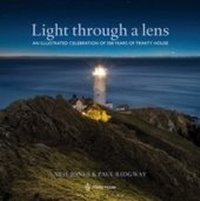
Light Through a Lens
An Illustrated Celebration of 500 Years of Trinity House
1st Edition
Published on 11. September 2014
160 pages
978-1-4729-1374-6 (ISBN)
Description

In 1514, Henry VIII granted the Corporation of Trinity House a royal charter that made them responsible for the provision and maintenance of navigational aids in British territorial waters. 500 years later they are still responsible for the running of Britain's lighthouses. Though automated now, these lighthouses are maintained in all their unique and idiosyncratic splendour, proving popular architectural landmarks with locals and visitors alike.
To celebrate Trinity House's quincentenary, this lavish photographic book features the best photography from the Corporation's own archive. Dramatic and evocative colour photos sit alongside text telling alternately fascinating and entertaining stories about these iconic structures dotted around the most vulnerable stretches of Britain's coastlines.
Told from the Corporation's point of view, this will be a photographic account of iconic buildings to be treasured by anyone who finds the haunting beam of a lighthouse at sea an immensely comforting sight, as well as walkers and families for whom a lighthouse on the landscape is a completely irresistible draw.
To celebrate Trinity House's quincentenary, this lavish photographic book features the best photography from the Corporation's own archive. Dramatic and evocative colour photos sit alongside text telling alternately fascinating and entertaining stories about these iconic structures dotted around the most vulnerable stretches of Britain's coastlines.
Told from the Corporation's point of view, this will be a photographic account of iconic buildings to be treasured by anyone who finds the haunting beam of a lighthouse at sea an immensely comforting sight, as well as walkers and families for whom a lighthouse on the landscape is a completely irresistible draw.
More details
Edition
1. Auflage
Language
English
Place of publication
London
United Kingdom
Publishing group
Bloomsbury Publishing PLC
Target group
Professional and scholarly
ISBN-13
978-1-4729-1374-6 (9781472913746)
Copyright in bibliographic data and cover images is held by Nielsen Book Services Limited or by the publishers or by their respective licensors: all rights reserved.
Schweitzer Classification
Other editions
Additional editions

Neil Jones | Paul Ridgway
Light Through a Lens
An illustrated celebration of 500 years of Trinity House
Book
09/2014
Thomas Reed Publications
€44.76
Article exhausted; check different version
Persons
Neil Jones has been the Records Manager for Trinity House since 2005, joining the Corporation from a background in museums. Responsible for marshalling the Corporation's history, archives and artefacts, he uses these often unique resources to create exhibitions and publications that highlight this fascinating history and helps others further their interests in lighthouses, navigation, genealogy and British maritime history.
Paul Ridgway's association with Trinity House goes back four decades, beginning as a PR assistant, then in Lighthouse Service operations at Headquarters on Tower Hill, as a consultant on PR and information matters. During this time he contributed to, or edited, Trinity House publications including its celebrated journal Flash. He has also assisted countless authors with their research into aids to navigation and related topics. For nearly a quarter of a century he edited the Bulletin of the International Association of Marine Aids to Navigation and Lighthouse Services (IALA).
Paul Ridgway's association with Trinity House goes back four decades, beginning as a PR assistant, then in Lighthouse Service operations at Headquarters on Tower Hill, as a consultant on PR and information matters. During this time he contributed to, or edited, Trinity House publications including its celebrated journal Flash. He has also assisted countless authors with their research into aids to navigation and related topics. For nearly a quarter of a century he edited the Bulletin of the International Association of Marine Aids to Navigation and Lighthouse Services (IALA).
Content
- Cover
- Half-title
- Title
- Copyright
- FOREWORD
- INTRODUCTION
- Sir Francis Bacon on Trinity House in 1617
- Seamarks Act of Elizabeth, 1566
- Board Minute, 16 May, 1741
- The Lighthouse Work of Sir James Chance, 1902
- Edward Ward
- Sir John Poland Bowen, Engineer-in-Chief 1924-51
- Court Minute, 26 April, 1738
- AFTERWORD
- IMAGE CREDITS
- FURTHER READING
