

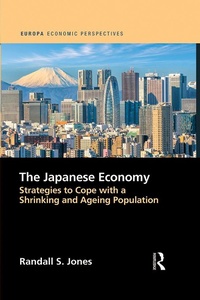
The Japanese Economy
Strategies to Cope with a Shrinking and Ageing Population
1st Edition
Published on 23. May 2022
466 pages
978-1-000-56606-2 (ISBN)
Description

Japan has many unique strengths, but it also faces numerous challenges, many of which are related to population ageing. Rapid demographic change is projected to reduce Japan's population by one-quarter by 2060 while increasing the share of elderly people from 29% of the total population to 38%, which would be the highest share among advanced countries. This book analyses the Japanese economy and the challenges it faces, and suggests policies to promote wellbeing, high living standards, fiscal sustainability, social inclusion and environmental sustainability. The book's 24 chapters focus on key aspects of Japan's economy, including the labour market, innovation, education, women in the workforce, corporate governance, small and medium-sized enterprises, the service sector, agriculture, fiscal and monetary policy, income distribution and policies to address climate change.
The volume aims to increase understanding of Japan, the world's third-largest economy and a key player in the global economy. It will assist policymakers and serve as a resource for academics and students of economics and public policy. As Japan is a front-runner in population ageing, the book's analysis and policy recommendations are highly relevant to other countries that are, or soon will be, facing similar challenges.
The volume aims to increase understanding of Japan, the world's third-largest economy and a key player in the global economy. It will assist policymakers and serve as a resource for academics and students of economics and public policy. As Japan is a front-runner in population ageing, the book's analysis and policy recommendations are highly relevant to other countries that are, or soon will be, facing similar challenges.
Reviews / Votes
"This is an excellent, comprehensive, balanced, readable, up-to-date policy-oriented analysis of the Japanese economy and its fundamental challenges by an outstanding expert. Given Japan's declining and aging population and labour force, Randall Jones provides sensible, clear-cut, specific policy recommendations to improve productivity and well-being through needed reforms."Hugh Patrick, R. D. Calkins Professor of International Business Emeritus, Columbia Business School
"Randall Jones offers the best economic survey on Japan, full of deep policy insights. Reviewing developments from the bubble burst in 1990 to the current COVID-19 crisis, his book provides key challenges and solutions for Japan as a frontier country with a policy agenda for an ageing society with a shrinking population."
Kazumasa Iwata, President of the Japan Center for Economic Research, Professor Emeritus Tokyo University
"A tour de force! Comprehensive comparisons of Japan with many nations, across many issues, with reliable data. This is the new book of record for Japan's achievements and missteps in labour, tax, technology, industrial policy, demographics, education, and other policy fields. A cornerstone work for scholars, policymakers, and investors."
Robert Alan Feldman, Professor, Tokyo University of Science
More details
Series
Edition
1. Auflage
Language
English
Place of publication
London
United Kingdom
Publishing group
Taylor & Francis Ltd
Target group
Professional and scholarly
Illustrations
30 Tables, black and white; 233 Line drawings, black and white; 233 Illustrations, black and white
ISBN-13
978-1-000-56606-2 (9781000566062)
Copyright in bibliographic data and cover images is held by Nielsen Book Services Limited or by the publishers or by their respective licensors: all rights reserved.
Schweitzer Classification
Other editions
Additional editions
Book
10/2024
1st Edition
Routledge
€68.70
Shipment within 10-20 days
Book
05/2022
1st Edition
Routledge
€197.80
Shipment within 15-20 days
Person
Randall S. Jones is a professional fellow at Columbia University's Center on Japanese Economy and Business and a non-resident fellow at the Korea Economic Institute. Previously, he served as the Senior Counsellor for East Asia and as Head of the Japan/Korea Desk at the Organization for Economic Cooperation and Development (OECD) in Paris from 2002 until 2019.
Content
The Author
Preface and Acknowledgements
Acronyms and Abbreviations
From the collapse of the bubble economy to the COVID-19 pandemic: an overview of the Japanese economy from 1990 to 2020
Key challenges facing Japan
Part I Labor market reform to sustain economic growth and promote social inclusion
Expanding the use of foreign workers and raising the fertility rate to cope with demographic challenges
Extending the careers of older persons
Promoting employment and leadership opportunities for women
Part II Raising productivity to sustain living standards in the face of a shrinking and aging population
Improving the innovation framework to boost productivity
Advancing the digitalization of Japan to raise productivity and well-being
Reforming the education system and increasing human capital
Strengthening the integration of Japan in the world economy to benefit more fully from globalization
Accelerating regulatory reform to strengthen competition and boost productivity
Upgrading corporate governance to revitalize the Japanese economy
Improving the insolvency regime to improve resource allocation
Making small and medium-sized enterprises a driver of growth and innovation
Part III Improving performance in key sectors
Enhancing productivity in the service sector
Upgrading productivity in the agricultural sector
Financial sector reforms to promote growth and financial stability
Part IV Macroeconomic policies to promote economic growth and fiscal sustainability
Improving the fiscal framework to ensure long-run fiscal sustainability
Providing universal high-quality healthcare while controlling spending
Consolidation of local government finances in tandem with the central government
Reforming Japan's tax system
Monetary policy: unconventional measures to achieve the inflation target
Part V Enhancing well-being
Reducing income inequality and poverty to promote social inclusion
Reforming the energy sector to achieve green growth and stop climate change
Part VI Summary
Summary: addressing Japan's economic and demographic challenges
Preface and Acknowledgements
Acronyms and Abbreviations
From the collapse of the bubble economy to the COVID-19 pandemic: an overview of the Japanese economy from 1990 to 2020
Key challenges facing Japan
Part I Labor market reform to sustain economic growth and promote social inclusion
Expanding the use of foreign workers and raising the fertility rate to cope with demographic challenges
Extending the careers of older persons
Promoting employment and leadership opportunities for women
Part II Raising productivity to sustain living standards in the face of a shrinking and aging population
Improving the innovation framework to boost productivity
Advancing the digitalization of Japan to raise productivity and well-being
Reforming the education system and increasing human capital
Strengthening the integration of Japan in the world economy to benefit more fully from globalization
Accelerating regulatory reform to strengthen competition and boost productivity
Upgrading corporate governance to revitalize the Japanese economy
Improving the insolvency regime to improve resource allocation
Making small and medium-sized enterprises a driver of growth and innovation
Part III Improving performance in key sectors
Enhancing productivity in the service sector
Upgrading productivity in the agricultural sector
Financial sector reforms to promote growth and financial stability
Part IV Macroeconomic policies to promote economic growth and fiscal sustainability
Improving the fiscal framework to ensure long-run fiscal sustainability
Providing universal high-quality healthcare while controlling spending
Consolidation of local government finances in tandem with the central government
Reforming Japan's tax system
Monetary policy: unconventional measures to achieve the inflation target
Part V Enhancing well-being
Reducing income inequality and poverty to promote social inclusion
Reforming the energy sector to achieve green growth and stop climate change
Part VI Summary
Summary: addressing Japan's economic and demographic challenges
