

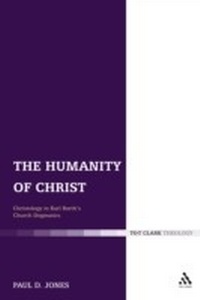
The Humanity of Christ
Christology in Karl Barth's Church Dogmatics
1st Edition
Published on 1. September 2008
304 pages
978-0-567-36075-5 (ISBN)
Description

Drawing on the best English and German language scholarship to date, this book offers a novel interpretation of Barth's mature Christology. Examining the entirety of the Dogmatics, it provides a nuanced analysis of Barth's treatment of the Chalcedonian Definition, the enhypostasis/anhypostasis pairing, and various Protestant scholastic Christological distinctions; an examination of the co-inherence of Barth's doctrines of God and Christ, which contributes to current debates about Barth's doctrine of election; and a lengthy account of the Christology of Church Dogmatics IV that foregrounds Barth's understanding of Christ's human involvement in the drama of reconciliation.
Throughout the text, the author shows convincingly that Barth's emphasis on Christ's divinity goes hand-in-hand with a dogmatically rich and often startling account of Christ's humanity. The text does not confine itself to the Church Dogmatics. It also situates Barth in the context of the wider Christian tradition and modern western philosophy of religion. Thus Barth is set in conversation with a wide range of thinkers, including Anselm of Canterbury, Martin Luther, John Calvin, Friedrich Schleiermacher, G. W. F. Hegel, Gottfried Thomasius, and Harry Frankfurt. In addition, the text makes a number of constructive gestures, showing a particular interest in feminist and liberationist trajectories of thought. The final chapter considers the standing of Barth's Christology today and its pertinence for theological ethics and political theology.
Throughout the text, the author shows convincingly that Barth's emphasis on Christ's divinity goes hand-in-hand with a dogmatically rich and often startling account of Christ's humanity. The text does not confine itself to the Church Dogmatics. It also situates Barth in the context of the wider Christian tradition and modern western philosophy of religion. Thus Barth is set in conversation with a wide range of thinkers, including Anselm of Canterbury, Martin Luther, John Calvin, Friedrich Schleiermacher, G. W. F. Hegel, Gottfried Thomasius, and Harry Frankfurt. In addition, the text makes a number of constructive gestures, showing a particular interest in feminist and liberationist trajectories of thought. The final chapter considers the standing of Barth's Christology today and its pertinence for theological ethics and political theology.
More details
Edition
1. Auflage
Language
English
Place of publication
London
United Kingdom
Publishing group
Bloomsbury Publishing PLC
Target group
Professional and scholarly
ISBN-13
978-0-567-36075-5 (9780567360755)
Copyright in bibliographic data and cover images is held by Nielsen Book Services Limited or by the publishers or by their respective licensors: all rights reserved.
Schweitzer Classification
Other editions
Additional editions
Book
07/2011
T.& T.Clark Ltd
€56.60
Shipment within 3-4 weeks
Book
09/2008
T.& T.Clark Ltd
€203.10
Shipment within 3-4 weeks
Person
Paul Dafydd Jones is Associate Professor in the Department of Religious Studies at the University of Virginia, USA.
Content
Contents
Introduction
Chapter One: Approaching Barth's Christology
I: The anhypostasis/enhypostasis pairing
II: Barth and the Definition of Chalcedon
III: Early moves
IV: Christology and the "historical Jesus"
Chapter Two: Election and Christology
I: Divine self-determination
(a) The relationship between Church Dogmatics I and II
(b) "God is," means, "God loves"
(c) Jesus Christ, "electing God" and "elected human"
II: Jesus' covenantal humanity
(a) Encounter
(b) Decision
(c) History
III: Summary remarks
Chapter Three: Jesus Christ, Embodiment of Grace
I: Christology after Church Dogmatics II.2
II: Christology in critical conversation with Protestant Orthodoxy
(a) Election reprised
(b) The unio hypostatica; anhypostasis/enhypostasis revisited; the communio naturarum
(c) Permutations of the communicatio idiomatum
(d) Summary remarks; the genus tapeinoticum
III: Jesus Christ, the "königliche Mensch"
(a) "Correspondence": the form of Jesus' life
(b) "Correspondence" as wholeheartedness, sovereignty, love, and deliverance
(c) Agency and freedom; Jesus and revolution
IV: Exaltation and Exinanition
Chapter Four: Obedience unto Death: Achieving the Salvation of the World
I: History
II: The obedience of Christ: Christology in light of the passion
(a) The obedience of the Son of God
(b) The obedience of Jesus of Nazareth
III: Gethsemane
(a) Jesus' history: a movement towards crisis
(b) The achievement of justificatory responsibility
(c) The consequences of Jesus' struggle
(d) Justification enacted
IV: Beyond tragedy
Chapter Five: Looking back, looking forward
I: Summary remarks
(a) Reviewing the argument
(b) Unanswered questions
(c) Potential problems
II: Barth's Christology today
Appendix One: The Organization of Church Dogmatics IV
Appendix Two: Barth and the genus maiestaticum
Bibliography
Introduction
Chapter One: Approaching Barth's Christology
I: The anhypostasis/enhypostasis pairing
II: Barth and the Definition of Chalcedon
III: Early moves
IV: Christology and the "historical Jesus"
Chapter Two: Election and Christology
I: Divine self-determination
(a) The relationship between Church Dogmatics I and II
(b) "God is," means, "God loves"
(c) Jesus Christ, "electing God" and "elected human"
II: Jesus' covenantal humanity
(a) Encounter
(b) Decision
(c) History
III: Summary remarks
Chapter Three: Jesus Christ, Embodiment of Grace
I: Christology after Church Dogmatics II.2
II: Christology in critical conversation with Protestant Orthodoxy
(a) Election reprised
(b) The unio hypostatica; anhypostasis/enhypostasis revisited; the communio naturarum
(c) Permutations of the communicatio idiomatum
(d) Summary remarks; the genus tapeinoticum
III: Jesus Christ, the "königliche Mensch"
(a) "Correspondence": the form of Jesus' life
(b) "Correspondence" as wholeheartedness, sovereignty, love, and deliverance
(c) Agency and freedom; Jesus and revolution
IV: Exaltation and Exinanition
Chapter Four: Obedience unto Death: Achieving the Salvation of the World
I: History
II: The obedience of Christ: Christology in light of the passion
(a) The obedience of the Son of God
(b) The obedience of Jesus of Nazareth
III: Gethsemane
(a) Jesus' history: a movement towards crisis
(b) The achievement of justificatory responsibility
(c) The consequences of Jesus' struggle
(d) Justification enacted
IV: Beyond tragedy
Chapter Five: Looking back, looking forward
I: Summary remarks
(a) Reviewing the argument
(b) Unanswered questions
(c) Potential problems
II: Barth's Christology today
Appendix One: The Organization of Church Dogmatics IV
Appendix Two: Barth and the genus maiestaticum
Bibliography
