

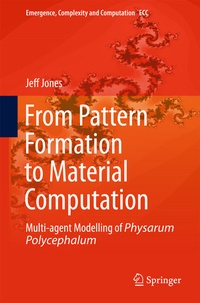
From Pattern Formation to Material Computation
Description

This book addresses topics of mobile multi-agent systems, pattern formation, biological modelling, artificial life, unconventional computation, and robotics. The behaviour of a simple organism which is capable of remarkable biological and computational feats that seem to transcend its simple component parts is examined and modelled. In this book the following question is asked: How can something as simple as Physarum polycephalum - a giant amoeboid single-celled organism which does not possess any neural tissue, fixed skeleton or organised musculature - can approximate complex computational behaviour during its foraging, growth and adaptation of its amorphous body plan, and with such limited resources? To answer this question the same apparent limitations as faced by the organism are applied: using only simple components with local interactions. A synthesis approach is adopted and a mobile multi-agent system with very simple individual behaviours is employed. It is shown their interactions yield emergent behaviour showing complex self-organised pattern formation with material-like evolution. The presented model reproduces the biological behaviour of Physarum; the formation, growth and minimisation of transport networks.
In its conclusion the book moves beyond Physarum and provides results of scoping experiments approximating other complex systems using the multi-agent approach. The results of this book demonstrate the power and range of harnessing emergent phenomena arising in simple multi-agent systems for biological modelling, computation and soft-robotics applications. It methodically describes the necessary components and their interactions, showing how deceptively simple components can create powerful mechanisms, aided by abundant illustrations, supplementary recordings and interactive models. It will be of interest to those in biological sciences, physics, computer science and robotics who wish to understand how simple components can result in complex and useful behaviours and who wish explore the potential of guided pattern formation themselves.
Reviews / Votes
"The book presents a full account of research and will be extremely useful for young and early career researchers exploring the topic of both multiagent modeling and the slime mold. . I found the book a useful tool for teaching students how agent-based modeling works, its complexities, and how it can be used to extend our knowledge of complex models to build better and reliable structures inspired by nature." (Mariam Kiran, Computing Reviews, November, 2015)
More details
Other editions
Additional editions
Content
Part I Slime Mould Physarum polycephalum. Part II Modelling Physarum polycephalum..- Part III Material Computation in a Multi-agent Model of Physarum polycephalum: Mechanisms and Applications.- Part IV From Emergent Oscillations to Collective Transport and Amoeboid Movement.- Part V Conclusions and Beyond Physarum models.
