

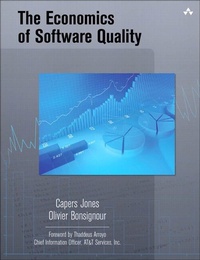
The Economics of Software Quality
Description

"Whether consulting, working on projects, or teaching, whenever I need credible, detailed, relevant metrics and insights into the current capabilities and performance of the software engineering profession, I always turn first to Capers Jones' work. In this important new book, he and Olivier Bonsignour make the hard-headed, bottom-line, economic case, with facts and data, about why software quality is so important. I know I'll turn to this excellent reference again and again."
-Rex Black, President, RBCS
Poor quality continues to bedevil large-scale development projects, but few software leaders and practitioners know how to measure quality, select quality best practices, or cost-justify their usage. In The Economics of Software Quality, leading software quality experts Capers Jones and Olivier Bonsignour show how to systematically measure the economic impact of quality and how to use this information to deliver far more business value.
Using empirical data from hundreds of software organizations, Jones and Bonsignour show how integrated inspection, structural quality measurement, static analysis, and testing can achieve defect removal rates exceeding 95 percent. They offer innovative guidance for predicting and measuring defects and quality; choosing defect prevention, pre-test defect removal, and testing methods; and optimizing post-release defect reporting and repair.
This book will help you
- Move beyond functional quality to quantify non-functional and structural quality
- Prove that improved software quality translates into strongly positive ROI and greatly reduced TCO
- Drive better results from current investments in Quality Assurance and Testing
- Use quality improvement techniques to stay on schedule and on budget
- Avoid "hazardous" metrics that lead to poor decisions
More details
Other editions
Additional editions
Person
Capers Jones, President/CEO of Capers Jones & Associates LLC, founded Software Productivity Research LLC (SPR), where he remains Chief Scientist Emeritus. One of the software engineering field's most influential thought leaders, his books include Patterns of Software Systems Failure and Success; Applied Software Measurement, Third Edition; and Software Assessments, Benchmarks, and Best Practices. Jones is a Distinguished Advisor to the Consortium for IT Software Quality (CISQ).
Olivier Bonsignour, Vice President of Product Development at CAST, is responsible for R&D and product management. Prior to CAST he was CIO at the Advanced Research Division of the French Defense Ministry. An early pioneer in distributed systems and object oriented development, Bonsignour holds advanced engineering and management degrees from top institutions in France.
Content
Foreword xix
Preface xxi
Acknowledgments xxvii
About the Authors xxxi
Chapter 1: Defining Software Quality and Economic Value 1
Introduction 1
Defining Software Quality 8
Defining Economic Value and Defining the Value of Software Quality 17
Summary and Conclusions 33
Chapter 2: Estimating and Measuring Software Quality 35
Introduction 35
Using Function Point Metrics for Defect Potentials 39
Software Defect Potentials 39
Estimating Software Defect Prevention 71
Estimating Software Defect Detection and Defect Removal 74
Measuring Application Structural Quality 77
Examples of Structural Quality Assessments 88
Three Problems That Distort Software Economic Analysis 95
Summary and Conclusions on Software Quality Estimation and Measurement 117
Chapter 3: Software Defect Prevention 119
Introduction 119
Analysis of Defect Prevention Results 135
Summary and Conclusions of Software Defect Prevention 188
Chapter 4: Pretest Defect Removal 191
Introduction 191
Small Project Pretest Defect Removal 196
Large System Pretest Defect Removal 201
Analysis of Pretest Defect Removal Activities 208
Summary and Conclusions about Pretest Defect Removal 277
Chapter 5: Software Testing 279
Introduction 279
Summary and Conclusions on Software Testing 344
Chapter 6: Post-Release Defect Removal 347
Introduction 347
User and Industry Costs from Post-Release Defects 409
Summary and Conclusions on Post-Release Defects 431
Chapter 7: Analyzing the Economics of Software Quality 433
Introduction 433
The Economic Value of Software 435
Economic Impact of Low-Quality and High-Quality Software 460
Summary and Conclusions on the Economics of Software Quality 541
References and Readings 545
Index 561
