

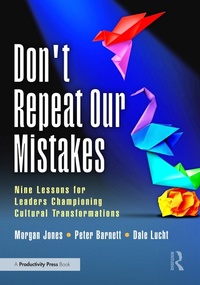
Don't Repeat Our Mistakes
Nine Lessons for Leaders Championing Cultural Transformations
1st Edition
Published on 30. June 2025
196 pages
978-1-040-36636-3 (ISBN)
Description

This book focuses on a practical application of how to coach senior leaders and executives to be personal lean leadership champions and how leaders coach their teams to do the same. The first part of the book focuses on the outcomes and nine key lessons learned from interviewing leaders and CEOs from the United States, Europe, South America, Asia, and Australasia on leading their organizations to be sustainable lean enterprises. The authors explore what these lessons are about, the underlying belief of each lesson, and how to coach these lessons.
The second part of the book focuses on the leaders transitioning from an external locus of influence by using an external executive lean coach to coach of self and understanding why parts of self are resisting the lessons. This is flipping the switch from external coach to coach self so that they can coach their team.
The third part of the book focuses on using these lessons and coaching of self to be better coaches of our teams, and finally taking these lessons and coaching leanings and converting them into habits of lean leaders.
Essentially, this book leads the reader through the process of practically coaching an executive leader to become a lean leadership champion. The reader works through interview examples depending on the answers given and decides the next question to ask. In addition, this book aids the executive to coach their teams to become lean leaders.
The second part of the book focuses on the leaders transitioning from an external locus of influence by using an external executive lean coach to coach of self and understanding why parts of self are resisting the lessons. This is flipping the switch from external coach to coach self so that they can coach their team.
The third part of the book focuses on using these lessons and coaching of self to be better coaches of our teams, and finally taking these lessons and coaching leanings and converting them into habits of lean leaders.
Essentially, this book leads the reader through the process of practically coaching an executive leader to become a lean leadership champion. The reader works through interview examples depending on the answers given and decides the next question to ask. In addition, this book aids the executive to coach their teams to become lean leaders.
Reviews / Votes
The nine key lessons in this book are not just about leading Lean enterprises; they provide a practical roadmap for building and then sustaining a high-performance team. Any leader looking to outperform their competition should study these nine lessons.-- Dave Burdakin, Retired President of The HON Company, Paladin Brands and JBT/Oshkosh AeroTech
Demonstrating the guiding principle of "lead with humility," the authors share their personal mistakes, provide practical lessons learned, and weave their insights within the framework of the Shingo Institute's Model for Operational Excellence to create a valuable resource for anyone on their journey of continuous improvement.
-- Tim Pettry, Senior Advisor, Continuous Improvement, Cleveland Clinic
For the past 29 years, I've been involved in Lean transformations. The team that has pulled this effort together rightly recognizes the importance of leadership in a cultural change. Cultural change is top-down driven (as opposed to bottom-up driven - sometimes referred to as a revolution - usually not effective in most organizations). The nine lessons they highlight fill a gap in the current Lean literature, namely, how do I, as a leader, ensure the success of our Lean initiatives? I will be sharing this with my clients.
-- David Hicks, Vice President, Consulting, TBM Consulting Group, Inc
More details
Edition
1. Auflage
Language
English
Place of publication
London
United Kingdom
Publishing group
Taylor & Francis Ltd
Target group
Professional and scholarly
Illustrations
2 Tables, black and white; 29 Line drawings, black and white; 29 Illustrations, black and white
File size
7,46 MB
ISBN-13
978-1-040-36636-3 (9781040366363)
Copyright in bibliographic data and cover images is held by Nielsen Book Services Limited or by the publishers or by their respective licensors: all rights reserved.
Schweitzer Classification
Other editions
Additional editions
Morgan Jones | Peter Barnett | Dale Lucht
Don't Repeat Our Mistakes
Nine Lessons for Leaders Championing Cultural Transformations
Book
06/2025
1st Edition
Productivity Press
€65.40
Shipment within 10-20 days
Morgan Jones | Peter Barnett | Dale Lucht
Don't Repeat Our Mistakes
Nine Lessons for Leaders Championing Cultural Transformations
Book
06/2025
1st Edition
Productivity Press
€204.90
Shipment within 10-20 days
Persons
Morgan Jones has over 30 years' experience in Lean and Six Sigma; he is a pragmatic and experienced improvement leader, delivering over $2.1Bn in hard savings to organizations, and improving customer and staff experiences and health and safety. His legacy capabilities of business improvement have resulted in over 23 international awards and he has chaired 27 international conferences on business improvement. Morgan is an international award-winning author and has written eight books, two of which have won the Shingo Prize publications award. He has led a business unit with an overall P&L accountability of $367M and has also led an organization to be the first bank to win a Shingo award. He is also a chartered engineer, certified Master Black Belt, lean master, and an executive coach. Morgan has leadership experience in marine, manufacturing, government, military, mining, utilities, telecommunications, oil and gas, banking, and supply chain.
Peter Barnett is an accomplished professional with more than 30 years of experience in guiding teams in all aspects of business operations and change management. His experience includes a history of crafting and executing strategies that reduce costs, improve services, drive revenue growth, and increase profitability as well as leveraging his vast knowledge of Lean and Six Sigma methodologies. His educational background includes a BS in Engineering with Master of Business Administration and Six Sigma Master Black Belt Certification.
Peter led the nationwide lean transformation initiative at Ensign- Bickford Industries across four Strategic Business Units. He held several roles there, including President & General Manager of the Ensign- Bickford Company where he held a full P&L responsibility for their nationwide commercial explosive business spanning Utah, Illinois, Texas, and Spain. The highlight of his time there was receiving the Shingo Prize. Rounding off his experience is ten years as an executive coach to Fortune 500 financial services companies in both insurance and banking.
Peter currently is the Director of Executive Education at the Shingo Institute and a lead examiner. He has led and participated in assessments of organizations, ranging from healthcare to automotive to military to food processing in the United States, China, Australia, Israel, Mexico, Canada, Brazil, and the United Kingdom, that were applying for the Shingo Prize for Organizational Excellence award.
Dale Lucht is a senior executive with a track record of achieving business objectives through the application of lean practices at the tool, strategic, and cultural levels of an organization. Much of his career has been focused on using his industrial engineering background and lean transformation experience to drive process improvement.
After early engineering roles involving improving flow and productivity in manufacturing, he progressed into leadership roles, including plant general manager and vice president roles in distribution, supply chain, quality, and customer service. Supply chain improvement efforts included suppliers, product distributors, and customers, resulting in end- to- end supply chain improvements. His career then shifted to leading the business transformation efforts and coaching senior leaders in three diverse businesses: manufacturing, healthcare, and financial services.
He is a senior examiner and team leader for the Shingo Prize. He's also served on advisory boards for numerous professional groups, including the Shingo Prize, Healthcare Value Network, and the Iowa Quality Center. His background has led him to be a frequent speaker at conferences and seminars.
Dale has a BS in Industrial Engineering from Iowa State University and an MBA from Drake University.
Peter Barnett is an accomplished professional with more than 30 years of experience in guiding teams in all aspects of business operations and change management. His experience includes a history of crafting and executing strategies that reduce costs, improve services, drive revenue growth, and increase profitability as well as leveraging his vast knowledge of Lean and Six Sigma methodologies. His educational background includes a BS in Engineering with Master of Business Administration and Six Sigma Master Black Belt Certification.
Peter led the nationwide lean transformation initiative at Ensign- Bickford Industries across four Strategic Business Units. He held several roles there, including President & General Manager of the Ensign- Bickford Company where he held a full P&L responsibility for their nationwide commercial explosive business spanning Utah, Illinois, Texas, and Spain. The highlight of his time there was receiving the Shingo Prize. Rounding off his experience is ten years as an executive coach to Fortune 500 financial services companies in both insurance and banking.
Peter currently is the Director of Executive Education at the Shingo Institute and a lead examiner. He has led and participated in assessments of organizations, ranging from healthcare to automotive to military to food processing in the United States, China, Australia, Israel, Mexico, Canada, Brazil, and the United Kingdom, that were applying for the Shingo Prize for Organizational Excellence award.
Dale Lucht is a senior executive with a track record of achieving business objectives through the application of lean practices at the tool, strategic, and cultural levels of an organization. Much of his career has been focused on using his industrial engineering background and lean transformation experience to drive process improvement.
After early engineering roles involving improving flow and productivity in manufacturing, he progressed into leadership roles, including plant general manager and vice president roles in distribution, supply chain, quality, and customer service. Supply chain improvement efforts included suppliers, product distributors, and customers, resulting in end- to- end supply chain improvements. His career then shifted to leading the business transformation efforts and coaching senior leaders in three diverse businesses: manufacturing, healthcare, and financial services.
He is a senior examiner and team leader for the Shingo Prize. He's also served on advisory boards for numerous professional groups, including the Shingo Prize, Healthcare Value Network, and the Iowa Quality Center. His background has led him to be a frequent speaker at conferences and seminars.
Dale has a BS in Industrial Engineering from Iowa State University and an MBA from Drake University.
Content
Part 1 - The Nine Mistakes and LessonsPart 2 - Overcoming Resistance through Self and Supported CoachingPart 3 - Coaching the Leader to Coach Their TeamAppendix
Bibliography
Index
Bibliography
Index
