

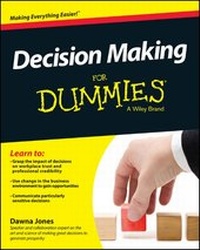
Decision Making For Dummies
Published on 11. September 2014
384 pages
978-1-118-84749-7 (ISBN)
Description

Discover the best approaches for making business decisions
Today's business leaders have to face the facts--you can'tseparate leadership from decision making. The importance of makingdecisions, no matter how big or small, cannot be overstated.Decision Making For Dummies is a candid resource that helpsleaders understand the impact of their choices, not only onbusiness, but also on their credibility and reputation. Designedfor managers, business owners, and anyone else who makes toughdecisions on a daily basis, this guide helps you figure out if thedecisions you're making are the right ones.
In addition to helping you explore how to evaluate your choices,Decision Making For Dummies covers ways to receive supportfor decision making, delves into various decision-making styles,reviews the importance of sifting through data and information, andincludes information on ways to engage others and make decisionscollectively. Being in charge can be challenging, but with thisguide, you don't have to go it alone.
* Discusses the effects of decision making and outlines theconsiderations that must be made to gain trust and confidence
* Demonstrates ways to communicate particularly sensitivedecisions, and offers approaches for making bold decisions thatchallenge the status quo
* Delves into the risks and benefits of certain decisions, andshows readers the best ways to evaluate choices
* Outlines smart strategies for engaging others and drawing theminto the decision-making process
Crucial decisions need to be made every day in the businessworld, so there's no time to waste. Make Decision Making ForDummies your primary resource for learning to choose youractions wisely and confidently.
More details
Other editions
Additional editions
Person
Dawna Jones generates imaginative insights and applies 25 years experience in helping businesses and organizations make bold decisions. She co-designs the future of organizations, transforming them from "business-as-usual" to inclusive cultures of prosperity.
Content
- Intro
- Title Page
- Copyright Page
- Table of Contents
- About This Book
- Foolish Assumptions
- Icons Used in This Book
- Beyond the Book
- Where to Go from Here
- Part I: Getting Started with Decision-Making
- Chapter 1: Big-Picture Pressures on Decision-Makers
- Making Decisions in an Ever-Changing World
- The ground shifting beneath your feet
- Assessing what these changes mean to you
- Embracing Uncertainty and Unpredictability
- Increase integrity and truth-telling
- Notice what is happening on the innovative edges
- Don't limit planning to an annual task
- Make your decision-making process values-based
- Cultivate learning and curiosity
- Invest in your personal and professional growth
- Raising the Integrity and Ethics of Business Decisions
- Overcoming factors that lead to unethical decisions
- Designing a healthy decision-making environment
- Chapter 3: Company Culture and Decision-Making
- Recognizing the Importance of Company Culture
- Paying attention to invisible forces
- Assessing your company's mindset
- Spotting addictions in company culture
- Creating High Performance Workplaces for Decision-Making
- Paying attention to long- and short-term focus
- Using smart design to speed up decision-making
- Paying attention to working relationships
- Assessing Risk and Its Impact on Decision-Making
- Understanding how humans perceive risk
- Working with risk in a complex world
- Chapter 2: The Key Ingredients for Effective Decisions
- Distinguishing the Different Kinds of Decisions
- Strategic decisions
- Tactical decisions
- Operational and frontline decisions
- Identifying the Different Decision-Making Styles
- Recognizing the Workplace Environment and Culture as a Force
- Mapping your company on the innovation curve
- Accounting for company organizational structures
- Assessing the health of the workplace
- Developing the Decision-Maker: To Grow or Not?
- Knowing thyself
- Avoiding temptations that obstruct sound decisions
- Part II: Knowing and Growing Yourselfas a Decision-Maker
- Chapter 4: Growing Your Business by Growing Yourself
- Connecting Personal Growth to Effective Decision-Making
- Exploring vulnerability as a leadership quality
- Having compassion for the ego
- Tapping into emotions for effective decision-making
- Recognizing How Beliefs Influence Decision-Making
- Examining your beliefs: Do they limit your options?
- Understanding how you perceive insight, intuition, and vision
- Acknowledging hidden bias or prejudice
- Gauging Personal Comfort with Conflict and Ambiguity
- Using conflict to your advantage
- Understanding classic responses to conflict
- Chapter 5: Raising Self- and Organizational Awareness for Better Decisions
- Understanding How You Make Decisions
- Instinctual decision-making
- Subconscious decision-making
- Belief-based decision-making
- Values-based decision-making
- Values-driven decision-making
- Comprehending the Value of a Deeper Intelligence
- Putting this knowledge to work
- Reducing Stress to Make Better Decisions
- Manager, manage thyself
- Managing the manager
- Practical ways to reduce stress in working relationships
- Chapter 6: Learning from Mistakes and Unintended Consequences
- Engaging in Reflective Learning
- Identifying blind spots in the decision-making process
- Learning from decision errors and disasters
- Turning Hindsight into Foresight
- Monitoring implementation and assessing risk
- Foreseeing inadvertent effects of a decision
- Listening to feedback from key suppliers and customers
- Implementing other's ideas wisely
- Stopping to see the big picture
- Overcoming persistent problems with procurement
- Accepting personal responsibility
- Separating good judgment from judging others
- Communicating authentically
- Reinventing your self-identity
- Part III: Jumping In: The How-to of Decision-Making
- Chapter 7: Understanding Intuitive Decision-Making
- Getting the Lowdown on Intuition
- Defining intuition
- Unraveling myth from fact
- Knowing how intuition differs from impulse and fear
- Understanding How Intuition Works
- Processing incoming data
- Forming patterns from cues
- Building Up Your Intuitive Powers
- Identifying your intuitive strengths - the mechanics
- Improving your intuitive intelligence
- Uncovering procedures that interfere with intuition
- Removing the risk of overwhelm
- Balancing the Rational with the Intuitive
- Chapter 8: Laying the Groundwork for All Decisions
- Reviewing the Essentials for Sound Decisions
- Identifying purpose
- Seeing ahead: Clarifying the endpoint
- Determining timing: Why now?
- Assessing commitment: Your own and your colleagues
- Calculating the risk and impact of doing nothing
- Deciding Who Decides
- Factoring in management style and working environment
- The buck stops where? Authority and responsibility
- Investigating Decision-Making Models
- Using consensus
- Building a Team for Participatory Decision-Making
- Chapter 9: The Nitty-Gritty: Walking through the Decision-Making Process
- Clarifying the Purpose of the Decision
- Identifying the reason for the decision
- Taking a tactical or strategic approach
- Taking the Blinders Off: Eliciting All Relevant Info
- Doing your research
- Gaining some distance to stay objective
- Paying attention to different perspectives
- Separating fact from speculation
- Including feelings as information
- Knowing when you have enough
- Sifting and Sorting Data: Analysis
- Conducting your analysis
- Critically evaluating your data
- Making assumptions intentionally . . . or not
- Establishing and weighing criteria
- Avoiding analysis paralysis
- Generating Options
- Avoiding the one-option only trap
- Vetting your top options
- Assessing Immediate and Future Risk
- Identifying risks
- Considering people's response to risk
- Mapping the Consequences: Knowing Who Is Affected and How
- Making the Decision
- Communicating the Decision Effectively
- Implementing the Decision
- Putting together your action plan
- Deciding what is important: Metrics
- Setting priorities
- Learning from the implementation process
- Decision-Making on Auto-Pilot: Intuition in Action
- Grasping intuitive decision-making
- Taking a closer look at intuition in different situations
- Chapter 10: Tackling Various Types of Business Decisions
- Visionary Decisions: Getting a Grip on Direction and Focus
- Strategic Decisions: Moving from Here to There
- Making high-level strategic decisions
- Applying strategic thinking to lower-level goals
- Adjusting your strategy as necessary
- Operational Decisions: Seeking Out Efficiencies
- Going to frontline employees for ideas
- Making operational decisions: Things to think about
- Financial Decisions: Raising and Protecting Your Cash Cow
- Securing financing
- Sustaining cash flow
- Avoiding the five most common financial errors
- Problem-Solving Decisions: Getting to the Root of Issues
- Uncovering and addressing the root cause
- Tackling problems creatively
- Making Partnership and Joint Venture Decisions
- Chapter 11: Exploring the Decision-Making Tool Kit
- Adopting an Approach That Gets Engagement and Results
- Differentiating between authority and power
- Powering up a more engaged workforce
- Engaging in Formal Decision-Making Methods
- Using negotiation to make mutually acceptable decisions
- Seeking consensus
- Using Participatory Decision-Making Tools
- The Gradients of Agreement tool
- Dot voting to gauge opinion and progress
- Chapter 12: Strengthening Relationships with Employees and Customers
- Improving Well-Being at Work
- R.J. Allen Construction, an example
- Recognizing the Consumer as a Change Agent
- Keeping an eye out for trends
- Chatting up consumers
- Reconnecting Business to Customer Service
- Bridging the gap to connect to your customers
- Getting inside the customer's head: Empathy mapping
- Using social media to obtain feedback
- Focusing on what's important to the customer
- Promoting Communication with Customers and Employees
- Establishing intention and value
- Calculating the benefits of communication
- Setting goals for your interactions
- Delving into Information-Gathering Methods
- Tools and techniques for formal consultation
- Establishing informal information-gathering channels
- Part IV: Making Decisions in Various Roles
- Chapter 13: Becoming a More Effective Decision-Maker
- Highlighting strategic decisions
- Avoiding the perils of micromanaging
- Displaying Character through Decision-Making
- Mirror, mirror, on the wall: Taking a close look at yourself
- Using defining moments to build character
- Handling yourself when things go wrong
- Improving Your Decision-Making by Becoming a Better Leader
- Differentiating between leadership and authority
- Using your power for good
- Being a leader good enough to ask the tough questions
- Creating Safe and Stable Workplaces
- Adapting your management style
- Being the leader you expect to see in others
- Chapter 14: Making Decisions as a Manager
- Recognizing the Changing Role of Manager
- Embracing your role as change agent
- Adapting your management style
- Choosing Your Leadership and Management Styles
- Looking at leadership styles
- Dealing with unmet expectations
- Chapter 15: Making Decisions as an Entrepreneur or Small Business Owner
- Knowing What Makes You Tick
- Identifying your entrepreneurial qualities
- Gaining clarity on your values and philosophical foundations
- From Flying by the Seat of Your Pants to Putting Systems in Place
- Moving from multitasking to building a team
- Deciding how work gets done
- Staying aware of your decision-making process
- Taking Steps When the Thrill is Gone
- Step 1: Figuring out what you want
- Step 2: Ascertaining where your business is
- Key questions when you still can't decide
- Part V: Applying Decision-Making Skills to Specific Challenges
- Chapter 16: Using Change to Achieve Personal Fulfillment
- Reinventing Yourself after a Setback
- Changing your mindset after a setback
- Taking the first steps to a new future
- Gaining Clarity on Your Passion, Purpose, and Direction
- Using a vision board to gain clarity
- Testing your commitment to a decision: Visualization
- Going my way? Choosing your path
- Strengthening Your Resiliency
- Assessing the state of your personal spirit
- Viewing your whole life as a lesson in leadership
- Chapter 17: Facilitating Participatory Decision-Making Meetings
- Clarifying Your Role in a Meeting
- Distinguishing among facilitating, moderating, and chairing
- Letting go of attachment to a specific outcome
- Meeting Preparation Basics
- Establishing the purpose of the meeting
- Identifying reasons to meet
- Putting together a bare-bones plan
- Choosing a formal or informal meeting structure
- Step 1: Stating the overall goal and metrics
- Step 2: Putting together a framework for the meeting
- Step 3: Assigning tasks in preparation for the meeting
- Step 4: Structuring the meeting with a meeting plan
- Running a Productive Meeting
- Getting on the same page with an overview
- Tools to Help You Facilitate and Manage Meetings
- Structured round table: A tool for gathering perspectives
- Visual and group collaboration tools for meetings
- Chapter 18: Making Decisions about Partnerships and Joint Ventures
- Understanding the Different Partnership Structures
- Looking at partnerships
- Examining joint ventures
- Determining Mutual Benefit
- Thinking through partnership potential
- Mapping out gains and value in joint ventures
- Assessing the fit
- Finalizing the Agreement
- Communicating Productively during the Venture
- Focusing on trust
- Using conflict to advantage
- Chapter 19: Setting Ethical Standards
- Defining Business Ethics
- Looking at ethics in business
- Falling from grace: Unethical business practices
- Understanding Pressures That Lead to Unethical Decisions
- External pressures: The changing nature of business
- Internal pressures: Working conditions and relationships
- Eliminating conditions that lead to ethics breaches
- Setting Formal and Informal Standards
- Developing a formal code of ethics
- Establishing an informal code
- Reducing workplace hazards
- Bringing the supply chain up to ethical standards
- Part VI: The Part of Tens
- Chapter 20: Ten Tips for Decision-Making in Uncertain Situations
- Check Assumptions
- Stretch Out of Your Comfort Zone
- Ask Profound Questions
- Learn from the Past
- Listen Deeply
- Shift Perspectives
- Move From Inertia to Action
- Pay Attention to What Your Heart Tells You
- Embrace the Unpredictable
- Work with Risk Differently
- Chapter 21: Ten Ways to Improve Decision-Making
- Find Your Inner Calm
- Know When to Follow Plans and When to Co-create
- Keep Your Mind Nimble
- Focus on the Mission
- Innovate through Disruption
- Tap into Your Intuition
- Learn from Mistakes
- Keep an Open Mind
- Balance the Intuitive with the Rational
- Pay Attention to the Workplace
- Chapter 22: Ten Secrets behind Ethical Decision-Making
- Employees Feel Respected and Happy
- Relationships Are Built on Trust
- The Focus Is on Collective Achievement
- The Right Things are Rewarded
- Minimum Compliance Isn't Enough
- Good Character is Important
- Everyone Leads
- Principles and Values Guide Action
- Attention Is Given to Workplace Culture
- Trust Is the Underlying Value
- Index
- EULA
