

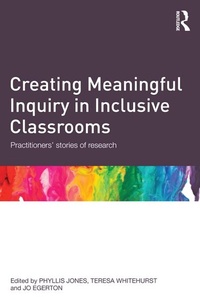
Creating Meaningful Inquiry in Inclusive Classrooms
Practitioners' stories of research
1st Edition
Published on 31. May 2012
160 pages
978-1-136-28340-6 (ISBN)
Description

In recent years, the concept of teachers as researchers in both special and mainstream school settings has become part of our everyday language. Whilst many educational practitioners will see the need for research within their setting, many may not be familiar with the technical elements they believe are required.
Creating Meaningful Inquiry in Inclusive Classrooms shows how practitioners can engage in a wide range of educational research and explores its value to the practice of teaching and learning. It introduces the Accessible Research Cycle (ARC), an understandable and meaningful framework for classroom and school-based inquiry for educators. This supports practitioner inquiry and validates the role of the practitioner as both practitioner and researcher. The book offers guidance to practitioners on how to use the ARC using familiar language with accompanying illustrative examples from inquiry carried out in special educational settings. It promotes meaningful participation within the inquiry process for all students.
As the learner population in all schools is changing and becoming more complex, the role of practitioners in exploring evidence-based educational solutions to meet the educational entitlement of children is essential. In supporting a research informed profession within education, this book will empower practitioners to become the agents of change, helping them to become reflective, strategic, investigative and inquiring practitioners.
Creating Meaningful Inquiry in Inclusive Classrooms shows how practitioners can engage in a wide range of educational research and explores its value to the practice of teaching and learning. It introduces the Accessible Research Cycle (ARC), an understandable and meaningful framework for classroom and school-based inquiry for educators. This supports practitioner inquiry and validates the role of the practitioner as both practitioner and researcher. The book offers guidance to practitioners on how to use the ARC using familiar language with accompanying illustrative examples from inquiry carried out in special educational settings. It promotes meaningful participation within the inquiry process for all students.
As the learner population in all schools is changing and becoming more complex, the role of practitioners in exploring evidence-based educational solutions to meet the educational entitlement of children is essential. In supporting a research informed profession within education, this book will empower practitioners to become the agents of change, helping them to become reflective, strategic, investigative and inquiring practitioners.
More details
Language
English
Place of publication
London
United Kingdom
Publishing group
Taylor & Francis Ltd
Target group
College/higher education
Professional and scholarly
Illustrations
11 s/w Abbildungen, 5 s/w Tabellen
5 Tables, black and white; 11 Illustrations, black and white
File size
2,13 MB
ISBN-13
978-1-136-28340-6 (9781136283406)
Copyright in bibliographic data and cover images is held by Nielsen Book Services Limited or by the publishers or by their respective licensors: all rights reserved.
Schweitzer Classification
Other editions
Additional editions
Phyllis Jones | Teresa Whitehurst | Jo Egerton
Creating Meaningful Inquiry in Inclusive Classrooms
Practitioners' stories of research
Book
05/2012
1st Edition
Routledge
€231.10
Shipment within 15-20 days
Phyllis Jones | Teresa Whitehurst | Jo Egerton
Creating Meaningful Inquiry in Inclusive Classrooms
Practitioners' stories of research
Book
05/2012
1st Edition
Routledge
€73.80
Shipment within 15-20 days
Persons
Phyllis Jones is Associate Professor in the Department of Special Education at the University of South Florida, USA.
Teresa Whitehurst is an Independent Research Consultant who works with organisations and charities supporting children with disability.
Jo Egerton is a Research Project Co-ordinator for the Schools Network and the lead Research Coach for their Research Charter Mark Award.
Teresa Whitehurst is an Independent Research Consultant who works with organisations and charities supporting children with disability.
Jo Egerton is a Research Project Co-ordinator for the Schools Network and the lead Research Coach for their Research Charter Mark Award.
Content
Chapter 1. Reclaiming Research: Connecting research to practitioners Phyllis Jones, Teresa Whitehurst & Katherine Hawley Chapter 2. What Do I Want to Accomplish through My Research? - Raising practitioner awareness of Foetal Alcohol Spectrum Disorders Carolyn Blackburn Chapter 3. Existing Knowledge - A starting point for an exploration of parents' views of their son or daughter's transition to adult services Jo Egerton Chapter 4. Possible Ways to Involve Others - An example of including transdisciplinary investigators in a research project Sally Conway & Teresa Whitehurst Chapter 5. Informed Consent - An ethical consideration when involving students in research Ann Gillies Chapter 6. Gathering Information - The 'Voice for Choice' project Victoria Hobday Chapter 7. Making Sense of Data - An analysis of Alternate Assessment Katherine Hawley Chapter 8. Sharing Discoveries about Students' Experiences of Inclusive Practices Christine Klopfer Chapter 9. Relating Discoveries to Practice - Student self monitoring Aisha Holmes Chapter 10. The ARC in action: Teachers' Practitioners' Perspectives Phyllis Jones, Jo Egerton & Teresa Whitehurst Chapter 11. Back to the Future: Moving forward with practitioner research Annie Fergusson
