

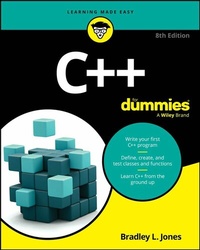
C++ For Dummies
Description

An accessible walkthrough of one of the world's most popular programming languages: C++
C++ For Dummies is your from-scratch guide that explains the essentials of what you need to know to understand the language and build your very first program in C++. Bradley Jones, experienced programmer and coding educator, packs this edition with examples and clear demonstrations that explain the "why" and the "how" of programming in C++, as well as the programming concepts that will form the foundation of your code, including classes, loops, classes, objects, inheritance, and more.
C++ For Dummies provides easy-to-understand tutorials for the use of C++26 and explains the modern approach to printing and displaying information with the std::print method. It also discusses:
- Explanations of features that make C++26 better including modules, smart pointers, concepts, and ranges
- Walkthroughs of updated libraries for the filesystem, ranges, formatting, time, printing, and more
- Testing and debugging techniques
Great for programmers, developers, students, or anyone interested in learning to code in C++ who are looking for a straightforward, hands-on approach to the language, C++ For Dummies is an accessible introduction to C++26 that offers readers a reliable head-start to a fun and rewarding skillset.
More details
Other editions
Additional editions
Person
Bradley L. Jones is the owner of Lots of Software, LLC, and a Microsoft MVP in C++. He has authored numerous books on C, C++, C#, and web development, and is a bestselling technical author and international technology speaker.
Content
Introduction 1
Part 1: Getting Started with C++ Programming 7
Chapter 1: Writing Your First C++ Program 9
Chapter 2: Storing Stuff in Variables 33
Chapter 3: Doing the Math 51
Chapter 4: Show Me the Good Stuff! 59
Chapter 5: Performing Logical Operations. 71
Chapter 6: Controlling the Flow 83
Part 2: Becoming a Functional C++ Programmer 101
Chapter 7: Creating Functions 103
Chapter 8: Grouping Similar Things Together Using Arrays 123
Chapter 9: Taking a First Look at C++ Pointers 149
Chapter 10: Taking a Second Look at C++ Pointers 167
Chapter 11: Using the C++ Preprocessor 183
Part 3: Giving Your Program a Bit of Class 207
Chapter 12: Examining Object-Oriented Programming 209
Chapter 13: Adding Class to C++ 215
Chapter 14: Separating Letters from Words: Character Arrays versus Strings 235
Chapter 15: Pointing and Staring at Objects 251
Chapter 16: Protecting Members: Do Not Disturb 275
Chapter 17: "Why Do You Build Me Up, Just to Tear Me Down, Baby?" 287
Chapter 18: Making Constructive Arguments 301
Chapter 19: Making Copies with the Copy/Move Constructor 327
Chapter 20: Adding Static Members: Can Fabric Softener Help? 345
Part 4: A First Look at Inheritance 359
Chapter 21: Passing the DNA: Sharing Code with Inheritance 361
Chapter 22: Creating Virtual Member Functions: Are They for Real? 371
Chapter 23: Factoring Classes 383
Part 5: Object-Oriented Programming in Overdrive. 395
Chapter 24: Adopting a New Assignment Operator, Should You Decide to Accept It 397
Chapter 25: Playing with the Computer's File System 413
Chapter 26: Twice the Fun: Tapping into Multiple Inheritance 421
Chapter 27: Getting Ahead of Problems: Exception Handling, Contracts, and More 435
Part 6: The Part of Tens 455
Chapter 28: Ten Ways to Avoid Adding Bugs to Your Program 457
Chapter 29: Ten Ways to Make Your Programs Easier to Update and Understand 465
Index 473
