

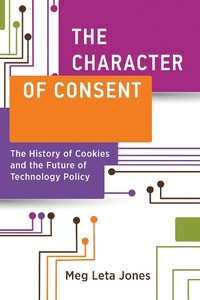
The Character of Consent
The History of Cookies and the Future of Technology Policy
Published on 18. June 2024
288 pages
978-0-262-37845-1 (ISBN)
Description

The rich, untold origin story of the ubiquitous web cookie-what's wrong with it, why it's being retired, and how we can do better.
Consent pop-ups continually ask us to download cookies to our computers, but is this all-too-familiar form of privacy protection effective? No, Meg Leta Jones explains in The Character of Consent, rather than promote functionality, privacy, and decentralization, cookie technology has instead made the internet invasive, limited, and clunky. Good thing, then, that the cookie is set for retirement in 2024. In this eye-opening book, Jones tells the little-known story of this broken consent arrangement, tracing it back to the major transnational conflicts around digital consent over the last twenty-five years. What she finds is that the policy controversy is not, in fact, an information crisis-it's an identity crisis.
Instead of asking how people consent, Jones asks who exactly is consenting and to what. Packed into those cookie pop-ups, she explains, are three distinct areas of law with three different characters who can consent. Within (mainly European) data protection law, the data subject consents. Within communication privacy law, the user consents. And within consumer protection law, the privacy consumer consents. These areas of law have very different histories, motivations, institutional structures, expertise, and strategies, so consent-and the characters who can consent-plays a unique role in those areas of law. The Character of Consent gives each computer character its due, taking us back to their origin stories within the legal history of computing. By doing so, Jones provides alternative ways of understanding the core issues within the consent dilemma. More importantly, she offers bold new approaches to creating and adopting better tech policies in the future.
Consent pop-ups continually ask us to download cookies to our computers, but is this all-too-familiar form of privacy protection effective? No, Meg Leta Jones explains in The Character of Consent, rather than promote functionality, privacy, and decentralization, cookie technology has instead made the internet invasive, limited, and clunky. Good thing, then, that the cookie is set for retirement in 2024. In this eye-opening book, Jones tells the little-known story of this broken consent arrangement, tracing it back to the major transnational conflicts around digital consent over the last twenty-five years. What she finds is that the policy controversy is not, in fact, an information crisis-it's an identity crisis.
Instead of asking how people consent, Jones asks who exactly is consenting and to what. Packed into those cookie pop-ups, she explains, are three distinct areas of law with three different characters who can consent. Within (mainly European) data protection law, the data subject consents. Within communication privacy law, the user consents. And within consumer protection law, the privacy consumer consents. These areas of law have very different histories, motivations, institutional structures, expertise, and strategies, so consent-and the characters who can consent-plays a unique role in those areas of law. The Character of Consent gives each computer character its due, taking us back to their origin stories within the legal history of computing. By doing so, Jones provides alternative ways of understanding the core issues within the consent dilemma. More importantly, she offers bold new approaches to creating and adopting better tech policies in the future.
More details
Other editions
Additional editions
Book
06/2024
MIT Press
€59.42
Shipment within 10-20 days
Person
Meg Leta Jones is Provost's Distinguished Associate Professor in the Communication, Culture & Technology program at Georgetown University and the author of Ctrl+Z: The Right to Be Forgotten. She is also a core faculty member of the Science, Technology and International Affairs program in Georgetown's School of Foreign Service, a faculty affiliate with the Institute for Technology Law & Policy at Georgetown Law Center, and a faculty fellow at the Georgetown Ethics Lab.
Content
- Intro
- Contents
- Series Editor's Introduction
- 1 Introduction: Cookies and Consenting Characters
- Making Up Computer Characters
- Consent Confusion
- Legal Construction of Technology
- New History, New Interventions
- 2 Computing the Data Subject
- The American Challenge for European Computing
- The Computer Reports
- The Computer Laws
- Transborder Data Flows
- 3 Networking the User
- Authorized Users in the Protocol Wars: Data Networks in the UK
- Anonymous Users on Minitel: Videotext in France
- CCC Hackers against BTX: BBSes in Germany
- Luser Screen Names: Online Services in the US
- ePrivacy Users: Euronet in the Single Market
- 4 Maintaining State for the Privacy Consumer
- The Stateless Web
- Advertising as Infrastructure
- Consumer Privacy
- Opt-Out
- 5 Contesting Cookies for Data Privacy
- Cookies in Court and on the Hill
- The EU Cookie Directive
- Building Data Privacy for Cookies
- The Transatlantic Breakdown
- 6 Conclusion: The (Forced) Retirement of Cookies
- Beyond Consent Theater
- Consent as a Backstop: The New Data Subject
- Consent as Privacy Civics: The New User
- Consent as Healthy Competition: The New Privacy Consumer
- New Characters for Tech Governance
- Conclusion
- Notes
- Series Editor's Introduction
- Chapter 1
- Chapter 2
- Chapter 3
- Chapter 4
- Chapter 5
- Chapter 6
- Index
