

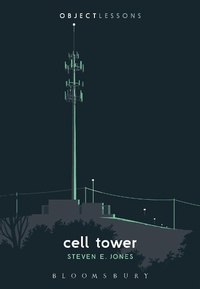
Cell Tower
1st Edition
Published on 19. March 2020
160 pages
978-1-5013-4879-2 (ISBN)
Description

Object Lessons is a series of short, beautifully designed books about the hidden lives of ordinary things.
Cropping up everywhere, whether steel latticework or tapered monopoles, encrusted with fiberglass antennas, cell towers raise up high into the air the communications equipment that channels our calls, texts, and downloads. For security reasons, their locations are never advertised. But it's our romantic notions of connectivity that hide them in plain sight. We want the network to be invisible, ethereal, and ubiquitous. The cell tower stands as a challenge to these desires.
Object Lessons is published in partnership with an essay series in The Atlantic.
Cropping up everywhere, whether steel latticework or tapered monopoles, encrusted with fiberglass antennas, cell towers raise up high into the air the communications equipment that channels our calls, texts, and downloads. For security reasons, their locations are never advertised. But it's our romantic notions of connectivity that hide them in plain sight. We want the network to be invisible, ethereal, and ubiquitous. The cell tower stands as a challenge to these desires.
Object Lessons is published in partnership with an essay series in The Atlantic.
Reviews / Votes
Overall, Cell Tower provides useful insights into an infrastructural system so essential to our everyday engagements, yet rarely noticed and understood. * Mobile Media and Communications * As Steven E. Jones observes, we imagine that our mobile devices connect us to each other, and to a certain version of the world, in a manner that's invisible and ethereal. But in fact, this illusion depends on a great multiplicity of 200-foot-tall structures that we see, or decline to see, wherever we go: cell towers. Briskly deconstructing these enablers of our digital lives as physical objects, and as quasi-magical connectors of the immaterial, Jones reveals them as secret object-icons of our time. Once you've read this, you won't be able to stop seeing--and thinking about--the cell phone tower. * Rob Walker, author of The Art of Noticing (2019) *More details
Series
Edition
1. Auflage
Language
English
Place of publication
New York
United States
Publishing group
Bloomsbury Publishing PLC (Digital)
Target group
Professional and scholarly
ISBN-13
978-1-5013-4879-2 (9781501348792)
Copyright in bibliographic data and cover images is held by Nielsen Book Services Limited or by the publishers or by their respective licensors: all rights reserved.
Schweitzer Classification
Other editions
Additional editions
Person
Steven E. Jones is DeBartolo Chair in Liberal Arts and Professor of English and Digital Humanities at the University of South Florida, USA. He is the author or editor of 11 books, including The Emergence of the Digital Humanities (2014).
Content
1. Cellspotting
2. Invisible waves
3. Camouflage
4. Ethereal connections
5. Design
6. Coverage
7. On Earth
List of Figures
Acknowledgments
Notes
Index
2. Invisible waves
3. Camouflage
4. Ethereal connections
5. Design
6. Coverage
7. On Earth
List of Figures
Acknowledgments
Notes
Index
