

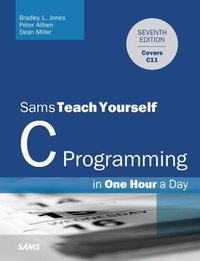
C Programming in One Hour a Day, Sams Teach Yourself
7th Edition
Published on 7. October 2013
704 pages
978-0-13-341438-7 (ISBN)
Description

Sams Teach Yourself C Programming in One Hour a Day, Seventh Edition is the newest version of the worldwide best-seller Sams Teach Yourself C in 21 Days. Fully revised for the new C11 standard and libraries, it now emphasizes platform-independent C programming using free, open-source C compilers. This edition strengthens its focus on C programming fundamentals, and adds new material on popular C-based object-oriented programming languages such as Objective-C.
Filled with carefully explained code, clear syntax examples, and well-crafted exercises, this is the broadest and deepest introductory C tutorial available. It's ideal for anyone who's serious about truly mastering C - including thousands of developers who want to leverage its speed and performance in modern mobile and gaming apps.
Friendly and accessible, it delivers step-by-step, hands-on experience that starts with simple tasks and gradually builds to professional-quality techniques. Each lesson is designed to be completed in hour or less, introducing and clearly explaining essential concepts, providing practical examples, and encouraging you to build simple programs on your own. Coverage includes:
Understanding C program components and structure
Mastering essential C syntax and program control
Using core language features, including numeric arrays, pointers, characters, strings, structures, and variable scope
Interacting with the screen, printer, and keyboard
Using functions and exploring the C Function Library
Working with memory and the compiler
Contents at a Glance
PART I: FUNDAMENTALS OF C
1 Getting Started with C
2 The Components of a C Program
3 Storing Information: Variables and Constants
4 The Pieces of a C Program: Statements, Expressions, and Operators
5 Packaging Code in Functions
6 Basic Program Control
7 Fundamentals of Reading and Writing Information
PART II: PUTTING C TO WORK
8 Using Numeric Arrays
9 Understanding Pointers
10 Working with Characters and Strings
11 Implementing Structures, Unions, and TypeDefs
12 Understanding Variable Scope
13 Advanced Program Control
14 Working with the Screen, Printer, and Keyboard
PART III: ADVANCED C
15 Pointers to Pointers and Arrays of Pointers
16 Pointers to Functions and Linked Lists
17 Using Disk Files
18 Manipulating Strings
19 Getting More from Functions
20 Exploring the C Function Library
21 Working with Memory
22 Advanced Compiler Use
PART IV: APPENDIXES
A ASCII Chart
B C/C++ Reserved Words
C Common C Functions
D Answers
Filled with carefully explained code, clear syntax examples, and well-crafted exercises, this is the broadest and deepest introductory C tutorial available. It's ideal for anyone who's serious about truly mastering C - including thousands of developers who want to leverage its speed and performance in modern mobile and gaming apps.
Friendly and accessible, it delivers step-by-step, hands-on experience that starts with simple tasks and gradually builds to professional-quality techniques. Each lesson is designed to be completed in hour or less, introducing and clearly explaining essential concepts, providing practical examples, and encouraging you to build simple programs on your own. Coverage includes:
Understanding C program components and structure
Mastering essential C syntax and program control
Using core language features, including numeric arrays, pointers, characters, strings, structures, and variable scope
Interacting with the screen, printer, and keyboard
Using functions and exploring the C Function Library
Working with memory and the compiler
Contents at a Glance
PART I: FUNDAMENTALS OF C
1 Getting Started with C
2 The Components of a C Program
3 Storing Information: Variables and Constants
4 The Pieces of a C Program: Statements, Expressions, and Operators
5 Packaging Code in Functions
6 Basic Program Control
7 Fundamentals of Reading and Writing Information
PART II: PUTTING C TO WORK
8 Using Numeric Arrays
9 Understanding Pointers
10 Working with Characters and Strings
11 Implementing Structures, Unions, and TypeDefs
12 Understanding Variable Scope
13 Advanced Program Control
14 Working with the Screen, Printer, and Keyboard
PART III: ADVANCED C
15 Pointers to Pointers and Arrays of Pointers
16 Pointers to Functions and Linked Lists
17 Using Disk Files
18 Manipulating Strings
19 Getting More from Functions
20 Exploring the C Function Library
21 Working with Memory
22 Advanced Compiler Use
PART IV: APPENDIXES
A ASCII Chart
B C/C++ Reserved Words
C Common C Functions
D Answers
More details
Series
Edition
7th edition
Language
English
Place of publication
Boston
United States
Publishing group
Pearson Education (US)
Target group
College/higher education
File size
31,91 MB
ISBN-13
978-0-13-341438-7 (9780133414387)
Copyright in bibliographic data and cover images is held by Nielsen Book Services Limited or by the publishers or by their respective licensors: all rights reserved.
Schweitzer Classification
Other editions
Additional editions
Bradley Jones | Bradley L. Jones | Peter Aitken
C Programming in One Hour a Day, Sams Teach Yourself
Book
10/2013
7th Edition
Sams Publishing
€42.49
Shipment within 3-4 weeks
Persons
Bradley L. Jones manages and directs the Developer.com Network, which includes sites such as Developer.com, CodeGuru, and DevX. He has developed systems using C, C#, C++, SQL Server, PowerBuilder, Visual Basic, HTML5, and more.
Peter Aitken was on the faculty at Duke University Medical Center, where he cut his programming teeth developing computer programs for research. He is an experienced author in the IT field-on both applications and programming topics-with more than 70 magazine articles and 40 books to his credit. Aitken currently works as a consultant in the pharmaceutical industry.
Dean Miller is a writer and editor with more than 20 years of experience in both the publishing and licensed consumer product businesses. Over the years, he has created or helped shape a number of bestselling books and series, including Teach Yourself in 21 Days, Teach Yourself in 24 Hours, and the Unleashed series, all from Sams Publishing.
Peter Aitken was on the faculty at Duke University Medical Center, where he cut his programming teeth developing computer programs for research. He is an experienced author in the IT field-on both applications and programming topics-with more than 70 magazine articles and 40 books to his credit. Aitken currently works as a consultant in the pharmaceutical industry.
Dean Miller is a writer and editor with more than 20 years of experience in both the publishing and licensed consumer product businesses. Over the years, he has created or helped shape a number of bestselling books and series, including Teach Yourself in 21 Days, Teach Yourself in 24 Hours, and the Unleashed series, all from Sams Publishing.
Content
Sams Teach Yourself C Programming in One Hour a Day
The Seventh Edition of Teach Yourself C in 21 Days
PART I: FUNDAMENTALS OF C
1 Getting Started with C
2 The Components of a C Program
3 Storing Information: Variables and Constants
4 The Pieces of a C Program: Statements, Expressions, and Operators
5 Packaging Code in Functions
6 Basic Program Control
7 Fundamentals of Reading and Writing Information
PART II: PUTTING C TO WORK
8 Using Numeric Arrays
9 Understanding Pointers
10 Working with Characters and Strings
11 Implementing Structures, Unions, and TypeDefs
12 Understanding Variable Scope
13 Advanced Program Control
14 Working with the Screen, Printer, and Keyboard
PART III: ADVANCED C
15 Pointers to Pointers and Arrays of Pointers
16 Pointers to Functions and Linked Lists
17 Using Disk Files
18 Manipulating Strings
19 Getting More from Functions
20 Exploring the C Function Library
21 Working with Memory
22 Advanced Compiler Use
PART IV: APPENDIXES
A ASCII Chart
B C/C++ Reserved Words
C Common C Functions
D Answers
The Seventh Edition of Teach Yourself C in 21 Days
PART I: FUNDAMENTALS OF C
1 Getting Started with C
2 The Components of a C Program
3 Storing Information: Variables and Constants
4 The Pieces of a C Program: Statements, Expressions, and Operators
5 Packaging Code in Functions
6 Basic Program Control
7 Fundamentals of Reading and Writing Information
PART II: PUTTING C TO WORK
8 Using Numeric Arrays
9 Understanding Pointers
10 Working with Characters and Strings
11 Implementing Structures, Unions, and TypeDefs
12 Understanding Variable Scope
13 Advanced Program Control
14 Working with the Screen, Printer, and Keyboard
PART III: ADVANCED C
15 Pointers to Pointers and Arrays of Pointers
16 Pointers to Functions and Linked Lists
17 Using Disk Files
18 Manipulating Strings
19 Getting More from Functions
20 Exploring the C Function Library
21 Working with Memory
22 Advanced Compiler Use
PART IV: APPENDIXES
A ASCII Chart
B C/C++ Reserved Words
C Common C Functions
D Answers
