

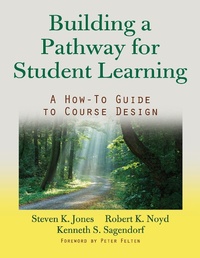
Building a Pathway to Student Learning
A How-To Guide to Course Design
1st Edition
Published on 3. July 2023
152 pages
978-1-000-97368-6 (ISBN)
Description

This book leads you through the process of designing a learning-centered course. It is written as a "how-to" handbook, providing step-by-step guidance on creating a pathway to student learning, including 26 workboxes (also available free online) that lead you through each element of the course design process and promote a rich reflection process akin to being in a workshop setting. The authors prompt you to (1) consider the distinctive characteristics of your students; (2) clearly articulate your course learning goals; (3) create aligned summative assessments; (4) identify the specific knowledge, skills, and attitudes students will need in order to be successful; (5) craft effective learning experiences, informed by the well-documented research on how people learn; and (6) incorporate formative assessment to ensure you and your students are staying on track. Completion of the sequence of worksheets leads to a poster as a visual display of your course design. This graphic depiction of your course ties the components together, provides a clear map of action for teaching your course, for modifying as you evaluate the success of particular strategies or want to introduce new concepts, and for developing your syllabus. A rubric for evaluating course posters is included.For faculty developers, this book provides a proven and ready-made resource and text around which to design or redesign learner-centered course design workshops or multi-day course design retreats, replicating or modifying the renowned workshop that the authors have developed at the Air Force Academy for both faculty new to teaching and those with many years of teaching experience under their belt.
Reviews / Votes
"The workbook has much to commend. First, each chapter contains a helpful and thorough survey of the more significant research on the topic under consideration. Second, the system suggested to redesign courses is logically ordered, and effective. Third, at several key points the authors suggest proactive ways of finding evaluation of stages in the course design from colleagues. Most importantly, the authors recognize that effective course design has to be a flexible system; they do not claim to have all the answers for how every course can best be structured, rather they provide a series of guiding questions so that individual instructors can think through how to order their classes so that they effectively take students from wherever they begin, to the acquisition of central proficiencies and the accomplishment of learning goals, whatever the discipline. For these reasons, this book should be essential for anyone developing or revising courses towards a learning-centered model."Reflective Teaching Journal
"This book is valuable for both the novice and experienced faculty member. I am particularly impressed that it is written at a level that is easy to understand, yet guides the reader to a complex product individually designed to improve student learning."
Todd Zakrajsek
International Teaching Learning Cooperative, Chapel Hill, NC
"Roll up your sleeves and get ready to learn practical guidelines for designing a learning-centered course. This book puts aside theory and argument for the transformational work of re-tooling courses with an emphasis on deep, lasting learning. Various strategies maximize the hands-on, retreat-like approach to achieving what the authors call transparency, alignment, and integration in course design. The book is more than a good read: it is a genuine workout for teachers committed to improving student learning."
John Zubizarreta, Ph.D., Professor of English, Director of Honors & Faculty Development, Carnegie Foundation/CASE U.S. Professor of the Year
Columbia College
"This book leads you through the entire process of designing a well-aligned, learning-centered course - and makes it easy. Not only does it explain solid course design principles we can all agree on, such as backward design, but it also provides the hands-on practicality of a workbook: The reader creates a course as she proceeds through the book. Faculty can use on their own, or educational developers can develop an extended course design workshop around it."
Linda B. Nilson, Ph.D. Director, Office of Teaching Effectiveness and Innovation
Clemson University
"Building a Pathway for Student Learning offers a practical, research-informed, systematic, comprehensive yet concise pathway for faculty interested in designing and building more effective courses. The book is itself a cleverly designed 'curriculum' that will engage and assist faculty across the disciplines - from novices to veterans, working individually or collaboratively - in understanding and implementing 'backward design.' I strongly commend and recommend this book to academic administrators and faculty alike for its conceptual clarity, pragmatic advice and admirable brevity."
Tom Angelo, Assistant Provost, Director of the Center for the Advancement of Faculty Excellence (CAFE) and Professor of Higher Education
Queens University of Charlotte
"Building a Pathway for Student Learning provides a practical and flexible guide to the wicked problem of teaching in higher education. As Jones, Noyd, and Sagendorf explain, faculty possess the content knowledge that is a prerequisite to teach effectively in college. That knowledge, however, is necessary but not sufficient for our work. What students know and are capable of doing as a result of our courses is what matters most, yet the dynamic nature of our students, disciplines, and institutions means that a static approach to teaching is bound to fail. Our disciplinary expertise, no matter how great, will not allow us to resolve this wicked problem.
We need to supplement our disciplinary understanding with a systematic yet flexible approach to designing learning experiences for students. This book outlines an efficient and powerful process to do that. Jones, Noyd, and Sagendorf are excellent guides along the way. They have synthesized the best scholarly literature on learning and teaching; they also have practical experience gained by facilitating scores of course design retreats for diverse faculty. 'Done well,' Jones, Noyd, and Sagendorf remind us, 'course design is a scholarly and deeply creative activity.'
With this book as our guide, we will make progress in building pathways toward deeper student learning in all of our courses."
Peter Felten, Assistant Provost for Teaching and Learning, Executive Director of the Center for Engaged Learning and the Center for the Advancement of Teaching and Learning
and Associate Professor of History at Elon University
More details
Edition
1. Auflage
Language
English
Place of publication
London
United Kingdom
Publishing group
Taylor & Francis Ltd
Target group
College/higher education
Professional and scholarly
ISBN-13
978-1-000-97368-6 (9781000973686)
Copyright in bibliographic data and cover images is held by Nielsen Book Services Limited or by the publishers or by their respective licensors: all rights reserved.
Schweitzer Classification
Other editions
Additional editions
Steven G. Jones | Robert K. Noyd | Kenneth S. Sagendorf
Building a Pathway to Student Learning
A How-To Guide to Course Design
Book
10/2014
1st Edition
Stylus Publishing
€202.50
Article not available at the moment
Steven G. Jones | Robert K. Noyd | Kenneth S. Sagendorf
Building a Pathway to Student Learning
A How-To Guide to Course Design
Book
10/2014
1st Edition
Stylus Publishing
€47.00
Shipment within 3-4 weeks
Persons
Steven G. Jones is the Assistant Director for Faculty Development in the Center for Teaching and Learning at Georgia College and State University. From 2002-2004, he was the Project Associate for Integrating Service with Academic Study at Campus Compact. During that time, he edited the second edition of the Compact's Service Learning Toolkit. He was also a co-author of two other Compact publications: The Promise of Partnerships and The Community's College. From 2004-2008, he was the Coordinator for Service Learning in the Center for Service and Learning at IUPUI. He was also the campus co-coordinator for the American Democracy Project. He was co-editor, with Robert Bringle and Julie Hatcher, of International Service Learning: Conceptual Frameworks and Research and co-editor, with James Perry of Quick Hits for Civic Engagement. Over the course of his career, Dr. Jones has published several book chapters and journal articles on civic engagement. Robert K. Noyd is Professor of Biology at the U.S. Air Force Academy where he teaches botany, general biology, and senior seminar courses. He has taught for over 35 years in high school, community college, small college, university, and service academy classrooms. He has served as the Academy's Director of Faculty Development and continues to write innovative educational materials and present workshops throughout the country on course design and learning-focused strategies. His new first edition biology textbook uses research-based principles of learning to motivate and inspire students nationwide. Kenneth S. Sagendorf is the founding Director of the Center for Excellence in Teaching and Learning (CETL) and a Professor at Regis University - a Jesuit University in Denver, CO. He holds degrees in biology (B.S.), applied exercise physiology (M.S.), and College Science Teaching (Ph.D.). In his 20+ years in higher education, he has worked as a faculty member and administrator at four academic institutions - from smal
Content
Part One. Introduction 1. Our Course Design System and Effective Ways to Use This Book 2. Principles of Learning-Centered Course Design Part Two. Elements of the Learning Pathway 3. The Starting Point. Student Learning Factors 4. Defining the Destination. Learning Goals 5. Students' Successful Arrival. Summative Assessment 6. What Your Students Need to Be Successful. Learning Proficiencies 7. Travelling the Pathway. Learning Experiences 8. Staying on Track. Formative Assessment Part Three. Pulling the Elements Together 9. Visualizing the Learning Pathway. The Course Poster 10. Students' Pathway to Success. The Course Syllabus 11. Anticipating the Challenges Ahead Appendix A. Rubric for Evaluating Course Posters Appendix B. Taxonomy of the Psychomotor and Affective Domains Appendix C. Sample Syllabus References About the Authors Index
