

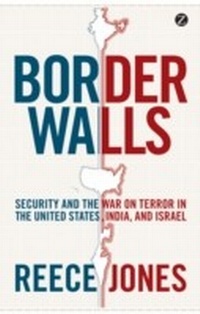
Border Walls
Security and the War on Terror in the United States, India, and Israel
1st Edition
Published on 12. July 2012
224 pages
978-1-84813-825-4 (ISBN)
Description

*** Winner of the 2013 Julian Minghi Outstanding Research Award presented at the American Association of Geographers annual meeting ***
Two decades after the fall of the Berlin Wall, why are leading democracies like the United States, India, and Israel building massive walls and fences on their borders? Despite predictions of a borderless world through globalization, these three countries alone have built an astonishing total of 5,700 kilometers of security barriers. In this groundbreaking work, Reece Jones analyzes how these controversial border security projects were justified in their respective countries, what consequences these physical barriers have on the lives of those living in these newly securitized spaces, and what long-term effects the hardening of political borders will have in these societies and globally.
Border Walls is a bold, important intervention that demonstrates that the exclusion and violence necessary to secure the borders of the modern state often undermine the very ideals of freedom and democracy the barriers are meant to protect.
Two decades after the fall of the Berlin Wall, why are leading democracies like the United States, India, and Israel building massive walls and fences on their borders? Despite predictions of a borderless world through globalization, these three countries alone have built an astonishing total of 5,700 kilometers of security barriers. In this groundbreaking work, Reece Jones analyzes how these controversial border security projects were justified in their respective countries, what consequences these physical barriers have on the lives of those living in these newly securitized spaces, and what long-term effects the hardening of political borders will have in these societies and globally.
Border Walls is a bold, important intervention that demonstrates that the exclusion and violence necessary to secure the borders of the modern state often undermine the very ideals of freedom and democracy the barriers are meant to protect.
Reviews / Votes
At a time when many commentators are preoccupied by forces undermining the power and authority of the territorial state, Border Walls serves as an important reminder that the modernist political-territorial order still matters. Reece Jones convincingly shows that the border security arrangements of the past decade are likely to be among the most enduring consequences of the global "war on terror" - not just for how people move around and use space, but for how they think about the political geographic organization of the planet. * Alexander B. Murphy, Department of Geography, University of Oregon * In a compelling analysis of the political agendas, identity politics, and growing civil militarization underlying the construction of barriers between neighboring countries and peoples, Reece Jones makes a significant contribution to the emerging but vital field of securitization studies. * Jeff Halper, director of the Israeli Committee Against House Demolitions (ICAHD) * Reece Jones provides an incisive and lucid examination of why wall-like barriers have become the tool of choice of so many countries along their geographical perimeters in the post-9-11 era. In doing so, he compellingly demonstrates not only how boundaries are produced, but also how they shape those within, and the relations with peoples and places beyond, in worrisome ways. Empirically rich, theoretically sophisticated, and highly accessible, Border Walls is an important and valuable book. * Joseph Nevins, author of Dying to Live: A Story of U.S. Immigration in an Age of Global Apartheid * Reece Jones's Border Walls links the paranoid narratives of terror and security emanating from the great democracies: the United States, India, and Israel. Rather than see the border walls that strangle these countries into delusions of security, these walls are frameworks to thwart the widest aspirations for human freedom. Like graffiti on the border walls, Jones's book tries to bring sunlight into the darkness of these states. * Vijay Prashad, author of The Darker Nations: A People's History of the Third World *More details
Edition
1. Auflage
Language
English
Place of publication
London
United Kingdom
Publishing group
Bloomsbury Publishing PLC
Target group
College/higher education
ISBN-13
978-1-84813-825-4 (9781848138254)
Copyright in bibliographic data and cover images is held by Nielsen Book Services Limited or by the publishers or by their respective licensors: all rights reserved.
Schweitzer Classification
Other editions
Additional editions
Book
07/2012
Zed Books Ltd
€36.50
Shipment within 3-4 weeks
Book
07/2012
Zed Books Ltd
€117.60
Shipment within 3-4 weeks
Person
Reece Jones is an associate professor of geography at the University of Hawai'i at Manoa and a leading authority on political borders. He has published fifteen research articles in highly ranked journals as well as opinion pieces in newspapers around the world on the role borders play in globalization and the global war on terror. He has won awards for both teaching and writing and was recently elected the Secretary/Treasurer for the Political Geography Specialty Group of the Association of American Geographers.
Content
Introduction: Fortress Democracy
1. Borders, Barriers, and the War on Terror
2. Securing the 'Homeland' in the United States
3. Border Fencing and the Global War on Terror in India
4. 'Arafat is our bin Laden': Territory and Terrorism in Israel and Palestine
5. Building Up, Rippling Out: Enforcement Practices at the US-Mexican Border
6. The Agents of Exception in the Indian Borderlands
7. The practices of Insecurity: The Barrier in the West Bank
8. The Enduring Significance of Borders
Appendix: Methodology and Methods
Notes
Bibliography
Index
1. Borders, Barriers, and the War on Terror
2. Securing the 'Homeland' in the United States
3. Border Fencing and the Global War on Terror in India
4. 'Arafat is our bin Laden': Territory and Terrorism in Israel and Palestine
5. Building Up, Rippling Out: Enforcement Practices at the US-Mexican Border
6. The Agents of Exception in the Indian Borderlands
7. The practices of Insecurity: The Barrier in the West Bank
8. The Enduring Significance of Borders
Appendix: Methodology and Methods
Notes
Bibliography
Index
