

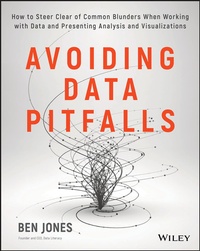
Avoiding Data Pitfalls
How to Steer Clear of Common Blunders When Working with Data and Presenting Analysis and Visualizations
1st Edition
Published on 13. November 2019
272 pages
978-1-119-27819-1 (ISBN)
Description

Avoid data blunders and create truly useful visualizations
Avoiding Data Pitfalls is a reputation-saving handbook for those who work with data, designed to help you avoid the all-too-common blunders that occur in data analysis, visualization, and presentation. Plenty of data tools exist, along with plenty of books that tell you how to use them--but unless you truly understand how to work with data, each of these tools can ultimately mislead and cause costly mistakes. This book walks you step by step through the full data visualization process, from calculation and analysis through accurate, useful presentation. Common blunders are explored in depth to show you how they arise, how they have become so common, and how you can avoid them from the outset. Then and only then can you take advantage of the wealth of tools that are out there--in the hands of someone who knows what they're doing, the right tools can cut down on the time, labor, and myriad decisions that go into each and every data presentation.
Workers in almost every industry are now commonly expected to effectively analyze and present data, even with little or no formal training. There are many pitfalls--some might say chasms--in the process, and no one wants to be the source of a data error that costs money or even lives. This book provides a full walk-through of the process to help you ensure a truly useful result.
* Delve into the "data-reality gap" that grows with our dependence on data
* Learn how the right tools can streamline the visualization process
* Avoid common mistakes in data analysis, visualization, and presentation
* Create and present clear, accurate, effective data visualizations
To err is human, but in today's data-driven world, the stakes can be high and the mistakes costly. Don't rely on "catching" mistakes, avoid them from the outset with the expert instruction in Avoiding Data Pitfalls.
Avoiding Data Pitfalls is a reputation-saving handbook for those who work with data, designed to help you avoid the all-too-common blunders that occur in data analysis, visualization, and presentation. Plenty of data tools exist, along with plenty of books that tell you how to use them--but unless you truly understand how to work with data, each of these tools can ultimately mislead and cause costly mistakes. This book walks you step by step through the full data visualization process, from calculation and analysis through accurate, useful presentation. Common blunders are explored in depth to show you how they arise, how they have become so common, and how you can avoid them from the outset. Then and only then can you take advantage of the wealth of tools that are out there--in the hands of someone who knows what they're doing, the right tools can cut down on the time, labor, and myriad decisions that go into each and every data presentation.
Workers in almost every industry are now commonly expected to effectively analyze and present data, even with little or no formal training. There are many pitfalls--some might say chasms--in the process, and no one wants to be the source of a data error that costs money or even lives. This book provides a full walk-through of the process to help you ensure a truly useful result.
* Delve into the "data-reality gap" that grows with our dependence on data
* Learn how the right tools can streamline the visualization process
* Avoid common mistakes in data analysis, visualization, and presentation
* Create and present clear, accurate, effective data visualizations
To err is human, but in today's data-driven world, the stakes can be high and the mistakes costly. Don't rely on "catching" mistakes, avoid them from the outset with the expert instruction in Avoiding Data Pitfalls.
More details
Other editions
Additional editions
Ben Jones
Avoiding Data Pitfalls
How to Steer Clear of Common Blunders When Working with Data and Presenting Analysis and Visualizations
Book
12/2019
1st Edition
Wiley
€47.00
Shipment within 15-20 days
Content
- Cover
- Title Page
- Copyright Page
- Contents
- Preface
- Chapter 1 The Seven Types of Data Pitfalls
- Seven Types of Data Pitfalls
- Pitfall 1: Epistemic Errors: How We Think About Data
- Pitfall 2: Technical Traps: How We Process Data
- Pitfall 3: Mathematical Miscues: How We Calculate Data
- Pitfall 4: Statistical Slipups: How We Compare Data
- Pitfall 5: Analytical Aberrations: How We Analyze Data
- Pitfall 6: Graphical Gaffes: How We Visualize Data
- Pitfall 7: Design Dangers: How We Dress up Data
- Avoiding the Seven Pitfalls
- "I've Fallen and I Can't Get Up"
- Chapter 2 Pitfall 1: Epistemic Errors
- How We Think About Data
- Pitfall 1A: The Data-Reality Gap
- Pitfall 1B: All Too Human Data
- Pitfall 1C: Inconsistent Ratings
- Pitfall 1D: The Black Swan Pitfall
- Pitfall 1E: Falsifiability and the God Pitfall
- Avoiding the Swan Pitfall and the God Pitfall
- Chapter 3 Pitfall 2: Technical Trespasses
- How We Process Data
- Pitfall 2A: The Dirty Data Pitfall
- Pitfall 2B: Bad Blends and Joins
- Chapter 4 Pitfall 3: Mathematical Miscues
- How We Calculate Data
- Pitfall 3A: Aggravating Aggregations
- Pitfall 3B: Missing Values
- Pitfall 3C: Tripping on Totals
- Pitfall 3D: Preposterous Percents
- Pitfall 3E: Unmatching Units
- Chapter 5 Pitfall 4: Statistical Slipups
- How We Compare Data
- Pitfall 4A: Descriptive Debacles
- Pitfall 4B: Inferential Infernos
- Pitfall 4C: Slippery Sampling
- Pitfall 4D: Insensitivity to Sample Size
- Chapter 6 Pitfall 5: Analytical Aberrations
- How We Analyze Data
- Pitfall 5A: The Intuition/Analysis False Dichotomy
- Pitfall 5B: Exuberant Extrapolations
- Pitfall 5C: Ill-Advised Interpolations
- Pitfall 5D: Funky Forecasts
- Pitfall 5E: Moronic Measures
- Chapter 7 Pitfall 6: Graphical Gaffes
- How We Visualize Data
- Pitfall 6A: Challenging Charts
- Pitfall 6B: Data Dogmatism
- Pitfall 6C: The Optimize/Satisfice False Dichotomy
- Chapter 8 Pitfall 7: Design Dangers
- How We Dress up Data
- Pitfall 7A: Confusing Colors
- Pitfall 7B: Omitted Opportunities
- Pitfall 7C: Usability Uh-Ohs
- Chapter 9 Conclusion
- Avoiding Data Pitfalls Checklist
- The Pitfall of the Unheard Voice
- Index
- EULA
