

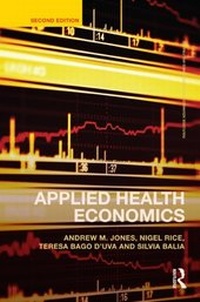
Applied Health Economics
2nd Edition
Published on 7. May 2013
416 pages
978-1-136-23982-3 (ISBN)
Description

The first edition of Applied Health Economics did an expert job of showing how the availability of large scale data sets and the rapid advancement of advanced econometric techniques can help health economists and health professionals make sense of information better than ever before.
This second edition has been revised and updated throughout and includes a new chapter on the description and modelling of individual health care costs, thus broadening the book's readership to those working on risk adjustment and health technology appraisal. The text also fully reflects the very latest advances in the health economics field and the key journal literature.
Large-scale survey datasets, in particular complex survey designs such as panel data, provide a rich source of information for health economists. They offer the scope to control for individual heterogeneity and to model the dynamics of individual behaviour. However, the measures of outcome used in health economics are often qualitative or categorical. These create special problems for estimating econometric models. The dramatic growth in computing power over recent years has been accompanied by the development of methods that help to solve these problems. The purpose of this book is to provide a practical guide to the skills required to put these techniques into practice.
Practical applications of the methods are illustrated using data on health from the British Health and Lifestyle Survey (HALS), the British Household Panel Survey (BHPS), the European Community Household Panel (ECHP), the US Medical Expenditure Panel Survey (MEPS) and Survey of Health, Ageing and Retirement in Europe (SHARE). There is a strong emphasis on applied work, illustrating the use of relevant computer software with code provided for Stata. Familiarity with the basic syntax and structure of Stata is assumed. The Stata code and extracts from the statistical output are embedded directly in the main text and explained at regular intervals.
The book is built around empirical case studies, rather than general theory, and the emphasis is on learning by example. It presents a detailed dissection of methods and results of some recent research papers written by the authors and their colleagues. Relevant methods are presented alongside the Stata code that can be used to implement them and the empirical results are discussed at each stage.
This text brings together the theory and application of health economics and econometrics, and will be a valuable reference for applied economists and students of health economics and applied econometrics.
This second edition has been revised and updated throughout and includes a new chapter on the description and modelling of individual health care costs, thus broadening the book's readership to those working on risk adjustment and health technology appraisal. The text also fully reflects the very latest advances in the health economics field and the key journal literature.
Large-scale survey datasets, in particular complex survey designs such as panel data, provide a rich source of information for health economists. They offer the scope to control for individual heterogeneity and to model the dynamics of individual behaviour. However, the measures of outcome used in health economics are often qualitative or categorical. These create special problems for estimating econometric models. The dramatic growth in computing power over recent years has been accompanied by the development of methods that help to solve these problems. The purpose of this book is to provide a practical guide to the skills required to put these techniques into practice.
Practical applications of the methods are illustrated using data on health from the British Health and Lifestyle Survey (HALS), the British Household Panel Survey (BHPS), the European Community Household Panel (ECHP), the US Medical Expenditure Panel Survey (MEPS) and Survey of Health, Ageing and Retirement in Europe (SHARE). There is a strong emphasis on applied work, illustrating the use of relevant computer software with code provided for Stata. Familiarity with the basic syntax and structure of Stata is assumed. The Stata code and extracts from the statistical output are embedded directly in the main text and explained at regular intervals.
The book is built around empirical case studies, rather than general theory, and the emphasis is on learning by example. It presents a detailed dissection of methods and results of some recent research papers written by the authors and their colleagues. Relevant methods are presented alongside the Stata code that can be used to implement them and the empirical results are discussed at each stage.
This text brings together the theory and application of health economics and econometrics, and will be a valuable reference for applied economists and students of health economics and applied econometrics.
Reviews / Votes
'Jones et al. provide an excellent introduction to the methods used by health economists for the statistical analysis of survey data ... Notwithstanding the health focus, the book will be a useful handbook for advanced undergraduates, graduate students, and researchers in many fields in addition to health.' - Stephen P. Jenkins, The Stata Journal'I would strongly recommend using Applied Health Economics on advanced undergraduate and postgraduate courses in health economics.' - Martin Karlsson, Institute of Ageing, University of Oxford, UK
More details
Series
Edition
2nd edition
Language
English
Place of publication
London
United Kingdom
Publishing group
Taylor & Francis Ltd
Target group
College/higher education
Edition type
Revised edition
Illustrations
118 s/w Tabellen, 32 s/w Zeichnungen
118 Tables, black and white; 32 Line drawings, black and white
File size
3,34 MB
ISBN-13
978-1-136-23982-3 (9781136239823)
Copyright in bibliographic data and cover images is held by Nielsen Book Services Limited or by the publishers or by their respective licensors: all rights reserved.
Schweitzer Classification
Other editions
Additional editions
Andrew M. Jones | Nigel Rice | Teresa Bago d'Uva
Applied Health Economics
Book
09/2012
2nd Edition
Routledge
€112.10
Shipment within 15-20 days
Andrew M. Jones | Nigel Rice | Teresa Bago d'Uva
Applied Health Economics
Book
09/2012
2nd Edition
Routledge
€273.40
Shipment within 15-20 days
Persons
Andrew M. Jones is Professor of Economics at the University of York, UK, where he is also Head of the Department of Economics and Related Studies.
Nigel Rice is Professor of Health Economics and Director of the Health, Econometrics and Data Group (HEDG) at the Centre for Health Economics, University of York, UK.
Teresa Bago d'Uva is an Associate Professor in the Department of Applied Economics at the Erasmus School of Economics, The Netherlands.
Silvia Balia is an Assistant Professor at the Department of Economics and Business and Social Research and a researcher at the Centre for North-South Economic Research (CRENoS) at the University of Cagliari, Italy.
Nigel Rice is Professor of Health Economics and Director of the Health, Econometrics and Data Group (HEDG) at the Centre for Health Economics, University of York, UK.
Teresa Bago d'Uva is an Associate Professor in the Department of Applied Economics at the Erasmus School of Economics, The Netherlands.
Silvia Balia is an Assistant Professor at the Department of Economics and Business and Social Research and a researcher at the Centre for North-South Economic Research (CRENoS) at the University of Cagliari, Italy.
Content
Part I: Describing and Summarising Data 1. Data and Survey Design 2. Describing the Dynamics of Health 3. Describing Health Care Costs Part II: Categorical Data 4. Reporting Heterogeneity in Health 5. Health and Lifestyles Part III: Duration Data 6. Smoking and Mortality 7. Health and Retirement Part IV: Panel Data 8. Health and Wages 9. Modelling the Dynamics of Health 10. Non-response and Attrition Bias Part V: Health Care Data 11. Models for Count Data 12. Modelling Health Care Costs
