

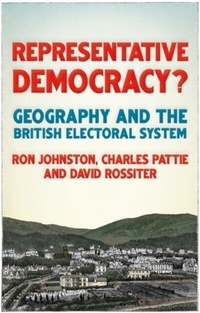
Representative Democracy?
Geography and the British Electoral System
1st Edition
Published on 12. January 2021
224 pages
978-1-5261-5182-7 (ISBN)
Description

Members of Parliament in the United Kingdom are elected to represent geographic constituencies; but how are these defined and what are the consequences for democracy?
Tracing the UK's system of parliamentary representation from its origins in the thirteenth century right through to the present, this comprehensive new survey reveals how a system initially designed to restrain the power of monarchs gradually evolved to serve their interests, then those of political parties before the twentieth century 'settlement' of an independent process for revising the constituency map.
That settlement is now under pressure, with the traditional pattern of constituencies representing communities about to be replaced by one which elevates numbers above community. Advanced under the slogan of 'making votes equal', this new regime promises fairness yet, as the authors show, is destined to fail to address the disproportional and biased election results that have long been a feature of UK politics.
Concluding with a detailed consideration of the ways in which various parts of the UK have embraced alternatives to first-past-the-post over the last two decades, this book serves as a timely reminder that the needs of political parties do not always coincide with those of us, the electors. -- .
Tracing the UK's system of parliamentary representation from its origins in the thirteenth century right through to the present, this comprehensive new survey reveals how a system initially designed to restrain the power of monarchs gradually evolved to serve their interests, then those of political parties before the twentieth century 'settlement' of an independent process for revising the constituency map.
That settlement is now under pressure, with the traditional pattern of constituencies representing communities about to be replaced by one which elevates numbers above community. Advanced under the slogan of 'making votes equal', this new regime promises fairness yet, as the authors show, is destined to fail to address the disproportional and biased election results that have long been a feature of UK politics.
Concluding with a detailed consideration of the ways in which various parts of the UK have embraced alternatives to first-past-the-post over the last two decades, this book serves as a timely reminder that the needs of political parties do not always coincide with those of us, the electors. -- .
More details
Language
English
Place of publication
Manchester
United Kingdom
Target group
College/higher education
Professional and scholarly
Edition type
Digital original
Illustrations
31 black & white figures; 23 tables
31 black & white figures; 23 tables
ISBN-13
978-1-5261-5182-7 (9781526151827)
Copyright in bibliographic data and cover images is held by Nielsen Book Services Limited or by the publishers or by their respective licensors: all rights reserved.
Schweitzer Classification
Other editions
Additional editions
Ron Johnston | Charles Pattie | David Rossiter
Representative Democracy?
Geography and the British Electoral System
Book
01/2021
Manchester University Press
€115.50
Shipment within 15-20 days
Ron Johnston | Charles Pattie | David Rossiter
Representative Democracy?
Geography and the British Electoral System
Book
01/2021
Manchester University Press
€24.50
Shipment within 15-20 days
Persons
Ron Johnston was Professor of Geography in the School of Geographical Sciences at the University of Bristol
Charles Pattie is Professor of Politics at the University of Sheffield
David Rossiter is now an independent researcher, having previously held posts at several British universities -- .
Charles Pattie is Professor of Politics at the University of Sheffield
David Rossiter is now an independent researcher, having previously held posts at several British universities -- .
Content
Preface
1 Introduction
2 Representation: of whom, what and where?
3 Creating an electoral system: 1832-1918
4 Consolidating the system: 1930-2010
5 The 2011 legislation: major changes?
6 How representative is our democracy?
7 Does it have to be this way?
8 Conclusion
Notes
Index -- .
1 Introduction
2 Representation: of whom, what and where?
3 Creating an electoral system: 1832-1918
4 Consolidating the system: 1930-2010
5 The 2011 legislation: major changes?
6 How representative is our democracy?
7 Does it have to be this way?
8 Conclusion
Notes
Index -- .
