
Red Tape
Description
Alles über E-Books | Antworten auf Fragen rund um E-Books, Kopierschutz und Dateiformate finden Sie in unserem Info- & Hilfebereich.
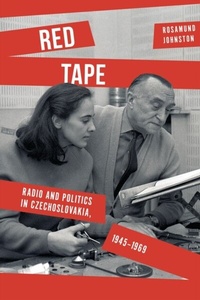
In socialist Eastern Europe, radio simultaneously produced state power and created the conditions for it to be challenged. As the dominant form of media in Czechoslovakia from 1945 until 1969, radio constituted a site of negotiation between Communist officials, broadcast journalists, and audiences. Listeners' feedback, captured in thousands of pieces of fan mail, shows how a non-democratic society established, stabilized, and reproduced itself. In Red Tape, historian Rosamund Johnston explores the dynamic between radio reporters and the listeners who liked and trusted them while recognizing that they produced both propaganda and entertainment.
Red Tape rethinks Stalinism in Czechoslovakia-one of the states in which it was at its staunchest for longest-by showing how, even then, meaningful, multi-directional communication occurred between audiences and state-controlled media. It finds de-Stalinization's first traces not in secret speeches never intended for the ears of "ordinary" listeners, but instead in earlier, changing forms of radio address. And it traces the origins of the Prague Spring's discursive climate to the censored and monitored environment of the newsroom, long before the seismic year of 1968. Bringing together European history, media studies, cultural history, and sound studies, Red Tape shows how Czechs and Slovaks used radio technologies and institutions to negotiate questions of citizenship and rights.
All prices
More details
Other editions
Additional editions


Person
Content
- Cover
- Title page
- Copyright
- Dedication
- Contents
- List of Figures
- Acknowledgments
- List of Abbreviations
- Introduction
- 1. The Radio Revolution
- 2. "The Brain Becomes a Phonograph Playing a Disc over Which It Has No Control" Show Trials and Stalinist Radio
- 3. When Travelogues Became News The Africa Reporting of Frantisek Foit, Jirí Hanzelka, and Miroslav Zikmund, 1947-1952
- 4. De-Stalinization Disturbs Listening
- 5. Listening in on the Neighbors The Reception of German and Austrian Radioin Cold War Czechoslovakia
- 6. Spring in the Air? Czechoslovak Radio's Foreign Correspondents, 1958-1968
- 7. All Together Now? Czechoslovak Radio during the Prague Springand Warsaw Pact Invasion in 1968
- Conclusion: From Socialist Media to Social Media
- Notes
- Bibliography
- Index
- Back Cover

System requirements
File format: ePUB
Copy protection: Adobe-DRM (Digital Rights Management)
System requirements:
- Computer (Windows; MacOS X; Linux): Install the free reader Adobe Digital Editions prior to download (see eBook Help).
- Tablet/smartphone (Android; iOS): Install the free app Adobe Digital Editions or the app PocketBook before downloading (see eBook Help).
- E-reader: Bookeen, Kobo, Pocketbook, Sony, Tolino and many more (not Kindle).
The file format ePub works well for novels and non-fiction books – i.e., „flowing” text without complex layout. On an e-reader or smartphone, line and page breaks automatically adjust to fit the small displays.
This eBook uses Adobe-DRM, a „hard” copy protection. If the necessary requirements are not met, unfortunately you will not be able to open the eBook. You will therefore need to prepare your reading hardware before downloading.
Please note: We strongly recommend that you authorise using your personal Adobe ID after installation of any reading software.
For more information, see our ebook Help page.
File format: PDF
Copy-Protection: Adobe-DRM (Digital Rights Management)
System requirements:
- Computer (Windows; MacOS X; Linux): Install the free reader Adobe Digital Editions prior to download (see eBook Help).
- Tablet/smartphone (Android; iOS): Install the free app Adobe Digital Editions or the app PocketBook before downloading (see eBook Help).
- E-reader: Bookeen, Kobo, Pocketbook, Sony, Tolino and many more (only limited: Kindle).
The file format PDF always displays a book page identically on any hardware. This makes PDF suitable for complex layouts such as those used in textbooks and reference books (images, tables, columns, footnotes). Unfortunately, on the small screens of e-readers or smartphones, PDFs are rather annoying, requiring too much scrolling.
This eBook uses Adobe-DRM, a „hard” copy protection. If the necessary requirements are not met, unfortunately you will not be able to open the eBook. You will therefore need to prepare your reading hardware before downloading.
Please note: We strongly recommend that you authorise using your personal Adobe ID after installation of any reading software.
For more information, see our eBook Help page.
File format: PDF
Copy protection: Watermark-DRM (Digital Rights Management)
System requirements:
- Computer (Windows; MacOS X; Linux): Use the free software Adobe Reader, Adobe Digital Editions, or any other PDF viewer of your choice (see eBook Help).
- Tablet/Smartphone (Android; iOS): Install the free app Adobe Digital Editions or another reading app for eBooks, e.g., PocketBook (see eBook Help).
- E-reader: Bookeen, Kobo, Pocketbook, Sony, Tolino and many more (only limited: Kindle).
The file format PDF always displays a book page identically on any hardware. This makes PDF suitable for complex layouts such as those used in textbooks and reference books (images, tables, columns, footnotes). Unfortunately, on the small screens of e-readers or smartphones, PDFs are rather annoying, requiring too much scrolling.
This eBook uses Watermark-DRM, a „soft” copy protection. This means that there are no technical restrictions to prevent illegal distribution. However, there is a personalised watermark embedded in the eBook that can be used to identify the purchaser of the eBook in the event of misuse and to provide evidence for legal purposes.
For more information, see our eBook Help page.
