

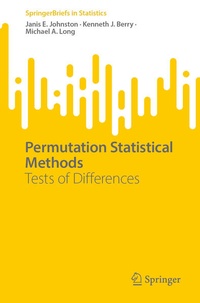
Permutation Statistical Methods
Description

The primary purpose of this book is to introduce the reader to elementary statistical methods as related to tests of differences, such as one-sample tests, tests of two independent samples, tests of two matched samples, and one-way analysis of variance. Throughout the book the emphasis is on permutation statistical methods, although the results of the permutation analyses are always compared and contrasted with the results of conventional statistical analyses. Unlike classical statistical methods, permutation statistical methods do not rely on theoretical distributions, avoid the usual assumptions of normality and homogeneity, depend only on the observed data, and do not require random sampling. The book is designed for an audience with limited statistical background and can easily serve as a supplementary textbook in an undergraduate or graduate course in departments such as statistics, psychology, economics, or biology. In particular, the audience for this book is quantitative undergraduate and graduate students in fields such as psychology, sociology, biology and political science. No statistical training beyond a first course in statistics is required.
More details
Other editions
Additional editions
Persons
Kenneth J. Berry is Professor Emeritus in the Department of Sociology at Colorado State University. His specialties are quantitative methods permutation statistics. He is the author of ten books and more than 180 journal articles, primarily in the areas of statistics and quantitative research methods.
Janis E. Johnston is an Affiliate Faculty member in the Department of Sociology at Colorado State University. She is the author of nine books and more than 40 journal articles, primarily in the areas of statistics and quantitative research methods.
Michael A. Long is Professor in the Department of Sociology at Oklahoma State University. He is the author of six books and over 100 journal articles and book chapters, primarily in the areas of environmental sociology, green criminology, and quantitative methodology. He is the past editor of Sociological Quarterly and is the present editor of Social Problems.
Content
1. Introduction.- 2. Permutation Methods.- 3.Analysis of One-Sample Data.- 4.Analysis of Two-Sample Data.- 5.Analysis of Matched-Pairs Data.- 6. Analysis of Multi-Sample Data.- Reference.- Author Index.- Subject Index.
