

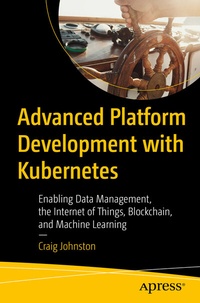
Advanced Platform Development with Kubernetes
Description

Leverage Kubernetes for the rapid adoption of emerging technologies. Kubernetes is the future of enterprise platform development and has become the most popular, and often considered the most robust, container orchestration system available today. This book focuses on platforming technologies that power the Internet of Things, Blockchain, Machine Learning, and the many layers of data and application management supporting them.
Advanced Platform Development with Kubernetes takes you through the process of building platforms with these in-demand capabilities. You'll progress through the development of Serverless, CICD integration, data processing pipelines, event queues, distributed query engines, modern data warehouses, data lakes, distributed object storage, indexing and analytics, data routing and transformation, query engines, and data science/machine learning environments. You'll also see how to implement and tie together numerous essential and trending technologies including: Kafka, NiFi, Airflow, Hive, Keycloak, Cassandra, MySQL, Zookeeper, Mosquitto, Elasticsearch, Logstash, Kibana, Presto, Mino, OpenFaaS, and Ethereum.
The book uses Golang and Python to demonstrate the development integration of custom container and Serverless functions, including interaction with the Kubernetes API. The exercises throughout teach Kubernetes through the lens of platform development, expressing the power and flexibility of Kubernetes with clear and pragmatic examples. Discover why Kubernetes is an excellent choice for any individual or organization looking to embark on developing a successful data and application platform.
What You'll Learn
- Configure and install Kubernetes and k3s on vendor-neutral platforms, including generic virtual machines and bare metal
- Implement an integrated development toolchain for continuous integration and deployment
- Use data pipelines with MQTT, NiFi,Logstash, Kafka and Elasticsearch
- Install a serverless platform with OpenFaaS
- Explore blockchain network capabilities with Ethereum
- Support a multi-tenant data science platform and web IDE with JupyterHub, MLflow and Seldon Core
- Build a hybrid cluster, securely bridging on-premise and cloud-based Kubernetes nodes
Who This Book Is For
System and software architects, full-stack developers, programmers, and DevOps engineers with some experience building and using containers. This book also targets readers who have started with Kubernetes and need to progress from a basic understanding of the technology and "Hello World" example to more productive, career-building projects.
More details
Other editions
Additional editions
Person
Craig has helped lead his team to significantly improved productivity and return on investment across many client projects; leveraging Kubernetes, Docker, Golang, Cassandra, Kafka and Elastic to name a few. The team and he are developing more productive, stable, clean and faster applications than ever in the past, and the results are beautiful and innovative IoT management systems, IoT implementations, mobile applications, business intelligence, data management and machine learning platforms.
As the former Director of R&D at Napster and later a hand full of Universal and Sony subsidiaries, Craig has been fortunate to spend many of my early days on the bleeding edge, in the open green fields of new media and disruptive technology.
Craig is successfully operating multiple commercial Kubernetes platforms utilizing nearly all the technology and concepts proposed in Platform Development with Kubernetes. Over the next 8-12 months he will be developing the next iteration of these concepts for a number of clients. Platform Development with Kubernetes will be based on successful real-world systems currently in development and production.
Content
Chapter 1: Software Platform and the API.- Chapter 2: DevOps Infrastructure.- Chapter 3: Development Environment.- Chapter 4: In Platform CI/CD.- Chapter 5: Pipeline.- Chapter 6: Indexing and Analytics.- Chapter 7: Data Lakes.- Chapter 8: Data Warehouses.- Chapter 9: Routing and Transformation.- Chapter 10: Platforming Blockchain.- Chapter 11: Platforming AIML.
