

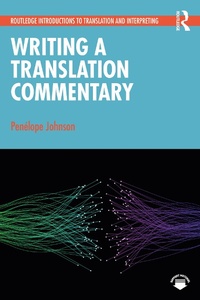
Writing a Translation Commentary
1st Edition
Published on 5. December 2023
244 pages
978-1-003-80401-7 (ISBN)
Description

This essential textbook is a step-by-step guide to how to write a self-reflective translation commentary, a key requirement of most courses on translation.
Starting with source text analysis, it guides students in how to set out a translation strategy and goes through the most common challenging issues encountered, thus enabling students to set out their translation priorities in an informed manner. Throughout each chapter, there are boxes summarising key concepts and suggestions of tasks and activities, as well as recommendations for further reading. The book is supplemented by online resources for students and teachers on the translation studies portal. There are nine PowerPoints based on the chapters of the book that could be used for teaching or self-study. There are also downloadable versions of sample assessment rubrics, tables for example selection, and checklists. Based on real life examples of students' work in different language combinations, drawing on the author's years of experience of teaching commentary writing, this book focuses on several types of language mediation that go beyond the written word, such as interpreting, audiovisual translation, localisation, and transcreation.
This is a vital textbook for students writing commentaries on translation and interpreting courses, a useful resource for supervisors providing students with guidance on how to write a balanced, articulate, and convincing commentary and a handy reference for professional translators and interpreters needing to explain their translation decisions to clients.
Starting with source text analysis, it guides students in how to set out a translation strategy and goes through the most common challenging issues encountered, thus enabling students to set out their translation priorities in an informed manner. Throughout each chapter, there are boxes summarising key concepts and suggestions of tasks and activities, as well as recommendations for further reading. The book is supplemented by online resources for students and teachers on the translation studies portal. There are nine PowerPoints based on the chapters of the book that could be used for teaching or self-study. There are also downloadable versions of sample assessment rubrics, tables for example selection, and checklists. Based on real life examples of students' work in different language combinations, drawing on the author's years of experience of teaching commentary writing, this book focuses on several types of language mediation that go beyond the written word, such as interpreting, audiovisual translation, localisation, and transcreation.
This is a vital textbook for students writing commentaries on translation and interpreting courses, a useful resource for supervisors providing students with guidance on how to write a balanced, articulate, and convincing commentary and a handy reference for professional translators and interpreters needing to explain their translation decisions to clients.
More details
Series
Edition
1. Auflage
Language
English
Place of publication
London
United Kingdom
Publishing group
Taylor & Francis Ebooks
Target group
College/higher education
Professional and scholarly
Product notice
Reflowable
Illustrations
8 Tables, black and white
ISBN-13
978-1-003-80401-7 (9781003804017)
Copyright in bibliographic data and cover images is held by Nielsen Book Services Limited or by the publishers or by their respective licensors: all rights reserved.
Schweitzer Classification
Other editions
Additional editions
Penelope Johnson
Writing a Translation Commentary
Book
12/2023
1st Edition
Routledge
€206.40
Shipment within 10-20 days
Penelope Johnson
Writing a Translation Commentary
Book
12/2023
1st Edition
Routledge
€61.30
Shipment within 10-20 days
Person
Penelope Johnson is an Associate Professor in the School of Modern Languages and Cultures at Durham University. She is currently the co-director of the MA in Translation Studies at Durham University. She has published articles on poetry translation, translating multilingual texts, and translator training. She has recently translated into Spanish the fact-based novel by Kim Kupperman (2018), Five Thousand Miles to Home.
Content
Introduction
PART I - Before translating: the big picture
Source Text Analysis
Statement of Translation Strategy
PART II - While translating: the specifics
Selecting Illustrative Examples
Writing your Commentary
Writing your Commentary in Practice
PART III - Beyond the written word
Writing a Reflective Report for Interpreting
Writing a Reflective Report for Audiovisual Translation, Localisation and Transcreation
Conclusion
PART I - Before translating: the big picture
Source Text Analysis
Statement of Translation Strategy
PART II - While translating: the specifics
Selecting Illustrative Examples
Writing your Commentary
Writing your Commentary in Practice
PART III - Beyond the written word
Writing a Reflective Report for Interpreting
Writing a Reflective Report for Audiovisual Translation, Localisation and Transcreation
Conclusion
