

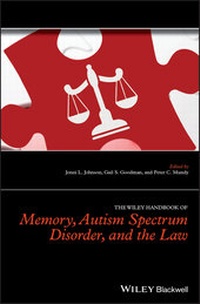
The Wiley Handbook of Memory, Autism Spectrum Disorder, and the Law
Description

An Important Contribution to Understanding Autobiographical and Eyewitness Memory in Those with ASD and the Unique Legal Challenges They Present
This book offers an in-depth discussion of how autobiographical and eyewitness memory operate in individuals with Autism Spectrum Disorder (ASD) and provides unique insights into current challenges faced by legal professionals, forensic psychologists, clinicians, and others who extend services to those with ASD. Throughout the book, authors demonstrate why a nuanced understanding of autobiographical and eyewitness memory is required when assessing individuals with ASD, given the developmental, social, and cognitive deficits at play. Authors review current legal services and structures, and explore ideas on whether and how modifications can be made to meet the needs of all individuals who seek and deserve justice, including individuals with ASD.
The Wiley Handbook of Memory, Autism Spectrum Disorder, and the Law is sure to spark debate within the mental health and legal communities, while advancing knowledge on the role of key clinical features of ASD in autobiographical and eyewitness memory. The book is distinct in its exploration of ways in which the legal system, with its formal yet inherently social infrastructure and regulated due process demands, should offer services to those with ASD. Of note, authors question if current policies and practices, such as reliance on interviewing protocols standardized for typically developing individuals, are adequate. The book is divided into three sections with the first providing a discussion of theoretical viewpoints on how memory functions in those with and without ASD, and providing a specialized consideration of developmental issues. A second section reviews empirical evidence, followed by a third and final section addressing legal and clinical considerations, including techniques for interviewing individuals with ASD.
- The first book offering an expert, science-based review of autobiographical and eyewitness memory research on those with ASD and the associated legal challenges
- Provides thought-provoking, informative, often debated observations on memory in ASD from an international team of experts
- Offers summaries of what is known about memory abilities in those with ASD as well as what is left unknown that future researchers will need to address and that legal professionals should consider.
A book that does much to advance the research frontier in the study of memory in ASD and application to the legal system, The Wiley Handbook of Memory, Autism Spectrum Disorder, and the Law is important reading for academic researchers, clinicians, judges, jurors, law enforcement officials, and public policy makers alike.
More details
Other editions
Additional editions
Persons
Jonni L. Johnson, MA, is an advanced researcher and doctoral candidate at the Developmental Research Center, Department of Psychology, University of California, Davis.
Gail S. Goodman, PhD, is Distinguished Professor in the Department of Psychology of the University of California, Davis. Professor Goodman is recognized as pioneering the scientific study of child witnesses in the legal system. She has received many awards for her writings and contributions to research. Her work has been cited repeatedly by the US Supreme Court.
Peter C. Mundy, PhD, is Director of Educational Research at the University of California, Davis MIND Institute and Professor in both the School of Education and Department of Psychiatry and Behavioral Sciences at the University of California, Davis, where he also holds the Lisa Capp Endowed Chair in Neurodevelopment and Education.
Content
Notes on Contributors vii
Autism Spectrum Disorder, Memory, and the Legal System: Knowns and Unknowns 1
Jonni L. Johnson, Gail S. Goodman, and Peter C. Mundy
Part I Autobiographical Memory Theories and Autism Spectrum Disorder 9
1 A Relational Processing Framework of Memory in Autism Spectrum Disorder 11
Sebastian B. Gaigg and Dermot M. Bowler
2 Autobiographical Memory in Autism Spectrum Disorder through the Lens of Fuzzy Trace Theory 27
Haylie L. Miller, Timothy N. Odegard, and Valerie Reyna
3 Executive Function and Complex Processing Models 53
Diane L. Williams
4 The Self in Autism and Its Relation to Memory 70
Sophie E. Lind, David M. Williams, Catherine Grainger, and Julia Landsiedel
5 Autobiographical Memory and Theory of Mind in Autism Spectrum Disorder 92
Céline Souchay, Matilda Ohlsson, and Tiziana Zalla
6 Autism Spectrum Disorders and Autobiographical Memory in the Forensic Setting 107
Henry V. Soper, Irina Zilberfayen, and Arthur MacNeill Horton, Jr.
Part II From Autobiographical Memory to Eyewitness Memory: Empirical Findings and Methodological Assessments 123
7 Development of Autobiographical Memory in Autism Spectrum Disorders 125
Lorna Goddard
8 General Memory Abilities for Autobiographical Events in Adults with Autism Spectrum Disorder 146
Laura Crane and Katie L Maras
9 Eyewitness Memory Abilities in Typically Developing Children 179
Yoojin Chae, Sue D. Hobbs, and Daniel Bederian]Gardner
10 Perceptual, Cognitive, and Social Foundations of Eyewitness Identifications: Why Do Identifications Go Wrong? 196
Emily F. Wood and Deborah Davis
11 Eyewitness Memory in Children with Autism Spectrum Disorder 214
Michael Carlin
Part III Investigative Tools and Legal Application 229
12 Interactions of Individuals with Autism Spectrum Disorder with the Criminal Justice System: Influences on Involvement and Outcomes 231
Neil Brewer and Robyn L. Young
13 The Cognitive Interview and Its Use for People with Autism Spectrum Disorder: Can We Create an ASD Friendly Version? 245
Joanne Richards and Rebecca Milne
14 Narrative Elaboration Technique 270
Lorinda B. Camparo, Ambar Guzman, and Karen J. Saywitz
15 Interviewing Children with Autistic Spectrum Disorder: The NICHD Protocol and Ten]Step Investigative Interview 292
Lindsay C. Malloy, Allison P. Mugno, and Andrea Arndorfer
16 Clinical and Forensic Interviewing of Children and Adults with Autism Spectrum Disorder: Strategies for Improving Eyewitness Memory Reports 311
Elisa Krackow
17 Children with Autism Spectrum Disorder in the Courtroom: How Courts Handle Testimony Today and What We Can Do in the Future 340
Deborah Goldfarb and Alejandra Gonzalez
Index
Notes on Contributors
Andrea Arndorfer is Assistant Professor of Criminology at California State University, Fresno. She received her Ph.D. in Psychology from Florida International University in 2016. Her research interests center on various topics at the intersection of psychology and the law such as criminal interrogation and confessions, eyewitness memory, and the social and cognitive factors influencing lineup identification decisions and post-decision judgments.
Daniel Bederian-Gardner, Ph.D., graduated from the University of California, Davis, studying various issues relating to children's involvement as witnesses in the legal system, such as the interplay of children's moral development and testimony. He has studied and authored chapters about characteristics of child witnesses that influence judgments of their credibility. Dr. Bederian-Gardner has also conducted research on true and false memory across development. He is currently addressing the impact of foster care on mental health outcomes.
Dermot M. Bowler graduated from Trinity College Dublin in 1976 and gained his Ph.D. from the University of London in 1986. After working at the Thomas Coram Research Unit, and subsequently, with Dr. Lorna Wing at the Medical Research Council, he joined City, University of London in 1990. At City, he set up the Autism Research Group and currently holds the position of Professor of Psychology. He has also held an adjunct professorship at McGill University, Montreal, as well as a European Union-funded visiting chair at the University of Caen and the French National Institute for Medical and Health Research (INSERM). His research interests center on the neuropsychology of memory across the lifespan in individuals with autism spectrum disorders.
Neil Brewer, Ph.D., is the Matthew Flinders Distinguished Professor of Psychology at Flinders University, South Australia. He is an experimental psychologist with broad interests in the psychology-law area, including eyewitness identification and reporting, determinants of testimonial credibility, and cognitive and social characteristics that may contribute to naive involvement in criminal activity by ASD individuals. He is on the editorial boards of Law and Human Behavior and Psychology, Public Policy and Law, and has served on the editorial boards of all of the major psychology-law journals. Professor Brewer is just completing his term as Editor of the Journal of Experimental Psychology: Applied.
Lorinda B. Camparo, Ph.D., is Professor in the Department of Psychological Sciences at Whittier College, where she has taught and conducted research on enhancing children's narrative reports since 1997. Dr. Camparo has published numerous articles and book chapters, and recently co-authored the book Evidence-based child forensic interviewing: The Developmental Narrative Elaboration Interview (Oxford University Press, 2014) with Dr. Karen Saywitz. Dr. Camparo has also conducted workshops on interviewing children for lawyers, judges, police officers, and social workers, and she has served as an expert witness on cases involving children alleging sexual abuse.
Michael Carlin, Ph.D., attended Peabody College of Education and Human Development of Vanderbilt University for his graduate training, and worked with Dr. Sal Soraci and Dr. Alan Baumeister at the John F. Kennedy Center. Upon graduation, he moved to Massachusetts to work at the Eunice Kennedy Shriver Center from 1994 to 2007. He then accepted a faculty position at Rider University, where he teaches courses in Cognitive and Developmental Disabilities, Statistics, and Cognitive Psychology.
Yoojin Chae, Ph.D., is Assistant Professor in Human Development and Family Studies at Texas Tech University. Her research focuses on children's abilities as witnesses, including children's eyewitness memory and suggestibility, trauma and memory, attachment and memory, language and memory, forensic interview techniques, and adults' evaluations of children's autobiographical memory. She received her doctorate in human development from Cornell University.
Laura Crane, Ph.D., is Senior Teaching and Engagement Fellow at the Centre for Research in Autism and Education (CRAE) at the University College London Institute of Education in the United Kingdom. Dr. Crane completed her undergraduate and postgraduate training in Psychology at Goldsmiths, University of London, before taking postdoctoral research positions at City, University of London and Goldsmiths, University of London. Dr. Crane's research focuses on supporting children and adults on the autism spectrum within the criminal justice system as well as exploring the educational and healthcare experiences of autistic adults, parents of children on the autism spectrum, and professionals working in the field of autism.
Deborah Davis, Ph.D., is Professor of Psychology at the University of Nevada, Reno, and a member of the faculty of the National Judicial College. She has published widely in the areas of witness memory, police interrogation and confessions, communicating and understanding sexual intentions, and other areas as well. She worked for more than 20 years as a trial consultant, has testified as an expert witness in close to 150 trials, and is a frequent speaker at Continuing Legal Education seminars across the country.
Sebastian B. Gaigg, Ph.D., joined the Autism Research Group at City, University of London in 2001 and has since then pursued two primary research interests. One strand of his work focuses on understanding learning and memory processes across the autism spectrum, with projects ranging from the examination of episodic memory in autistic adults who live relatively independent lives to studies of basic learning processes in young autistic children who have very significant language and intellectual impairments. His second strand of work seeks to develop a better understanding of the emotional lives of individuals with autism, particularly concerning the mechanisms underlying the unusually high prevalence of anxiety disorders in this population.
Lorna Goddard, Ph.D., is a senior lecturer at Goldsmiths, University of London. She has published over 20 articles and chapters related to theoretical research on autobiographical memory in autism. She is also a registered cognitive behavior therapist involved in researching and delivering intervention service for individuals with autism spectrum disorder.
Deborah Goldfarb, J.D., is a developmental psychology doctoral candidate at the University of California, Davis. Prior to attending graduate school, Deborah worked as an attorney, including two years as a law clerk to a federal district court judge. She graduated cum laude with a Juris Doctor degree from the University of Michigan Law School and a Bachelor of Science degree in Psychology from the University of Illinois, Urbana-Champaign. She has published research on children's legal involvement in law reviews, books, and journals, and has presented this work internationally.
Alejandra Gonzalez is a researcher at the University of California, Davis, currently conducting studies on trauma and memory. She received a Bachelor of Arts degree in Psychology and a Bachelor of Science degree in Genetics and Genomics from the University of California, Davis, and she has published about the topic of child suggestibility in the courtroom. Her interests include trauma-related psychopathology as well as challenges faced by disadvantaged populations in the legal system.
Gail S. Goodman, Ph.D., is Distinguished Professor of Psychology at the University of California, Davis. Her research concerns such topics as children's and adults' eyewitness memory, child maltreatment, forensic interviewing, victimization, legal involvement, and trauma and memory. She has served as President of several divisions of the American Psychological Association (e.g., Developmental Psychology, American Psychology-Law Society, Child and Family Policy and Practice). She is internationally known for her research on victims and witnesses, which has been cited multiple times by the U.S. Supreme Court. Dr. Goodman has published widely and received numerous national awards and grants for her research and writings.
Catherine Grainger, Ph.D., is a lecturer at the University of Stirling. Her research focuses on understanding the nature of autism spectrum disorder. In particular, she is interested in understanding self-awareness, theory of mind, and memory in autism.
Ambar Guzman, ACSW, is a clinical social worker and recent graduate of the University of California Los Angeles, where she was also a trainee for the University of California Leadership Education in Neurodevelopmental and Other Related Disabilities (UC-LEND). She worked as a therapist for adolescents, and then most recently, transitioned to serving the community as a medical social worker. Her experience in the forensic interviewing field includes her past work as the project director of a child interviewing lab and serving as a bilingual forensic interviewer for a local Children's Advocacy Center.
Sue D. Hobbs, Ph.D., is a developmental psychologist, Assistant Professor at Sacramento State University in the Child Development Area of the College of Education, and a member of the American Psychological Association Division 7 (Developmental Psychology) Executive Committee. Her research focuses on two key areas of child development as they relate to child victims and witnesses:...
