

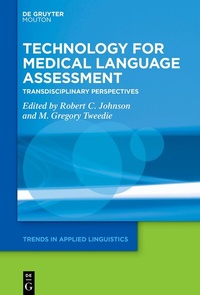
Technology for Medical Language Assessment
Transdisciplinary Perspectives
1st Edition
Published on 6. May 2025
VI, 153 pages
978-3-11-079332-1 (ISBN)
Description

This volume presents research that lies at the intersection of healthcare communication, global migration, and the rapidly expanding technologies used for language testing. Readers will find engagement with the interdisciplinary studies, given that effective communication - and its assessment - lies at the very core of quality healthcare delivery.
More details
Series
Language
English
Place of publication
Berlin/Boston
Germany
Publishing group
de Gruyter Mouton
Target group
Professional and scholarly
US School Grade: College Graduate Student
Illustrations
9 s/w Abbildungen, 20 s/w Tabellen, 6 farbige Abbildungen
9 b/w and 6 col. ill., 20 b/w tbl.
File size
3,75 MB
ISBN-13
978-3-11-079332-1 (9783110793321)
Schweitzer Classification
Other editions
Additional editions
Robert C. Johnson | M. Gregory Tweedie
Technology for Medical Language Assessment
Transdisciplinary Perspectives
E-Book
05/2025
1st Edition
De Gruyter Mouton
€109.95
Available for download
Robert C. Johnson | M. Gregory Tweedie
Technology for Medical Language Assessment
Transdisciplinary Perspectives
Book
05/2025
1st Edition
De Gruyter Mouton
€109.95
Shipment within 5-7 days
Persons
Content
- Intro
- Contents
- Assessing language and communication ability of healthcare professionals: Current technological and societal trends - an introduction
- 1 Impetus for this book
- 2 Defining technology
- 3 Book sections and chapters
- 4 Conclusion
- References
- Section 1: Technology for medical language assessment: AI and machine learning
- Artificial Intelligence for improving medical communication: Envisioning a healthcare communication training technology ecosystem
- 1 Introduction: Just when you thought it was safe to go back to the hospital ...
- 1.1 Language and cultural barriers in zones of multilingual and multicultural medical contact
- 2 The shift: Patient-Centred Care and intercultural competence for healthcare communication
- 3 Communication and medical errors
- 4 Defining empathy and compassion
- 5 Defining (nursing) intercultural competency as an element of patient-centred care
- 6 Defining artificial intelligence (AI) and machine learning (ML) in healthcare
- 7 ML assessment of EC-IC
- 7.1 Current limitations in assessing and improving EC-IC in healthcare communication
- 7.2 AI assessment of medical communication
- 7.3 An AI ecosystem for healthcare communication teaching, learning, assessment and research
- 8 Case Study 1: Audio - verbal input only - mobile application - empathy / compassion
- 8.1 Case Study 2: Video - verbal and non-verbal input - simulation - intercultural competence
- 8.2 Case study 3: Audio/video - researchers - empathy
- 9 Conclusion
- References
- Assessing reflective writing of medical students using Natural Language Processing approaches
- 1 Introduction
- 1.1 Benefits and challenges of reflection writing in medical education
- 2 Methods
- 2.1 Medical reflection corpora
- 2.2 Evaluating the topic representation of the narrative writing
- 2.2.1 Qualitative coding process
- 2.2.2 Quantitative coding using NLP
- 2.3 Evaluating the writing styles of the reflection writing
- 3 Results
- 3.1 Reflection writing topic identification
- 3.1.1 Confirming the existing topics
- 3.1.2 Newly emerging topics related to "Challenges"
- 3.2 Evaluation of topic diversity in reflection writing
- 3.3 Evaluation of writing styles in reflection writing
- 4 Conclusion and discussion
- 4.1 Implications for undergraduate medical education
- Appendix A:Quantitative coding process results
- References
- Overcoming the bias of English as the universal scientific language in a technological age - specific challenges for nursing scholars
- 1 Introduction
- 2 Background
- 2.1 The hegemony of English
- 2.2 Challenges related to perspectives
- 2.3 Political and socio-cultural factors
- 2.4 English language as a career requirement
- 2.5 Problems writing in English as a second language
- 2.6 Style, meaning and supporting the emerging argument
- 2.7 Supporting English language for academic writing
- 2.8 Assistive technology support
- 2.9 Assistive technology for non-native English-speaking academics in healthcare
- 3 Conclusion
- References
- Section 2: Technology for medical language assessment: Mathematical modeling and data visualization
- Mapping medical communication assessments: Prescribing Rasch measurement technology as a tool for visualizing evaluations
- 1 Introduction: assessment challenges
- 2 Limitations of current assessment approaches
- 3 Addressing these limitations with modern measurement
- 4 Instrument and map: Rasch measurement and visual communication
- 5 Rasch measurement
- 5.1 Constructing measures
- 5.2 Transforming ordinal level data
- 5.3 An interval scale measurement ruler
- 5.4 Mapping for assessment
- 5.5 Item banking
- 6 Rasch technology rationale
- 7 Conclusion: changes are long overdue
- References
- Section 3: Technology for medical language assessment: Online delivery platforms for testing and education
- Designing tech-enhanced medical English class with a focus on healthcare communication
- 1 Introduction
- 2 Background
- 3 Methods
- 3.1 Defining design parameters
- 3.2 Formulating the course rationale
- 3.3 Framing the instructional design
- 3.4 Determining the course content
- 3.5 Conceptualizing the content: Focus on healthcare communication
- 3.6 Determining goals and objectives
- 3.7 Organizing the syllabus and clarifying the intersection of educational technology, healthcare communication and language assessment
- 3.8 Enhancing thesuggested EMP course with technology
- 3.8.1 Monitoring the medical students' progress: the intersection of healthcare communication, language assessment and educational technology
- 3.9 Introducing the courseware to the lecturers
- 3.10 Delivery of the tech-enhanced courseware
- 3.11 Training and orientation meetings
- 3.12 Getting started: piloting of the suggested course
- 4 Concluding remarks
- References
- Language assessment at the intersection of nursing communicative competence and technology
- 1 CELBAN: Canada's Nursing Language Exam
- 2 Technology
- 2.1 Scan of Computer-Based Testing (CBT) platforms
- 2.2 Designing on the platform
- 2.3 Test security
- 3 CELBAN's transition to online delivery - the LRW test
- 3.1 General test modifications
- 3.2 Listening and reading task analysis
- 4 CELBAN's transition to online delivery - the Speaking interview
- 4.1 Preliminary Research and Modelling
- 4.2 Proof of concept
- 4.3 A new examiner model
- 4.3.1 Exploring single examiner interviews
- 4.3.2 Examiner training
- 4.4 Identifying and trialling the technology
- 4.4.1 Requirements
- 4.4.2 Dry run
- 5 Custom versus Off-the-Shelf options for rating and generating results
- 5.1 Custom applications
- 5.2 Rating options
- 5.2.1 Exploring speaking rating options
- 5.2.2 Customised interface for scoring the interview
- 5.2.3 Rating the Writing test
- 6 Post-pandemic CELBAN: a virtual nursing language exam
- References
- Conclusion
- A tentative glimpse into the future of technology for healthcare language assessment
- References
- Index
