

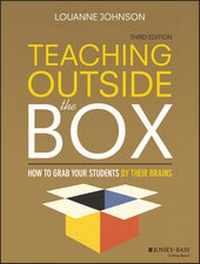
Teaching Outside the Box
Description

Teaching Outside the Box: How to Grab Your Students by Their Brain, Third Edition integrates practical strategies and engaging advice for new and experienced teachers. Whether you are preparing for your first year of teaching or have been working in the classroom for decades, this conversational book provides you with answers to the essential questions that you face as an educator--how to engage students, encourage self-directed learning, differentiate instruction, and create dynamic lessons that nurture critical thinking and strategic problem solving. This updated edition includes expanded material that touches on Project-Based Learning, brain-based teaching, creating smooth transitions, integrating Common Core into the classroom, and other key subject areas. Questions for reflection at the end of each chapter help you leverage this resource in book groups, professional development courses, and in both undergraduate and graduate classes.
The art of teaching is one that evolves with changing educational standards and best practices; to be the most effective teacher possible, daily self-reflection is critical, along with a need to see things from a different perspective. This means we must step outside the box--moving our focus from 'fixing' the students when a problem arises to helping a teacher improve his or her practice.
* Improve classroom management, discipline, motivation, and morale
* Explore strategies for arranging your classroom, engaging students, and avoiding the misbehavior cycle
* Create an environment where students learn and teachers teach
* Leverage insight from teachers and students
Teaching Outside the Box: How to Grab Your Students by Their Brain, Third Edition is an essential resource for teachers at any stage in their careers.
More details
Other editions
Additional editions
Person
Content
The Author xi
Introduction xiii
ONE Dear Teacher: An Open Letter 1
TWO Are You Teacher Material? 5
Super, Excellent, or Good? 7
Earn Some Extra Credit 10
Those Who Can't Teach Can Still Do 12
What Is Teaching All About? 13
THREE Do Your Homework 17
Choose Your Persona 18
Dress the Part 20
Train Your Little Darlings 21
Control Your Classroom, Not Your Students 23
Plan for Bathroom Breaks 25
Your Optional Agenda 27
Face Your Own Prejudices 29
Facing My Own Prejudices 31
Respect Yourself 32
The Gang Thang 35
Grades: Percentage? Curve? Coin Toss? 37
Catch the Cheaters--Or Not? 38
Covering Curriculum Is Not Teaching 43
School Is an Emotional Experience 45
There Is No Such Thing as a Casual Remark to a Child 46
FOUR The Big Three: Preparation, Preparation, Preparation 51
Prepare Your Room 52
Prepare Your Paperwork 71
Prepare Yourself 87
FIVE Start with a Smile 97
Don't Keep Your Distance 99
Choose an Engaging Opener 100
Provide Clear Instructions 102
Grab Your Students by Their Brains 102
No More Teacher Versus Student 104
Teach Your Procedure for Oral Responses 109
Be Prepared for Test the Teacher 110
Create a Daily Do-Now Activity 113
Introduce Students to Each Other 116
Establish Routines and Rituals 118
Take Time to Think 123
Do Some Diagnostics 124
Welcome Handouts and Folders 125
Delegate Some Authority 127
Review Maslow's Hierarchy 128
Introduce Metacognition 130
Show Your Gratitude 133
The Hard Part Is Over--We Hope 133
SIX Discipline Is Not a Dirty Word 135
Define Your Philosophy 137
Punitive or Positive 139
Cowboy Philosophy 141
Rules Versus Procedures 143
Rules for Creating Rules 144
Electronic Intervention 146
ID Your Bullies and Outcasts 148
Characteristics of Successful Discipline Policies 149
Twelve Steps to Better Discipline 158
If You Have to Have Detention, Make ItWorthwhile 166
Keep Records 167
Consult the Experts, Trust Your Instincts 167
Emergency Meltdown Plan 168
SEVEN The Three Rs: Reading, Reading, Reading 177
What's the Problem? 178
What's the Solution? 180
One Teacher's Experience 194
Use Music to Introduce Poetry 195
Shakespeare for Everyone 197
What About Eager Readers? 201
And Now for Something Completely Different 202
EIGHT Light and Learning 205
Light and Reading Linked 207
Better Grades--and Fewer Cavities! 207
Sunnier Classes = Higher Test Scores 208
A Roomwith a ViewImprovesGrades 208
The View from My Room 209
Scoop on Scotopic Sensitivity 211
Signs of Light Sensitivity 213
Feedback from Future Teachers 213
Pass theWord 215
Scientific Support 216
NINE Motivation and Persuasion 219
Group 1: A Little Basic Moto 220
Group 2: Powerful Persuasion Required 234
TEN Foods for Thought 261
A Few Appetizers 262
The Big, Fat Problem 264
Mother's Milk Versus Formula 267
Doctor's Orders 268
Other Major Nutritional Villains 269
We Need to Use Our Noodles 273
ELEVEN Teacher Talk 275
Questions and Answers 276
TWELVE Now the Good News 293
Positive Thinking for Teachers 294
Twenty Years from Now 295
The Flip Side 297
The Posse Update 301
A Personal Movie Review 306
Appendix 309
Index 315
Chapter Two
Are You Teacher Material?
"How can I tell if I'm really teacher material?" a teacher candidate asked me by e-mail. "Can I learn to be a good teacher? Or is it something you have to be born with?" She went on to explain that she had recently abandoned a well-paid position in advertising to pursue her dream of becoming a teacher.
"I know I will make a lot less money as a teacher," she wrote, "and I have accepted that reality, but now I'm wondering what will happen if I get my degree and get a job, and then I hate teaching. What if I find out that I just can't do it? I have a feeling that teaching is going to be very different from being a student teacher or observing experienced teachers. I guess what I'm asking is: Do you have any advice that might help me make the right decision about becoming a teacher?"
To teach or not to teach? is a question that stumps many people. Far too many of us know bright, energetic people who spent five or more years earning a bachelor's degree and teaching credential only to quit after one or two years in the classroom. New teachers give up for a long laundry list of reasons, but the most common complaints include disrespectful and disruptive students, apathetic administrators, overwhelming stacks of paperwork, lunchroom politics, parental pressure and pestering, and mental or emotional exhaustion.
Those complaints are valid. I have to say that I have worked with some excellent administrators, and their support enabled me to be a better teacher. But even with good support, teaching is very demanding and difficult work. Children today suffer from a host of emotional, mental, and physical challenges that affect their behavior and ability to learn. And unfortunately many of their role models encourage them to treat themselves and others with disrespect. Dealing with children requires abundant reserves of patience and tact. An indestructible sense of humor also helps. Government regulations have created a testing and accountability monster that consumes mountains of money, paperwork, time, and energy-and teachers have the task of feeding the monster. The monster is fickle, too, so if last-minute changes upset you, teaching will tax you to the limits of your flexibility. If you don't bend, you will definitely break. Of course, you already know that the pay is atrocious, primarily because people outside of education view teaching as babysitting with books. Thus, if wealth and prestige are important to you, teaching will be a disappointment. And teaching can be physically painful: hours of standing on your feet, bending over to read small print on small desks, and lugging boxes of books and papers to and fro can send you home with tired feet, an aching back, and a heavy heart.
And then there are the students. It might seem facetious to say that you should like children if you plan to teach school, but apparently many people overlook this obvious fact. Every staff lunchroom has at least a few (and most have a large handful of) complainers and groaners who spend their breaks and lunch hours plotting against the enemy, sharing their strategies for revenge, nursing their wounds, and displaying their battle scars. These are not necessarily bad people, but they are people who grew up and immediately forgot their own childhoods. Like people who fall in love with the idea of owning a dog, dreaming of the unconditional love a dog will offer and forgetting that puppies pee on the carpet, vomit on the bath mat, chew your slippers, and poop on the lawn, some would-be teachers envision themselves standing in front of a quiet, orderly classroom, facing a sea of silent, adoring, obedient, angelic little faces. When those angelic faces turn out to belong to noisy, messy, ill-mannered, selfish, and obstinate little stinkers, those teachers go into shock. Some fail to recover. They become bitter, humorless, and overly strict, and they spend the rest of their years in the classroom making themselves and their students miserable by trying to make reality fit their impossible fantasies.
All right, that's the downside of teaching. If you're still reading, still thinking you might like to be a teacher, then you are persistent and optimistic-two very helpful attributes for would-be teachers. And you are right to be hopeful because the upside of teaching is so much bigger and so much more important than the downside.
Teaching is the most wonderful profession in the world. As a teacher, you make a direct, tangible contribution to the future of our country and the world by helping young people acquire knowledge and skills. You know that you are spending your life in an honorable pursuit and that your life has a purpose. Teaching provides endless challenges and opportunities for growth. Every day, teaching tests your interpersonal communications skills, your academic knowledge, or your leadership ability. On a good day, you'll be tested in all three areas, and you'll pass all three tests. You have the opportunity as a teacher to share your passion for learning with young people. If you are a good teacher, you will also inspire, motivate, and challenge those youngsters to develop their individual strengths and talents, and you will feel the incomparable joy when one of them (usually far more than one) realizes how much you have given and makes his or her way back to your classroom to give you a hug and a teary thank-you. And you will cry your own tears. And when you go home, you will share that student's thank-you with your family and friends, and they will all cry a few tears. When you go to bed that night, the last thing you will think before you go to sleep is, I did a fine thing. I helped a child become a successful adult. And that night, you will dream the sweetest dreams.
Super, Excellent, or Good?
Teachers come in three basic flavors-super, excellent, and good. (Of course, there are mediocre teachers and, sadly, terrible teachers. But teaching poorly is not acceptable or excusable, so such practices are not included in this discussion.) Which flavor of teacher you decide to become depends on your personal strengths, intimate relationships, professional goals, and individual priorities. Before you begin teaching, seriously consider how much time and emotional energy you can afford to spend on your work outside the home. Take a long look at your life, your relationships, your financial and emotional obligations, your personal and career goals. If you find it hard to view your own life objectively, discussing your situation with a friend or close relative may improve your perspective. If your sister points out that you like expensive clothes and your husband reminds you that you become impatient and overly critical under stress, for example, you will need to decide whether you are willing to trim your wardrobe and do the hard work required to develop more patience.
Decide what is important to you and which aspects of your life should take priority. Will your children, parents, spouse, or partner feel neglected if you spend some of your free time creating lesson plans or counseling students? How much emotional energy will you need to conserve during the day to have enough left over for your family at night? Will you feel comfortable counseling students about their personal problems, or would you rather leave such things up to their own parents or guardians?
There is no right or wrong answer to these questions, but if you know the answers before you begin teaching, you will be a happier, more successful instructor. Not everybody can or should be a super teacher. It is perfectly acceptable to be an excellent or good teacher.
Super teaching requires the highest amounts of physical, emotional, and mental energy. Super teachers usually arrive at school early and stay late. They also attend seminars and continuing education classes, volunteer for student activities, and make themselves available to students who need extra help, both in and out of the classroom. Because super teachers enjoy a solid rapport with their students, they don't have to focus so much time or energy on discipline in their classrooms. Instead, there is a give-and-take, an ebb and flow, the teaching equivalent of the runner's high that so many athletes find addictive. Unfortunately, unless they are extraordinary people with impressive reserves of natural energy or unless they make an effort to rejuvenate themselves regularly, super teachers may find themselves in danger of burning out.
Super teaching demands huge amounts of physical and mental effort, and depending on your budget it may absorb some money as well. If you are single, childless, and unattached, you may choose to devote the bulk of your energies to teaching for some period of time. However, if you are a single mother with three young children and have a close friend or intimate partner, you may not be willing or able to devote the amount of emotional energy that being a super teacher requires. Having children doesn't disqualify you from becoming a super teacher; it simply means that you will need to make sure that your family understands and supports your teaching. If your children are well-adjusted, self-motivated, and respectful of you and your partner, if your partner supports your career goals, and if you have a high level of energy, then you may be able to handle the stresses involved in super teaching. But don't beat yourself up if you can't be extraordinary. Being an excellent or good teacher is a true achievement.
Excellent...
