

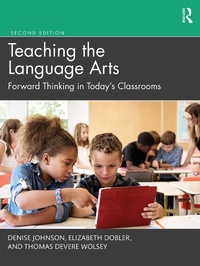
Teaching the Language Arts
Forward Thinking in Today's Classrooms
2nd Edition
Published on 30. September 2022
468 pages
978-1-000-53663-8 (ISBN)
Description

This eBook+ version includes the following enhancements: interactive features and links to the up-to-date Companion Website, with more strategies and examples of practice and student work. This book's unique and engaging voice, supported by its many resources, will help future and in-service teachers bring the language arts to life in their own classrooms.
This book helps readers envision their future classrooms, including the role technology will play, as they prepare to be successful teachers. Comprehensively updated, the second edition addresses new demands on teaching in traditional and virtual ELA classrooms, and the new ways technology facilitates effective instructional practices. Organized around the receptive language arts-the way learners receive information-and the expressive language arts-the way leaners express ideas-chapters cover all aspects of language arts instruction, including new information on planning and assessment; teaching reading and writing fundamentals; supporting ELLs, dyslexic, and dysgraphic learners; using digital tools; and more. In every chapter, readers can explore a rich array of teaching tools and experiences, which allow readers to learn from real-world classrooms.
This book helps readers envision their future classrooms, including the role technology will play, as they prepare to be successful teachers. Comprehensively updated, the second edition addresses new demands on teaching in traditional and virtual ELA classrooms, and the new ways technology facilitates effective instructional practices. Organized around the receptive language arts-the way learners receive information-and the expressive language arts-the way leaners express ideas-chapters cover all aspects of language arts instruction, including new information on planning and assessment; teaching reading and writing fundamentals; supporting ELLs, dyslexic, and dysgraphic learners; using digital tools; and more. In every chapter, readers can explore a rich array of teaching tools and experiences, which allow readers to learn from real-world classrooms.
More details
Edition
2nd edition
Language
English
Place of publication
London
United Kingdom
Publishing group
Taylor & Francis Ltd
Target group
College/higher education
Illustrations
133 Line drawings, black and white; 67 Halftones, black and white; 200 Illustrations, black and white
ISBN-13
978-1-000-53663-8 (9781000536638)
Copyright in bibliographic data and cover images is held by Nielsen Book Services Limited or by the publishers or by their respective licensors: all rights reserved.
Schweitzer Classification
Other editions
Additional editions
Denise Johnson | Elizabeth Dobler | Thomas DeVere Wolsey
Teaching the Language Arts
Forward Thinking in Today's Classrooms
Book
09/2022
2nd Edition
Routledge
€68.50
Shipment within 15-20 days
Denise Johnson | Elizabeth Dobler | Thomas DeVere Wolsey
Teaching the Language Arts
Forward Thinking in Today's Classrooms
Book
09/2022
2nd Edition
Routledge
€179.51
Shipment within 15-20 days
Book
07/2022
Taylor & Francis
Unfortunately, price unknown
Available (delivery time upon request)
Persons
Denise Johnson is Professor and Director of Literacy Leadership at the College of William & Mary, USA.
Elizabeth Dobler is a Literacy professor at The Teachers College at Emporia State University, USA.
Thomas DeVere Wolsey teaches literacy and research courses and supports professional development for teachers worldwide.
Elizabeth Dobler is a Literacy professor at The Teachers College at Emporia State University, USA.
Thomas DeVere Wolsey teaches literacy and research courses and supports professional development for teachers worldwide.
Content
Preface
Chapter 1. Language Arts and Creating a Supportive Learning Space
Chapter 2. Planning and Assessment in the Language Arts
Chapter 3. Reading Fundamentals
Chapter 4. Reading to Enhance Meaning
Chapter 5. Listening and Viewing
Chapter 6. Assessing the Receptive Modes
Chapter 7. Writing as A Process
Chapter 8. Writing Tools for Enhancing Meaning
Chapter 9. Speaking and Visually Representing
Chapter 10. Assessing the Expressive Modes
Chapter 1. Language Arts and Creating a Supportive Learning Space
Chapter 2. Planning and Assessment in the Language Arts
Chapter 3. Reading Fundamentals
Chapter 4. Reading to Enhance Meaning
Chapter 5. Listening and Viewing
Chapter 6. Assessing the Receptive Modes
Chapter 7. Writing as A Process
Chapter 8. Writing Tools for Enhancing Meaning
Chapter 9. Speaking and Visually Representing
Chapter 10. Assessing the Expressive Modes
