

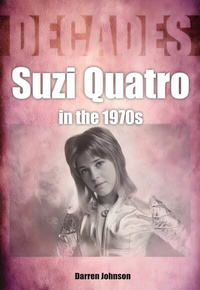
Suzi Quatro
Description

'If you talk about the '70s, I was a hardworking artist. I did nothing but tour - recording, touring, TV, you know. I had constant jetlag. Constant black shadows under my eyes but, oh, what a ride! What a wonderful ride. And I'm still doing it now.' Suzi Quatro
With a succession of hit singles, including eight UK top twenty hits and two number ones, sell-out tours and six studio albums, Suzi Quatro was an enduring presence throughout the 1970s. It was the decade that saw her move away from being part of an all-girl band in Detroit and relocate to England for a solo career that challenged old stereotypes and helped redefine the image of the female rock icon.
Taking each year in turn, this book takes a detailed look at Suzi Quatro's career throughout the decade where she enjoyed her greatest successes, including a comprehensive overview of each album and single released during that period, her touring schedule and her frequent media appearances, including that famous guest role in Happy Days. As well as making extensive use of press archives from the era, Suzi Quatro in The 1970s also includes personal reflections from an exclusive interview with Suzi herself.
A former politician, Darren had previously written for a number of national newspapers but after stepping away from politics, he was able to devote more time to his first love: music. Although a teenager in the 1980s, it was always the music of the previous decade that most captured his imagination. His first book The Sweet in The 1970s was published by Sonicbond in 2021. A keen follower of both rock and folk, he maintains a popular music blog Darren's Music Blog and has reviewed albums and gigs for a variety of publications. He lives in Hastings, East Sussex, UK.
All prices
More details
Other editions
Additional editions
Content
The Early Days
It was an extremely exciting time. I'm very proud of the Detroit pedigree. Musicians from Detroit have an energy level, an edge that's second to none. I don't know why that is.
Interview with Mark Savage for BBC online, October 2017
Born in Detroit on 3 June 1950, Susan Kay Quatro has always been keen to pay homage to her home city's illustrious musical heritage, a music scene that would give the world the likes of Alice Cooper, Iggy Pop, Ted Nugent and Bob Seger, not to mention the wealth of artists who rose to prominence as part of the Motown Records roster. Quatro's links to the Detroit scene were more than just a fleeting association. Even though she was to make her main breakthrough in Britain in the early 1970s, it was as a teenager in the 1960s that she became an intrinsic part of that scene through her membership of The Pleasure Seekers, the all-girl band that Quatro helped form alongside her sisters and school friends. Suzi Quatro's immersion into the world of music and entertainment predates even that, however. Born to an Italian American father and a Hungarian mother, her father played professionally in dance bands in the evening while working at General Motors during the day. 'Life in the Quatro household was very 'showbiz'', recalled Quatro in her 2007 autobiography, Unzipped. 'Every family get-together, from birthdays and Easter to Thanksgiving and Christmas, was an excuse to put on some kind of performance.'
The 'very showbiz' home life would clearly have a profound impact. Suzi Quatro was one of five siblings brought up in Grosse Pointe Woods, a comfortable, mainly white suburb in the north-eastern corner of Detroit, alongside older sisters, Arlene (born in 1941) and Patti (born in 1947); brother, Michael (born in 1943); and younger sister, Nancy, (born in 1953). To varying degrees of success, all five would go on to have careers in music, with her three sisters each performing alongside Suzi at varying points in her early career; while her brother Michael, himself a musician who went on to release eleven albums, also worked as a music promoter and facilitated some life-changing introductions working on behalf of his sisters. A pivotal moment for the young Suzi Quatro was seeing Elvis Presley performing on TV. As she recalls in her autobiography:
I even know the exact date. 6 January 1957. Arlene and I were watching the Ed Sullivan Show, a Sunday night must for the majority of American families. 'Ladies and gentlemen, here he is. Elvis Presley'. Pandemonium broke out and Elvis went into 'Don't Be Cruel'. This moment is forever burned into my psyche - Arlene was screaming, I was mesmerised.
Another pivotal moment would come seven years later with another act that would turn popular music upside down: The Beatles on the Ed Sullivan Show in 1964. To be fair, Quatro always remained more closely aligned with Elvis than The Beatles. 'I was only fifteen when The Beatles happened and I went along with the others and screamed at them but I never felt involved as I did when I first saw Elvis on TV because there was no music to get into. It was everyone screaming around you - I liked their music, but it wasn't the same,' she told Music Scene's Keith Altham in a 1974 interview. Nevertheless, The Beatles' US TV debut was to have a profound impact on Quatro's life and future direction: 'It was a moment that changed our world of music forever,' Quatro recounted in her autobiography. 'The phone rang, and Patti and I raced to separate extensions. It was Marylou and Nan Ball. and they were excited as we were. Then all of a sudden Patti said, 'Hey, why don't we form an all-girl band.''
In the ensuing melee of teenage excitement, roles in the nascent all-girl band were rapidly decided upon, with Nan Ball opting for drums, Nan's younger sister, Marylou Ball, bagging rhythm guitar, and Suzi's older sister, Patti, plumping for lead guitar. Another teenage friend, Diane Baker, was put forward as a candidate for keyboard player, all of which left the young Suzi Quatro wondering what her role would be. 'Suzi, you will play the bass,' was her older sister's response.
Approaching her music-loving father to see if he was able to help provide her with an instrument she could learn to play, he gifted her a 1957 Fender Precision bass. Quatro has always been clear that encouragement from her father in those early days was key to both her and her sisters following a musical path. This was in marked contrast to what many budding musicians of the post-war baby-boomer generation would experience. 'When I talk to other musicians and they start telling me the fights they had, the struggles, I guess I didn't have that. My dad really pushed all of his four daughters to be just who they are,' she told Classic Rock magazine's Ian Fortnam, in a February 2018 interview.
While it may have been a spur of the moment suggestion from an older sister keen to ensure every member of the band had a clear role and a designated instrument, she would never feel any regrets about plumping for bass rather than guitar. In a 2020 interview with Den of Geek's Tony Sokol, Quatro, who had been classically trained as a pianist in her childhood and had been playing percussion since she first joined her father on stage aged eight, was extremely clear: 'I was never going to be a guitar player. Look at the instruments I play. Piano is a percussive instrument. It's listed under percussion. I play the drums, which is percussion. I never played guitar and went to bass. Really, I play enough on guitar to write, but I'm a really crappy guitar player. It's just too tiny for me. I like the big bass.'
Thumbing through a dictionary on the lookout for a band name and alighting on the definition of the word 'hedonist', namely 'one engaged in the pursuit of pleasure', the girls decided this was the perfect inspiration for their newly formed band. The Pleasure Seekers was born. The original line-up was Suzi Quatro (bass and vocals), Patti Quatro (lead guitar and vocals), Marylou Ball (rhythm guitar and vocals) and Nan Ball (drums and vocals). Another friend, Diane Baker, soon joined on keyboards and, although she took some time out of the band in the Autumn of 1965, while she was undertaking her college studies, she was with them when they entered the studio, and this is the line-up that recorded the band's first single.
There had actually been two attempts to record a single in that first year of the band's existence, as The Pleasure Seekers were also approached by producer John Rhys, of Detroit's Golden World Records. The band visited their studios on Davison West in Detroit to lay down two tracks, a cover of The Crystals' 'He's A Rebel', with Marylou Ball on vocals, and an original band composition entitled 'Long White Line', with Suzi Quatro on vocals. Unfortunately, the single was never released and, regrettably, the master tapes have never been located, so 'Never Thought You'd Leave Me' / 'What A Way To Die' gets the distinction of being the first-ever Pleasure Seekers release.
Single Release: The Pleasure Seekers
'Never Thought You'd Leave Me' (Leone / Pleasure Seekers) b/w 'What A Way To Die' (Leone / Pleasure Seekers)
Personnel:
Suzi Quatro: bass guitar, lead vocals
Patti Quatro: lead guitar, vocals
Diane Baker: keyboards
Marylou Ball: guitar, vocals
Nan Ball: drums, lead vocals
Produced at: unnamed home studio in Franklin Park, Detroit, 1965 by David Leone
US release date: February 1966
Highest chart places: Did not chart
After playing a series of gigs at the Hideout Club, located in Harper Woods on the suburban outskirts of Detroit, venue manager, Dave Leone, invited The Pleasure Seekers to record a single which was to be released on his own independent Hideout label. Recorded at a small home studio owned by a member of another local band, the two tracks were co-written by Leone and the band. 'Dave brought lyrics and we put the songs together quickly,' recalled Patti Quatro in the sleeve notes for the What A Way To Die compilation album, first released in 2011.
The A-side, 'Never Thought You'd Leave Me', featuring a lead vocal from the band's drummer, Nan Ball, is an enjoyable enough slice of typical mid-1960s pop. A keyboards and guitar-led track, it features some nice bass lines from the fifteen-year-old Suzi Quatro. The stand-out track, however, is the B-side, 'What A Way To Die'. With a wild, raunchy, power-packed lead vocal from Suzi Quatro and a series of bloodcurdling screams from guitarist Marylou Ball, this is raw, thrilling, and slightly dangerous-sounding garage rock. The song is built around some fairly risqué lyrics, too, all about drinking and youthful hedonistic excess:
Well I may not live past twenty-one
But WOO!
What a way to die!
It is probably not a huge surprise that, compared to the somewhat more anodyne 'Never Thought You'd Leave Me', a bunch of teenage girls belting out a song about partying themselves to death was not deemed suitable A-side material....
