

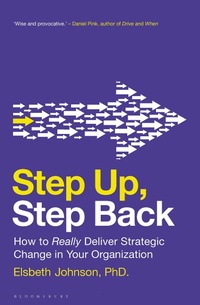
Step Up, Step Back
How to Really Deliver Strategic Change in Your Organization
1st Edition
Published on 20. February 2020
352 pages
978-1-4729-7067-1 (ISBN)
Description

Many strategic change efforts fail. And virtually all of them are harder than they need to be. Why is this? And what can we do to make change more likely to stick?
Dr. Elsbeth Johnson, a former equity analyst and London Business School Professor now teaching at MIT, has spent a decade researching how to deliver strategic change in practice. Based on asking managers what they needed from leaders, rather than just asking leaders what they did, her resulting Step Up, Step Back approach challenges some of our most fundamental beliefs about how to lead change - and indeed, about what we even consider to be 'leadership'.
The Step Up, Step Back approach suggests leaders need to step up and do more than they typically do in the early stages of the change - in specific ways and at specific times; and then step back and do less than they typically do in the later stages of the change - again, in specific ways, at specific times. The result is not only change that sticks, but empowered, motivated managers who can get on with delivering change, without needing ongoing input or cover from leaders. Using real-world examples of how to apply the science in practice, Step Up, Step Back gives you a roadmap for how to deliver strategic change in your organization.
Dr. Elsbeth Johnson, a former equity analyst and London Business School Professor now teaching at MIT, has spent a decade researching how to deliver strategic change in practice. Based on asking managers what they needed from leaders, rather than just asking leaders what they did, her resulting Step Up, Step Back approach challenges some of our most fundamental beliefs about how to lead change - and indeed, about what we even consider to be 'leadership'.
The Step Up, Step Back approach suggests leaders need to step up and do more than they typically do in the early stages of the change - in specific ways and at specific times; and then step back and do less than they typically do in the later stages of the change - again, in specific ways, at specific times. The result is not only change that sticks, but empowered, motivated managers who can get on with delivering change, without needing ongoing input or cover from leaders. Using real-world examples of how to apply the science in practice, Step Up, Step Back gives you a roadmap for how to deliver strategic change in your organization.
More details
Edition
1. Auflage
Language
English
Place of publication
London
United Kingdom
Publishing group
Bloomsbury Publishing PLC
Target group
Professional and scholarly
ISBN-13
978-1-4729-7067-1 (9781472970671)
Copyright in bibliographic data and cover images is held by Nielsen Book Services Limited or by the publishers or by their respective licensors: all rights reserved.
Schweitzer Classification
Other editions
Additional editions
Book
03/2025
Bloomsbury Business
€21.00
Shipment within 10-20 days
Book
02/2020
Bloomsbury Business
€33.00
Article exhausted; check different version
Person
Dr. Elsbeth Johnson is a Senior Lecturer at MIT's Sloan School of Management and a Visiting Fellow at the London School of Economics. Prior to joining MIT, she taught at London Business School for five years, having previously worked as an equity analyst and a corporate strategist. Through her consultancy firm, SystemShift, she works extensively with organizations and their leaders, advising them on strategy, leadership and change. She splits her time between London and Boston.
Content
- Intro
- Title Page
- Copyright Page
- Contents
- Introduction: Why this book is needed
- Why strategic change is harder than it needs to be
- The 'Hollywood' version of leading change: charisma is all you need
- The genesis of this book
- Who can benefit from this book?
- Roadmap for the book
- chapter one
- Chapter 1: The Problem
- The 'Hollywood' version of how to lead change
- The Four Delusions of Leadership that underpin much of what we still believe about how to lead change
- Why the 'Hollywood' version of leadership - and the Four Delusions - persists
- The three major biases in much of the empirical research on leading change
- chapter two
- The Research
- Background to the research
- Which of the 16 business units to study?
- Diagram 2.1: The Progress Graphs: Business unit progress in closing the gap between their actual and target customer retention rates
- Summaries of the four cases
- Overcoming the Three Biases in existing change research
- The research design
- chapter three
- The Result
- A new, 'anti-Hollywood' approach to leading change
- How and when leaders need to Step Up
- How and when leaders need to Step Back
- The result
- Diagram 3.1: How strategic change unfolds over time
- An important caveat - organizations are human
- chapter four
- Ask #1: Clarity
- Element 1 of Clarity: Make it personal
- What the Ideal Case got right
- What the other cases got wrong
- Practice Spotlight: Making It Personal
- Element 2 of Clarity: Explain why it's necessary and how it fits
- What the Ideal Case got right
- What the other cases got wrong
- Science Spotlight: Strategy as Choice
- Practice Spotlight: Explaining Why it's Necessary and How it Fits
- Element 3 of Clarity: Specify the outcomes and behaviours you want
- What the Ideal Case got right
- What the other cases got wrong
- Practice Spotlights: Making the Outcomes and Behaviours Clear
- Element 4 of Clarity: Emphasize this change is fundamental, not cosmetic
- What the Ideal Case got right
- Practice Spotlight: Emphasizing the change is fundamental, not cosmetic - Choosing Good 'Quick Wins'
- What the other cases got wrong
- Science Spotlight: Why 'Quick Wins' Can Be Toxic to Fundamental Change
- Diagram 4.1: Summary of how the Cases delivered Clarity
- Leadership lessons from Ask #1
- The 'work' of Clarity
- Where the four cases stand at the end of the first three months
- Tips and Watch-outs to Help You Get Clarity
- chapter five
- Ask #2: Alignment
- Element 1: Alignment by Conversations
- What the Ideal Case got right
- Practice Spotlight: Alignment by Conversations - Talking About the New Strategy at Every Opportunity
- What the other cases got wrong
- Science Spotlight: Overcoming the Curse of Knowledge
- Element 2: Alignment by Actions
- Practice Spotlight: Alignment by Actions - Role-modelling and Giving Time to the Change
- Practice Spotlight: Alignment by Actions - 'The Power of the Diary'
- Practice Spotlight: Alignment by Actions - 'The Power of the Agenda'
- What the Ideal Case got right
- What the other cases got wrong
- Element 3: Alignment by Resourcing
- What the Ideal Case got right
- What the other cases got wrong
- Science Spotlight: The 'Overcommitted Organization'
- Element 4: Alignment by Metrics
- Practice Spotlight: Alignment by Metrics - The Difference Between 'Data' and 'Metrics'
- What the Ideal Case got right
- Practice Spotlight: Alignment by Metrics - 'A Test of Seriousness'
- What the other cases got wrong
- Science Spotlight: The Impact of Metrics and Rewards
- The sequencing of these four sources of Alignment
- Diagram 5.1: Summary of how the Cases delivered Alignment
- Leadership lessons from Ask #2
- The 'work' of Alignment
- Where the four cases stand at the end of Year 1
- Tips and Watch-outs to Help You Get Alignment
- chapter six
- Ask #3: Focus
- The two elements required for Focus
- Element 1 of Focus: Give them some 'slack'
- Science Spotlight: Why Organizations Need Some Slack
- Practice Spotlight: Making Sure Employees Have the Opportunity to Stand Back, Reflect, Think and Learn
- What the Ideal Case got right
- What the other cases got wrong
- Practice Spotlight: How Leaders Can Eat Up Managers' Slack - and What to Do About It
- Element 2 of Focus: Be patient and focus on the learning
- Practice Spotlight: How 'Active Patience' Delivered Long-term Value for Hendrick's
- Science Spotlight: Building a Learning Orientation Within an Organization
- What the Ideal Case got right
- Practice Spotlight: Balancing Performance and Learning by Understanding How to Use Long-term Targets and Short-term Milestones
- What the other cases got wrong
- Diagram 6.1: Summary of how the Cases delivered Focus
- Leadership lessons from Ask #3
- The 'work' of Focus
- Tips and Watch-outs to Help You Focus
- chapter seven
- Ask #4: Consistency
- The two elements required for Consistency
- Element 1 of Consistency: Maintain the changes
- Practice Spotlight: Maintain the Changes - Keep Telling the Story
- Practice Spotlight: Maintain the Changes - The Need to 'Manage' Yourself
- What the Ideal Case got right
- What the other cases got wrong
- Element 2 of Consistency: No conflicting strategies or messages
- Science Spotlight: Why Organizations Can't - and Shouldn't Have to - Deal with Conflicting Strategic Choices Simultaneously
- Practice Spotlight: Being Consistent So Clarity is Preserved
- What the Ideal Case got right
- What the other cases got wrong
- Diagram 7.1: Summary of how the Cases delivered Consistency
- Leadership lessons from Ask #4
- The 'work' of Consistency
- Science Spotlight: The Benefits of Boredom
- Change that no longer needs leaders
- Where the four cases stand at the end of Year 2
- Tips and Watch-outs to Help You Be Consistent
- chapter eight
- 'Meaningful' Autonomy
- What does it mean for managers to have 'meaningful' autonomy?
- Science Spotlight: What the Empirical Research Tells us About Autonomy (or 'Empowerment')
- Element 1: Autonomy is possible
- What the Ideal Case got right
- What the other cases got wrong
- Element 2: Autonomy is comfortable
- What the Ideal Case got right
- What the other cases got wrong
- Diagram 8.1: Summary of how the Cases delivered 'Meaningful' Autonomy
- Change - and 'meaningful' autonomy - delivered?
- One final watch-out: the stories people tell themselves
- Tips and Watch-outs to Help You Make Managers' Autonomy 'Meaningful'
- chapter nine
- A Different Way to Think About Organizations
- Organizations as systems
- Using both people and structure to effect lasting change
- The 'Rock Star' and the 'Nerd'
- How this new way of leading change helps counter the Four Delusions of Leadership
- The benefits for leaders, for managers and for organizations
- Acknowledgements
- Endnotes
- Index
