

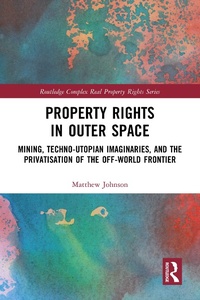
Property Rights in Outer Space
Mining, Techno-Utopian Imaginaries, and the Privatisation of the Off-World Frontier
1st Edition
Published on 28. May 2024
282 pages
978-1-040-03709-6 (ISBN)
Description

This book explores the role of private mining rights in the utopian imaginary of space colonisation. It presents a transdisciplinary account of the new and evolving legislative frameworks that have been established in anticipation of commercial exploitation of the mineral resources of the off-world frontier. Written in an engaging style, the book investigates a novel case study in the history of capitalism and 'the commons': the emergence of a nascent space mining industry, undergirded by a contentious legislative framework. In 2015, the US passed laws that would recognise the claims of US corporations to own and sell space resources. This unilateral act of pre-emptive law-making would appear to contravene the terms of the UN Outer Space Treaty (1967), which declared that the exploration and use of outer space should be 'for the benefit of all mankind' and 'not subject to national appropriation'.
Using this central dynamic between privately held mining rights and outer space as a 'global commons', Matthew Johnson constructs an historical sociology of space mining - from the deep historical roots of common and private property to the contemporary networks of neoliberalism that have engaged with the commercialisation of space activity. The anticipatory expansion of private property claims beyond the Earth both resonates with and problematises the 'terrain' of political history, such as the tensions between states and markets, public law and private power, 'the commons' and exclusive property. The emerging cosmopolitics of off-world private property mirrors (and is often explicitly embedded within) neoliberal geopolitics, prompting urgent questions about how we can reaffirm principles of democracy and 'common heritage' in the international laws of Earth and space. This book is compelling reading for anyone interested in the social study of space, law, economics, technology, politics and property rights.
Using this central dynamic between privately held mining rights and outer space as a 'global commons', Matthew Johnson constructs an historical sociology of space mining - from the deep historical roots of common and private property to the contemporary networks of neoliberalism that have engaged with the commercialisation of space activity. The anticipatory expansion of private property claims beyond the Earth both resonates with and problematises the 'terrain' of political history, such as the tensions between states and markets, public law and private power, 'the commons' and exclusive property. The emerging cosmopolitics of off-world private property mirrors (and is often explicitly embedded within) neoliberal geopolitics, prompting urgent questions about how we can reaffirm principles of democracy and 'common heritage' in the international laws of Earth and space. This book is compelling reading for anyone interested in the social study of space, law, economics, technology, politics and property rights.
More details
Series
Edition
1. Auflage
Language
English
Place of publication
London
United Kingdom
Publishing group
Taylor & Francis Ltd
Target group
College/higher education
Illustrations
5 Halftones, black and white; 5 Illustrations, color
ISBN-13
978-1-040-03709-6 (9781040037096)
Copyright in bibliographic data and cover images is held by Nielsen Book Services Limited or by the publishers or by their respective licensors: all rights reserved.
Schweitzer Classification
Other editions
Additional editions
Matthew Johnson
Property Rights in Outer Space
Mining, Techno-Utopian Imaginaries, and the Privatisation of the Off-World Frontier
Book
09/2025
1st Edition
Routledge
€82.00
Shipment within 10-20 days
Matthew Johnson
Property Rights in Outer Space
Mining, Techno-Utopian Imaginaries, and the Privatisation of the Off-World Frontier
Book
05/2024
1st Edition
Routledge
€204.60
Shipment within 10-20 days
Person
Matthew Johnson was awarded his PhD in 2020 from the University of Technology, Sydney, Australia. He has worked in a variety of academic and public sector roles, and currently lives and works in Sydney.
Content
Foreword
1. Introduction
2. NewSpace and neoliberalism
3. Enclosing the space commons? Off-world property through the lens of political history
4. On mineral sovereignty: state-corporate appropriation and the power of mining capital
5. Making and re-making the 'space constitution'
6. Privateering the cosmic frontier: empire, myth and the violence of property
7. Techno-utopianism and post-limits environmentalism
8. Epilogue
References
1. Introduction
2. NewSpace and neoliberalism
3. Enclosing the space commons? Off-world property through the lens of political history
4. On mineral sovereignty: state-corporate appropriation and the power of mining capital
5. Making and re-making the 'space constitution'
6. Privateering the cosmic frontier: empire, myth and the violence of property
7. Techno-utopianism and post-limits environmentalism
8. Epilogue
References
