

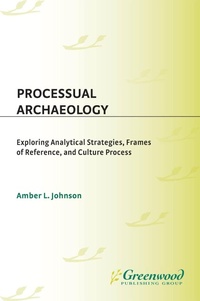
Processual Archaeology
Exploring Analytical Strategies, Frames of Reference, and Culture Process
1st Edition
Published on 30. November 2004
364 pages
978-0-313-02779-6 (ISBN)
Description

Processual archaeologists seek to explain variability in the static archaeological record we observe in the present as a necessary first step toward learning how to learn about the operation of cultural dynamics in the past. The approach is a diverse and productive one that focuses on developing learning strategies. Researchers pursuing processual archaeology have already discovered a great deal about the archaeological record and about past dynamics, and there is a huge potential for building on the foundation laid thus far.
The contributors to this volume provide clearly written research articles that are easily accessible to upper-level undergraduates and professional archaeologists. Although the papers do not focus on a single region, time period, or domain of observation (e.g. settlement patterns or lithics or site structure), they are integrated by shared goals for archaeology. This book clearly demonstrates that processual archaeology, far from having been replaced by post-processual archaeology, is becoming more and more powerful as our analytic sophistication and knowledge of the archaeological record grow.
The contributors to this volume provide clearly written research articles that are easily accessible to upper-level undergraduates and professional archaeologists. Although the papers do not focus on a single region, time period, or domain of observation (e.g. settlement patterns or lithics or site structure), they are integrated by shared goals for archaeology. This book clearly demonstrates that processual archaeology, far from having been replaced by post-processual archaeology, is becoming more and more powerful as our analytic sophistication and knowledge of the archaeological record grow.
More details
Edition
1. Auflage
Language
English
Place of publication
New York
United States
Publishing group
Bloomsbury Publishing Plc
Target group
Interest Age: From 7 to 17 years
ISBN-13
978-0-313-02779-6 (9780313027796)
Copyright in bibliographic data and cover images is held by Nielsen Book Services Limited or by the publishers or by their respective licensors: all rights reserved.
Schweitzer Classification
Other editions
Additional editions
Amber Johnson
Processual Archaeology
Exploring Analytical Strategies, Frames of Reference, and Culture Process
Book
11/2004
Praeger Publishers Inc
€99.50
Shipment within 15-20 days
Person
AMBER L. JOHNSON received her Ph.D. in anthropology from Southern Methodist University in 1997 and is currently an assistant professor of anthropology at Truman State University. Her research interests are in learning to explain variability in the pace and pattern of long term culture change processes through comparison of archaeological sequences on a global scale.
Content
Prelude: Searching for Home in the Modern Landscape of Archaeology by Robert L. Kelly
The Goals of Processual Archaeology by Amber L. Johnson
Middle Paleolithic Assemblage Formation at Riparo Mochi by Steven L. Kuhn
Taphonomy and Site Structure of a Late Paleolithic Open-air Site by James G. Enloe
Modes of Ceramic Production and Distribution: Some Observations from Philippine Ethnoarchaeology by William A. Longacre
Mobility, Sendentism, and Intensification: Organizational Responses to Environmental and Social Change among the San of Southern Africa by Robert K. Hitchcock
Poison Hunting Stategies and the Organization of Technology in the Circumpolar Region by Alan J. Osborn
The Functional Hypothesis Revisited: An Evaluation of Cumulative Graphs Using the Mousterian in the Eastern Sahara of Egypt and in Southwest France by Fred Wendorf and Romauld Schild
Population Ecology, Predator-Prey Dynamics, and Paleolithic Society by Mary C. Stiner
On Niche Breadth, System Stability and the Importance of a Phrase by Amber L. Johnson
Niche--A Productive Guide for Use in the Analysis of Cultural Complexity by Lewis R. Binford
Solving Meno's Puzzle, Defeating Merlin's Subterfuge: Bodies of Reference Knowledge and Archaeological Inference by LuAnn Wandsnider
The Goals of Processual Archaeology by Amber L. Johnson
Middle Paleolithic Assemblage Formation at Riparo Mochi by Steven L. Kuhn
Taphonomy and Site Structure of a Late Paleolithic Open-air Site by James G. Enloe
Modes of Ceramic Production and Distribution: Some Observations from Philippine Ethnoarchaeology by William A. Longacre
Mobility, Sendentism, and Intensification: Organizational Responses to Environmental and Social Change among the San of Southern Africa by Robert K. Hitchcock
Poison Hunting Stategies and the Organization of Technology in the Circumpolar Region by Alan J. Osborn
The Functional Hypothesis Revisited: An Evaluation of Cumulative Graphs Using the Mousterian in the Eastern Sahara of Egypt and in Southwest France by Fred Wendorf and Romauld Schild
Population Ecology, Predator-Prey Dynamics, and Paleolithic Society by Mary C. Stiner
On Niche Breadth, System Stability and the Importance of a Phrase by Amber L. Johnson
Niche--A Productive Guide for Use in the Analysis of Cultural Complexity by Lewis R. Binford
Solving Meno's Puzzle, Defeating Merlin's Subterfuge: Bodies of Reference Knowledge and Archaeological Inference by LuAnn Wandsnider
