

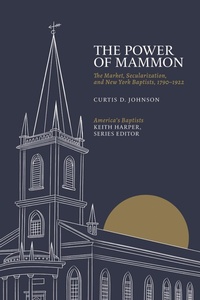
The Power of Mammon
Description

In The Power of Mammon, Curtis D. Johnson describes how the market economy and market-related forces, such as the media, politics, individualism, and consumerism, radically changed the nature of Baptist congregational life in New York State during three centuries. Collectively, these forces emphasized the importance of material wealth over everything else, and these values penetrated the thinking of Baptist ministers and laypeople alike. Beginning in the 1820s, the pastorate turned into a profession, the laity's influence diminished, closeknit religious fellowships evolved into voluntary associations, and evangelism became far less effective. Men, being the most engaged in the market, secularized the more quickly and became less involved in church affairs. By the 1870s, male disengagement opened the door to increased female participation in church governance. While scientific advances and religious pluralism also played a role, the market and its related distractions were the primary forces behind the secularization of Baptist life.
The Power of Mammon is history from the ground up. Unlike many denominational histories, this book emphasizes congregational life and the importance of the laity. This focus allows the reader to hear the voices of ordinary Baptists who argued over a host of issues. Johnson deftly connects large social trends with exhaustive attention to archival material, including numerous well-chosen records preserved by forty-two New York churches. These records include details related to membership, discipline, finance, and institutional history. Utilizing statistical analysis to achieve even greater clarity, Johnson effectively bridges the gap between the particularity of church records and the broader history of New York's Baptist churches.
Johnson's narrative of Baptist history in New York will serve as a model for other regional studies and adds to our understanding of secularization and its impact on American religion.
More details
Other editions
Additional editions
Person
CURTIS D. JOHNSON is professor of history at Mount St. Mary's University, Emmitsburg, Maryland. He is the author of Islands of Holiness: Rural Religion in Upstate New York, 1790-1860 and Redeeming America: Evangelicals and the Road to Civil War.
