

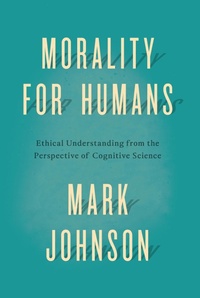
Morality for Humans
Ethical Understanding from the Perspective of Cognitive Science
1st Edition
Published on 22. December 2022
274 pages
978-0-226-11354-8 (ISBN)
Description

"A welcome renewal and defense of John Dewey's ethical naturalism, which Johnson claims is the only morality 'fit for actual human beings.'" -
Notre Dame Philosophical Reviews
What is the difference between right and wrong? This is no easy question to answer, yet we constantly try to make it so, frequently appealing to absolutes, whether drawn from God, universal reason, or societal authority. Combining cognitive science with a pragmatist philosophical framework, Mark Johnson argues that appealing solely to absolute principles is not only scientifically unsound but even morally suspect. He shows that the standards for the kinds of people we should be and how we should treat one another are frequently subject to change. Taking context into consideration, he offers a nuanced, naturalistic view of ethics that sees us creatively adapt our standards according to given needs, emerging problems, and social interactions.
Ethical naturalism is not just a revamped form of relativism. Indeed, Johnson attempts to overcome the absolutist-versus-relativist impasse that has been one of the most intractable problems in the history of philosophy. Much of our moral thought, he shows, is automatic and intuitive, gut feelings that we attempt to justify with rational analysis and argument. However, good moral deliberation is not limited to intuitive judgments supported after the fact by reasoning. Johnson points out a crucial third element: we imagine how our decisions will play out, how we or the world would change with each action we might take. Plumbing this imaginative dimension of moral reasoning, he provides a psychologically sophisticated view of moral problem solving, one perfectly suited for the embodied, culturally embedded, and ever-developing human creatures that we are.
What is the difference between right and wrong? This is no easy question to answer, yet we constantly try to make it so, frequently appealing to absolutes, whether drawn from God, universal reason, or societal authority. Combining cognitive science with a pragmatist philosophical framework, Mark Johnson argues that appealing solely to absolute principles is not only scientifically unsound but even morally suspect. He shows that the standards for the kinds of people we should be and how we should treat one another are frequently subject to change. Taking context into consideration, he offers a nuanced, naturalistic view of ethics that sees us creatively adapt our standards according to given needs, emerging problems, and social interactions.
Ethical naturalism is not just a revamped form of relativism. Indeed, Johnson attempts to overcome the absolutist-versus-relativist impasse that has been one of the most intractable problems in the history of philosophy. Much of our moral thought, he shows, is automatic and intuitive, gut feelings that we attempt to justify with rational analysis and argument. However, good moral deliberation is not limited to intuitive judgments supported after the fact by reasoning. Johnson points out a crucial third element: we imagine how our decisions will play out, how we or the world would change with each action we might take. Plumbing this imaginative dimension of moral reasoning, he provides a psychologically sophisticated view of moral problem solving, one perfectly suited for the embodied, culturally embedded, and ever-developing human creatures that we are.
More details
Other editions
Additional editions
Book
03/2014
University of Chicago Press
€99.04
Shipment within 10-20 days
Content
- Intro
- Contents
- Preface
- Introduction: The Need for Ethical Naturalism
- 1. Moral Problem-Solving as an Empirical Inquiry
- 2. Where Are Our Values Bred?-Sources of Moral Norms
- 3. Intuitive Processes of Moral Cognition
- 4. Moral Deliberation as Cognition, Imagination, and Feeling
- 5. The Nature of "Reasonable" Moral Deliberation
- 6. There Is No Moral Faculty
- 7. Moral Fundamentalism Is Immoral
- 8. The Making of a Moral Self
- Acknowledgments
- Notes
- References
- Index
