

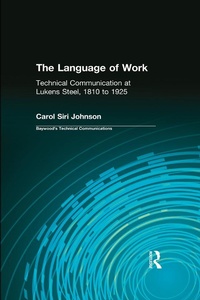
The Language of Work
Technical Communication at Lukens Steel, 1810 to 1925
Published on 5. December 2016
194 pages
978-1-351-84117-7 (ISBN)
Description

Lukens Steel was an extraordinary business that spanned two centuries of American history. The firm rolled the first boiler plate in 1818 and operated the largest rolling mills in America in 1890, 1903, and 1918, Later it worked on the Manhattan Project and built the steel beams for the base of the World Trade Center. The company stayed in the family for 188 years, and they kept the majority of their business papers."The Language of Work" traces the evolution of written forms of communication at Lukens Steel from 1810 to 1925. As standards for iron and steel emerged and industrial processes became more complex, foremen, mechanics, and managers began to use drawing and writing to solve problems, transfer ideas, and develop new technology. This shift in communication methods - from 'prediscursive' (oral) communication to 'chirographic' (written) communication - occurred as technology became more complex and knowledge had to span space and time.This richly illustrated volume begins with a theoretical overview linking technical communication to literature and describing the historical context. The analysis is separated into four time periods: 1810 to 1870, when little writing was used; 1870-1900, when Lukens Steel began to use record keeping to track product from furnace, through production, to the shipping dock; 1900-1915, when written and drawn communication spread throughout the plant and literacy became more common on the factory floor; and 1915-1925, when stenographer typists took over the majority of the written work. Over time, writing - and literacy - became an essential part of the industrial process.
More details
Series
Language
English
Place of publication
London
United Kingdom
Publishing group
Taylor & Francis Ltd
Target group
Professional and scholarly
Product notice
Reflowable
File size
16,13 MB
ISBN-13
978-1-351-84117-7 (9781351841177)
Copyright in bibliographic data and cover images is held by Nielsen Book Services Limited or by the publishers or by their respective licensors: all rights reserved.
Schweitzer Classification
Other editions
Additional editions
Carol Siri Johnson | Charles Sides
The Language of Work
Technical Communication at Lukens Steel, 1810 to 1925
Book
12/2016
1st Edition
Routledge
€82.30
Shipment within 15-20 days

Carol Siri Johnson | Charles Sides
The Language of Work
Technical Communication at Lukens Steel, 1810 to 1925
Book
08/2008
1st Edition
Baywood Publishing Company Inc
€232.90
Shipment within 3-4 weeks
Persons
Carol Siri Johnson, Charles Sides
Content
INTRODUCTION
Theory and History of Technical Communication
This introduction is an overview of scholarly research in the history of technical communication and its relation to literary theory.
PART ONE: BACKGROUND
Chapter 1: The Evolution of Technical Communication in the American Iron and Steel Industry
The chapter describes the historical context of technical communication in the American iron and steel industry as a whole and the evolution of genres within it (such as the publication of scientific articles and trade journals).
Chapter 2: The Evolution of Lukens Steel (1810 to 1925)
This chapter summarizes the history of Lukens Steel, a rolling mill that specialized in boiler plate, in order to provide the industrial and social context.
PART TWO: ANALYSIS
Chapter 3: 1810-1870: Prediscursive Technical Communication
At this early stage, written technical communication was limited to letters of specification sent to and from customers; any technical knowledge was exchanged directly between the workers.
Chapter 4: 1870-1900: Record Keeping Paves the Way
When Lukens Steel built their own open hearth furnaces, exact record keeping became necessary to track and maintain the quality of the iron and steel as it traveled from the furnace through the mill to the inspector waiting at the end.
Chapter 5: 1900-1915: An Explosion of Technical Communication
As the plant grew in size and complexity, workers, managers and foremen had to communicate in writing; an interplant mail system relayed handwritten notes and drawings to communicate essential technical matters.
Chapter 6: 1915-1925: The Union of Words and Work
As the amount of written communication increased, Lukens Steel hired stenographer typists to bridge the gap between varying levels of literacy. The result was a further increase in the amount of written communication.
CONCLUSION
The conclusion reiterates the theme that, over time, the working world shifted from prediscursive (spoken) to chirographic (written and drawn) communication. It ends with a plea to include technical communication as a form of literature in order to broaden our understanding of the world.
Glossary
Index
Theory and History of Technical Communication
This introduction is an overview of scholarly research in the history of technical communication and its relation to literary theory.
PART ONE: BACKGROUND
Chapter 1: The Evolution of Technical Communication in the American Iron and Steel Industry
The chapter describes the historical context of technical communication in the American iron and steel industry as a whole and the evolution of genres within it (such as the publication of scientific articles and trade journals).
Chapter 2: The Evolution of Lukens Steel (1810 to 1925)
This chapter summarizes the history of Lukens Steel, a rolling mill that specialized in boiler plate, in order to provide the industrial and social context.
PART TWO: ANALYSIS
Chapter 3: 1810-1870: Prediscursive Technical Communication
At this early stage, written technical communication was limited to letters of specification sent to and from customers; any technical knowledge was exchanged directly between the workers.
Chapter 4: 1870-1900: Record Keeping Paves the Way
When Lukens Steel built their own open hearth furnaces, exact record keeping became necessary to track and maintain the quality of the iron and steel as it traveled from the furnace through the mill to the inspector waiting at the end.
Chapter 5: 1900-1915: An Explosion of Technical Communication
As the plant grew in size and complexity, workers, managers and foremen had to communicate in writing; an interplant mail system relayed handwritten notes and drawings to communicate essential technical matters.
Chapter 6: 1915-1925: The Union of Words and Work
As the amount of written communication increased, Lukens Steel hired stenographer typists to bridge the gap between varying levels of literacy. The result was a further increase in the amount of written communication.
CONCLUSION
The conclusion reiterates the theme that, over time, the working world shifted from prediscursive (spoken) to chirographic (written and drawn) communication. It ends with a plea to include technical communication as a form of literature in order to broaden our understanding of the world.
Glossary
Index
