

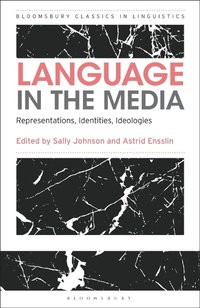
Language in the Media
Representations, Identities, Ideologies
1st Edition
Published on 18. October 2018
408 pages
978-1-350-06337-2 (ISBN)
Description

Examining the ways in which the media represents language-related issues and how it shapes and constructs what people think language is, this book offers a multilingual survey of the construction of language in and by the media.
Tackling the big issues of identity, gender, youth, citizenship, politics and ideology across a range of mediums including television, radio, newspapers, magazines and the internet, Language in the Media brings together an international team of experts to examine how the media gives language distinctive forms and values. This is an essential text for students and researchers of sociolinguistics or language and communication. At a time when trust in the mainstream media is at an all-time low and world leaders are using new media to deride so called 'fake news', this classic text offers insight and critical analysis into the key issues surrounding the relationship between language, the media and its audience.
Tackling the big issues of identity, gender, youth, citizenship, politics and ideology across a range of mediums including television, radio, newspapers, magazines and the internet, Language in the Media brings together an international team of experts to examine how the media gives language distinctive forms and values. This is an essential text for students and researchers of sociolinguistics or language and communication. At a time when trust in the mainstream media is at an all-time low and world leaders are using new media to deride so called 'fake news', this classic text offers insight and critical analysis into the key issues surrounding the relationship between language, the media and its audience.
More details
Series
Edition
1. Auflage
Language
English
Place of publication
London
United Kingdom
Publishing group
Bloomsbury Publishing PLC
Target group
College/higher education
ISBN-13
978-1-350-06337-2 (9781350063372)
Copyright in bibliographic data and cover images is held by Nielsen Book Services Limited or by the publishers or by their respective licensors: all rights reserved.
Schweitzer Classification
Other editions
Additional editions
Book
10/2018
Bloomsbury Academic
€52.18
Shipment within 15-20 days
Persons
Sally Johnson is Emeritus Professor of Linguistics at University of Leeds, UK.
Astrid Ensslin is Professor of Media and Digital Communication at the University of Alberta, Canada.
Astrid Ensslin is Professor of Media and Digital Communication at the University of Alberta, Canada.
Content
Foreword, Sally Johnson and Astrid Ensslin
1. Language in the Media: Theory and Practice, Sally Johnson (University of Leeds, UK) and Astrid Ensslin (University of Alberta, Canada)
Part I: Metaphors and Meanings
2. Metaphors for Speaking and Writing in the British Press, John Heywood and Elena Semino (Lancaster University, UK)
3. Journalistic Constructions of Blair's 'Apology' for the Intelligence Leading to the Iraq War, Lesley Jeffries (University of Huddersfield, UK)
4. Crises of Meaning: Personalist Language Ideology in US Media Discourse, Jane Hill (University of Arizona, USA)
Part II: National Identities, Citizenship and Globalization
5. National Identities, Citizenship and Globalization, Sally Johnson (University of Leeds, UK)
6. A Language Ideology in Print: the Case of Sweden, Tommaso M. Milani (University of the Witwatersrand, South Africa)
7. Global Challenges to Nationalist Ideologies: Language and Education in the Luxembourg Press, Kristine Horner (University of Sheffield, UK)
Part III: Contact and Codeswitching in Multilingual Mediascapes
8. Corsican on the Airwaves: Media Discourse in a Context of Minority Language Shift, Alexandra Jaffe (California State University, Long Beach, USA)
9. 'When Hector met Tom Cruise': Attitudes to Irish in a Radio Satire, Helen Kelly-Holmes and David Atkinson (University of Limerick, Ireland)
10. Dealing with Linguistic Difference in Encounters with Others on British Television, Simon Gieve and Julie Norton (University of Leicester, UK)
Part IV: Youth, Gender and Cyber-Identities
11. Fabricating Youth: New-media Discourse and the Technologization of Young People, Crispin Thurlow (University of Bern, Switzerland)
12. Dreaming of Genie: Gender Difference and Identity on the Web, Deborah Cameron (Oxford University, UK)
13. Of Chords, Machines and Bumble-bees: The Metalinguistics of Hyperpoetry, Astrid Ensslin (University of Alberta, Canada)
14. Language in the Media: Authenticity and Othering, Adam Jaworski (Cardiff University, UK)
Index
1. Language in the Media: Theory and Practice, Sally Johnson (University of Leeds, UK) and Astrid Ensslin (University of Alberta, Canada)
Part I: Metaphors and Meanings
2. Metaphors for Speaking and Writing in the British Press, John Heywood and Elena Semino (Lancaster University, UK)
3. Journalistic Constructions of Blair's 'Apology' for the Intelligence Leading to the Iraq War, Lesley Jeffries (University of Huddersfield, UK)
4. Crises of Meaning: Personalist Language Ideology in US Media Discourse, Jane Hill (University of Arizona, USA)
Part II: National Identities, Citizenship and Globalization
5. National Identities, Citizenship and Globalization, Sally Johnson (University of Leeds, UK)
6. A Language Ideology in Print: the Case of Sweden, Tommaso M. Milani (University of the Witwatersrand, South Africa)
7. Global Challenges to Nationalist Ideologies: Language and Education in the Luxembourg Press, Kristine Horner (University of Sheffield, UK)
Part III: Contact and Codeswitching in Multilingual Mediascapes
8. Corsican on the Airwaves: Media Discourse in a Context of Minority Language Shift, Alexandra Jaffe (California State University, Long Beach, USA)
9. 'When Hector met Tom Cruise': Attitudes to Irish in a Radio Satire, Helen Kelly-Holmes and David Atkinson (University of Limerick, Ireland)
10. Dealing with Linguistic Difference in Encounters with Others on British Television, Simon Gieve and Julie Norton (University of Leicester, UK)
Part IV: Youth, Gender and Cyber-Identities
11. Fabricating Youth: New-media Discourse and the Technologization of Young People, Crispin Thurlow (University of Bern, Switzerland)
12. Dreaming of Genie: Gender Difference and Identity on the Web, Deborah Cameron (Oxford University, UK)
13. Of Chords, Machines and Bumble-bees: The Metalinguistics of Hyperpoetry, Astrid Ensslin (University of Alberta, Canada)
14. Language in the Media: Authenticity and Othering, Adam Jaworski (Cardiff University, UK)
Index
