

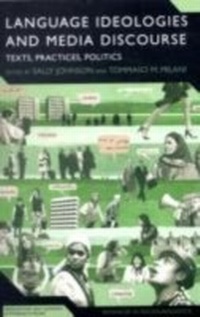
Language Ideologies and Media Discourse
Texts, Practices, Politics
1st Edition
Published on 24. December 2009
312 pages
978-1-4411-8273-9 (ISBN)
Description

The study of language ideologies has become a key theme in sociolinguistics over the past decade. It is the study of the relationship between representations of language, on the one hand, and broader aesthetic, economic, moral and political concerns, on the other. Research into the particular role played by media discourse in the construction, reproduction and contestation of such ideologies has been widely scattered - this book brings together this emerging field. It considers how, in an era of global communication technologies, the media - by which we understand the press, radio, television, cinema, the internet and multimodal gaming - help to disseminate preferred uses of, and ideas about, language.
The book is tightly focussed on the relationship between language ideologies and media discourse, together with the methods and techniques required for the analysis of that relationship. It also places emphasis on television and new-media texts, incorporating and expanding upon recent theoretical insights into visual communication and multimodal discourse analysis.
International in scope, this book will also be of interest to students from a wide range of fields including linguistics (particularly sociolinguistics and linguistic anthropology), modern languages, education, media studies, communication studies and cultural theory.
The book is tightly focussed on the relationship between language ideologies and media discourse, together with the methods and techniques required for the analysis of that relationship. It also places emphasis on television and new-media texts, incorporating and expanding upon recent theoretical insights into visual communication and multimodal discourse analysis.
International in scope, this book will also be of interest to students from a wide range of fields including linguistics (particularly sociolinguistics and linguistic anthropology), modern languages, education, media studies, communication studies and cultural theory.
Reviews / Votes
"Language Ideologies and Media Discourse is an excellent collection which demonstrates the complex and multilayered ways in which language value is shaped by both media power and media use, and reciprocally, how media power and media use themselves are entangled at every step with the value-laden nature of language. It joins a growing body of work within sociolinguistics, linguistic anthropology, and discourse analysis devoted to prying apart the always and everywhere socially, politically, historically, and culturally-charged nature of language use and language value. Here we see in bold relief, just how language choices, linguistic registers, discursive idioms, and linguistic labels across a range of media (e.g. television, newspapers, radio, Internet, and computer games) have consequences for national, ethnic, and global affiliations, as well as the very tenor of people's affective encounters with media technologies." -Debra Spitulnik, Associate Professor, Department of Anthropology, Emory University, USA English-speaking academics in the field of language ideologies will appreciate it and feel familiar with many of these topics ... [M]any contributions can open doors for the study of the social dynamics of cultures and ideologies. * Discourse & Communication *More details
Series
Edition
1. Auflage
Language
English
Place of publication
New York
United States
ISBN-13
978-1-4411-8273-9 (9781441182739)
Copyright in bibliographic data and cover images is held by Nielsen Book Services Limited or by the publishers or by their respective licensors: all rights reserved.
Schweitzer Classification
Other editions
Additional editions
Book
02/2010
Continuum Publishing Corporation
€63.20
Shipment within 15-20 days
Book
02/2010
Continuum Publishing Corporation
€234.60
Shipment within 15-20 days
Persons
Sally Johnson is Emeritus Professor of Linguistics at University of Leeds, UK. Tommaso M. Milani is George C. and Jane G. Greer Professor and Head of Applied Linguistics at the Pennsylvania State University, USA.
Content
Introduction
1. Tommaso M. Milani & Sally Johnson (University of Leeds, UK)
Part I: Standards and Standarisation in National and Global Contexts
2. Metalinguistic discourse in and about the media: some recent trends in Greek and German prescriptivism
Spiros Moschonas (University of Athens, Greece) & Juergen Spitzmueller (University of Zurich, Switzerland)
3. Globalising standard Spanish: the promotion of 'panhispanism' in the Spanish press, Darren Paffey (University of Southampton, UK)
4. Language games on Korean television: between globalization, nationalism and authority, Joseph Sung-Yul Park (National University of Singapore, Singapore)
Part II: Planning and Policy in Media Programming
5. Planeta Brasil: language practices and the construction of space in Brazilian TV abroad, Iris Bachmann (University of Manchester, UK)
6. Sociolinguistic practices, media politics and Greek Cypriot TV series: reproducing language ideologies, Vasiliki Georgiou (University of Southampton, UK)
7. Language ideologies and state imperatives: the strategic use of Singlish in public media discourse, Michelle M. Lazar (National University of Singapore, Singapore)
Part III. Media, Ethnicity and the Racialisation of Language
8. Lost in translation? Racialisation of a debate about language in a BBC news item, Adrian Blackledge (University of Birmingham, UK)
9. Metadiscourses of race in the news: the Celebrity Big Brother row, Bethan Davies (University of Leeds, UK)
10. Ideologising ethnolectal German, Jannis Androutsopoulos (King's College London, UK)
Part IV: Language Ideologies in New-Media Commentary
11. 'Black and white': language ideologies in computer game discourse, Astrid Ensslin (University of Bangor, Wales)
12. Whose voices? A hypermodal approach to language ideological debates on the BBC 'Voices' website, Sally Johnson, Tommaso M. Milani & Clive Upton (all University of Leeds, UK)
13. 'It's not a telescope, it's a telephone': encounters with the telephone on early commercial sound recordings, Richard Bauman (Indiana University, Bloomington, USA)
Commentary
14. Monica Heller (University of Toronto, Canada)
Index
Bibliography
1. Tommaso M. Milani & Sally Johnson (University of Leeds, UK)
Part I: Standards and Standarisation in National and Global Contexts
2. Metalinguistic discourse in and about the media: some recent trends in Greek and German prescriptivism
Spiros Moschonas (University of Athens, Greece) & Juergen Spitzmueller (University of Zurich, Switzerland)
3. Globalising standard Spanish: the promotion of 'panhispanism' in the Spanish press, Darren Paffey (University of Southampton, UK)
4. Language games on Korean television: between globalization, nationalism and authority, Joseph Sung-Yul Park (National University of Singapore, Singapore)
Part II: Planning and Policy in Media Programming
5. Planeta Brasil: language practices and the construction of space in Brazilian TV abroad, Iris Bachmann (University of Manchester, UK)
6. Sociolinguistic practices, media politics and Greek Cypriot TV series: reproducing language ideologies, Vasiliki Georgiou (University of Southampton, UK)
7. Language ideologies and state imperatives: the strategic use of Singlish in public media discourse, Michelle M. Lazar (National University of Singapore, Singapore)
Part III. Media, Ethnicity and the Racialisation of Language
8. Lost in translation? Racialisation of a debate about language in a BBC news item, Adrian Blackledge (University of Birmingham, UK)
9. Metadiscourses of race in the news: the Celebrity Big Brother row, Bethan Davies (University of Leeds, UK)
10. Ideologising ethnolectal German, Jannis Androutsopoulos (King's College London, UK)
Part IV: Language Ideologies in New-Media Commentary
11. 'Black and white': language ideologies in computer game discourse, Astrid Ensslin (University of Bangor, Wales)
12. Whose voices? A hypermodal approach to language ideological debates on the BBC 'Voices' website, Sally Johnson, Tommaso M. Milani & Clive Upton (all University of Leeds, UK)
13. 'It's not a telescope, it's a telephone': encounters with the telephone on early commercial sound recordings, Richard Bauman (Indiana University, Bloomington, USA)
Commentary
14. Monica Heller (University of Toronto, Canada)
Index
Bibliography
