

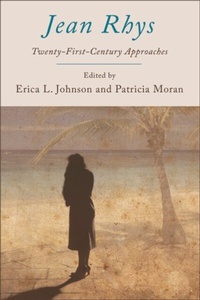
Jean Rhys
Description

Presents new critical perspectives on Jean Rhys in relation to modernism, postcolonialism, and theories of affect.
Jean Rhys (1890-1979) is the author of five novels and over seventy short stories. She has played a major figure in debates attempting to establish the parameters of postcolonial and particularly Caribbean studies, and although she has long been seen as a modernist writer, she has also been marginalized as one who is not quite in, yet not quite out, either. The 10 newly commissioned essays and introduction collected in this volume demonstrate Jean Rhys's centrality to modernism and to postcolonial literature alike by addressing her stories and novels from the 1920s and 1930s, including Voyage in the Dark, Quartet, After Leaving Mr. Mackenzie, and Good Morning, Midnight, as well as her later bestseller, Wide Sargasso Sea (1966). The volume establishes Rhys as a major author with relevance to a number of different critical discourses, and includes a path-breaking section on affect theory that shows how contemporary interest in Rhys correlates with the recent ''affective turn'' in the social sciences and humanities. As this collection shows, strangely haunting and deeply unsettling, Rhys's portraits of dispossessed women living in the early and late twentieth-century continue to trouble easy conceptualisations and critical categories.
Key Features: - New and original work on Jean Rhys's fiction and short stories, highlighting key areas of her work. - Contributors are leading scholars on Jean Rhys from the US, the UK, and Australia, including Mary Lou Emery, Elaine Savory, John J. Su, Maroula Joannou, H. Adlai Murdoch, Rishona Zimring, Carine Mardorossian, Patricia Moran, Erica L. Johnson, and Sue Thomas. - Organised around 3 important themes: Rhys and modernism, postcolonial Rhys, and affective Rhys
Patricia Moran is the author of Word of Mouth: Body/Language in Katherine Mansfield and Virginia Woolf; Virginia Woolf, Jean Rhys, and the Aesthetics of Trauma; and co-editor of Scenes of the Apple: Food and the Female Body in 19th and 20th-Century Women's Writing and The Female Face of Shame. Formerly Professor of English at the University of California, Davis, she is now Lecturer in English at the University of Limerick.
Erica L. Johnson is an Associate Professor of English at Pace University in New York. She is the author of Caribbean Ghostwriting (2009) and Home, Maison, Casa: The Politics of Location in Works by Jean Rhys, Marguerite Duras, and Erminia Dell'Oro (2003), and is the co-editor with Patricia Moran of The Female Face of Shame (2013).
More details
Other editions
Additional editions
Persons
Content
- Intro
- Jean Rhys
- Copyright
- Contents
- List of Figures
- Acknowledgements
- Notes on Contributors
- Introduction: The Haunting of Jean Rhys
- Part I Rhys and Modernist Aesthetics
- 1 Jean Rhys and Katherine Mansfield Writing the 'sixth act'
- 2 Making a Scene: Rhys and the Aesthete at Mid-Century
- 3 On the Veranda: Jean Rhys's Material Modernism
- Part II Postcolonial Rhys
- 4 Jean Rhys's Environmental Language: Oppositions, Dialogues and Silences
- 5 Caribbean Formations in the Rhysian Corpus
- 6 Rhys and Dress 'From Black to Red': Jean Rhys's Use of Dress in Wide Sargasso Sea
- 7 The Discourses of Jean Rhys: Resistance, Ambivalence and Creole Indeterminacy
- Part III Affective Rhys
- 8 The Empire of Affect: Reading Rhys after Postcolonial Theory
- 9 'The feelings are always mine': Chronic Shame and Humiliated Rage in Jean Rhys's Fiction
- 10 'Upholstered Ghosts': Jean Rhys's Posthuman Imaginary
- Bibliography
- Index
