

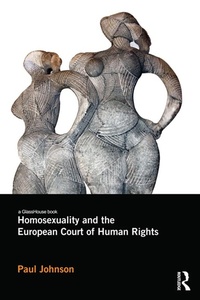
Homosexuality and the European Court of Human Rights
1st Edition
Published on 5. September 2013
272 pages
978-1-136-21897-2 (ISBN)
Description

Homosexuality and the European Court of Human Rights
is the first book-length study of the Court's jurisprudence in respect of sexual orientation. It offers a socio-legal analysis of the substantial number of decisions and judgments of the Strasbourg organs on the wide range of complaints brought by gay men and lesbians under the European Convention on Human Rights. Providing a systematic analysis of Strasbourg case law since 1955 and examining decades of decisions that have hitherto remained obscure, the book considers the evolution of the Court's interpretation of the Convention and how this has fashioned lesbian and gay rights in Europe. Going beyond doctrinal analysis by employing a nuanced sociological consideration of Strasbourg jurisprudence, Paul Johnson shows how the Court is a site at which homosexuality is both socially constructed and regulated. He argues that although the Convention is conceived as a 'living instrument' to be interpreted 'in the light of present-day conditions' the Court's judgments have frequently forged and advanced new social conditions in respect of homosexuality. Johnson argues that the Court's jurisprudence has an extra-legal importance because it provides an authoritative and powerful discursive resource that can be mobilized by lesbians and gay men to challenge homophobic and heteronormative social relations in contemporary societies. As such, the book considers how the Court's interpretation of the Convention might be evolved in the future to better protect lesbian and gay rights and lives.
is the first book-length study of the Court's jurisprudence in respect of sexual orientation. It offers a socio-legal analysis of the substantial number of decisions and judgments of the Strasbourg organs on the wide range of complaints brought by gay men and lesbians under the European Convention on Human Rights. Providing a systematic analysis of Strasbourg case law since 1955 and examining decades of decisions that have hitherto remained obscure, the book considers the evolution of the Court's interpretation of the Convention and how this has fashioned lesbian and gay rights in Europe. Going beyond doctrinal analysis by employing a nuanced sociological consideration of Strasbourg jurisprudence, Paul Johnson shows how the Court is a site at which homosexuality is both socially constructed and regulated. He argues that although the Convention is conceived as a 'living instrument' to be interpreted 'in the light of present-day conditions' the Court's judgments have frequently forged and advanced new social conditions in respect of homosexuality. Johnson argues that the Court's jurisprudence has an extra-legal importance because it provides an authoritative and powerful discursive resource that can be mobilized by lesbians and gay men to challenge homophobic and heteronormative social relations in contemporary societies. As such, the book considers how the Court's interpretation of the Convention might be evolved in the future to better protect lesbian and gay rights and lives.
Reviews / Votes
"Johnson's book provides an incredibly thorough discussion of the sheer range of cases dealing with homosexuality that have come before the Court since its inception. It is clearly a useful and thought-provoking text for anybody interested in the Court's jurisprudence in regard to homosexuality and its engagement with 'moral' issues more generally" - Flora Renz, Social and Legal Studies, 2014, Vol.23(2), 275-277.More details
Edition
1. Auflage
Language
English
Place of publication
London
United Kingdom
Publishing group
Taylor & Francis Ltd
Target group
College/higher education
Illustrations
2 s/w Tabellen
2 Tables, black and white
File size
3,23 MB
ISBN-13
978-1-136-21897-2 (9781136218972)
Copyright in bibliographic data and cover images is held by Nielsen Book Services Limited or by the publishers or by their respective licensors: all rights reserved.
Schweitzer Classification
Other editions
Additional editions
Paul Johnson
Homosexuality and the European Court of Human Rights
Book
03/2014
1st Edition
Routledge
€78.70
Shipment within 15-20 days
Paul Johnson
Homosexuality and the European Court of Human Rights
Book
09/2012
1st Edition
Routledge
€231.90
Shipment within 15-20 days
Person
Paul Johnson is Professor of Sociology at the University of York. His current research focuses on the relationship between law, sexuality and social control.?He is the author of Love, Heterosexuality and Society (Routledge, 2005), Genetic Policing (Willan Publishing, 2008), and co-editor of Policing Sex (Routledge, 2012).
Content
Table of cases. Introduction. PART 1: MAKING THE HOMOSEXUAL OF HUMAN RIGHTS 1. Emerging voices: homosexuality and the Commission 1955-1980. 2. An ontological struggle: the Court and the homosexual since 1981. PART 2: METHODS AND MORALS 3. Homosexuality in the judicial laboratory: instruments, interpretations, and evolutions. PART 3: EXISTING JURISPRUDENCE AND POTENTIAL FUTURE DEVELOPMENTS 4. 'An essentially private manifestation of the human personality': the limitations of Article 8. 5. The anti-discrimination provisions of the Convention: Article 14 and Protocol 12. 6. A right to marriage? Same-sex relationships and Article 12. 7. Expression, Assembly and Association: Articles 10 and 11. 8. Humiliation and debasement: degrading treatment and Article 3 Conclusion. Bibliography. Appendix 1: European Convention on Human Rights (truncated). Appendix 2: Chronological list of Decisions and Judgments of the Strasbourg organs in respect of homosexuality. Index
