

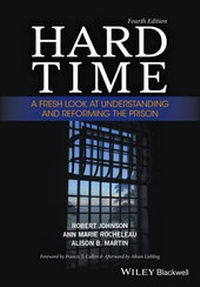
Hard Time
Description

More details
Other editions
Additional editions
Persons
Content
Foreword xi
Acknowledgments xvii
1 Crime, Prison, and the Case for Corrections 1
A Predilection for Prisons 4
Prison America 6
Incarcerating Men and Women of Color 7
No Escaping Prison 9
The Goals of Prison Punishment 12
A Case for Decent Prisons 16
Decent Prisons and Mature Coping 17
General Dynamics of Adjustment 21
Decent Prisons as a Human Right 23
Notes 25
References 30
2 Modern Prisons in Historical Context 35
American Prisons Before the Penitentiary 35
Penitentiaries 37
Models of Reformative Penitentiary Quarantine 39
Women and Minorities in the Penitentiary 41
The Southern Plantation Prison 42
Reformatories 44
The Big House 47
Women and Minorities in the Big House 48
The Big House: Repression and Its Discontents 49
The Decline of the Big House 52
The Correctional Institution 53
Models of Correctional Facilities 55
Prison Violence 58
Deinstitutionalization and the Increase in Mentally Ill Inmates 61
Supermax Prisons 62
Notes 65
References 71
3 the Pains of Modern Imprisonment 76
Pain Amelioration in Prisons: Three Stages 77
Living With Deprivation 79
Loss of Liberty 79
Deprivation of Autonomy 81
Deprivation of Goods and Services 83
Boredom 85
Deprivation of Heterosexual Contact 87
Missing Family 90
Disrespect 93
Deprivation of Security 96
Pain and Harm 99
Notes 103
References 107
4 Prisoner Deficits and Immature Coping 111
Immature Coping 112
Limited Cognitive and Interpersonal Skills 112
Denial 113
Poor Self-Control 114
Defective Socialization 115
Lack of Empathy 119
Prisoner Types 120
Predatory Convicts 120
State-Raised Convicts 121
Institutionalized Inmates 122
The Mentally Ill 124
Exceptions to Immature Coping: Square Johns and Long-Termers 126
Dysfunctional Adaptations to Imprisonment 128
Reconciling Public and Private Inmate Cultures 130
Notes 133
References 138
5 the Public Culture of the Prison: Violence 144
The Nature of Violent Prisoners 146
Predatory Convicts and State-Raised Youth 148
Gang Violence 150
Hypermasculinity in Prisons 152
Fear, Street Culture, and the Campaign for Respect 154
The Mentally Ill 159
The Nature of Violent Prisons 161
Violence Exacerbated By Prison Administration and Conditions 162
Relationships Between Inmates and Officers 163
Situational Violence 166
A Note on Violence in women's Prisons 169
Notes 172
References 177
6 The Private Culture of the Prison: Living in Prison 182
Living in Prison 183
A Day in a Life in Prison 185
The Ecology of Prison Survival 189
Prison Life, Prison Niches 194
Types of Prison Niches 197
Coping Strategies for Living in Prison 209
General Coping Strategies 209
Coping Adaptations Unique to Prison 210
Coping Strategies for Lifers and Long-Termers 212
More Than Survival 216
Notes 219
References 225
7 Correctional Officers' Public Custodial Agenda 230
Correctional Officer as Hack 231
The Persistent Image 231
Prevalence of Correctional Officer Violence 234
Nature of Prohibited Correctional Officer Violence 236
Nature of Prison-Sanctioned Correctional Officer Violence 240
Correctional Practices That Breed Violence 244
Stress, Alienation, and Burnout 250
Dimensions of Alienation 252
Causes of Stress in the Prison Workplace 258
Notes 261
References 266
8 Prison Officers' Private Correctional Agenda 271
Providing Human Service 271
The Nature of Human Service 272
Typology of Correctional Officers as Agents of Care 275
Human Service Activities 277
Goods and Services 277
Referrals and Advocacy 278
Helping Prisoners Adjust and Solve Problems 279
Rule Enforcement as Human Service Work: Developing Relationships and Legitimacy 282
Collaboration in Helping 286
Human Service in Perspective 291
Notes 294
References 298
9 Supermax and the Overuse of Solitary Confinement 303
Living and Working in Supermax 304
Assessing the Efficacy of the Supermax Experiment 311
Do Supermax Prisons Meet Their Goals? 311
Supermax as a Shelter and a Place to Pause 314
Some Failures of Supermax 315
Getting Into Supermax 316
Contributing to a Cycle of Violence 323
Deterioration of Mental Health 327
Supermax as Anti-Rehabilitation and Anti-Public Safety 329
Moving Forward: the Devil is in the Details 330
Notes 335
References 341
10 Reform 346
Smarter Punishment, Better Prisons 348
Reforming Prison Ecology 350
Prison Programs and the Cultivation of Mature Coping 363
Getting Out and Staying Out 372
Transitional Support 373
Reconciliation 377
Notes 379
References 387
Afterword 397
Index 400
Foreword
The growth in incarceration in the United States has been so sustained and long-lasting that virtually all readers have spent their entire academic lives, if not their entire lives, in the era of mass imprisonment. During this time, the count of inmates behind bars rolled forward much like the odometer on an automobile - clicking upward relentlessly toward the next round number: a few hundred thousand in the 1970s eventually surpassed the 2 million mark and then moved beyond 2.4 million in 2008. In the past 5 years or so, it is as though policymakers have finally come to their senses, awakening to the reality that this mindless embrace of locking up fellow Americans was an astounding policy failure that has created a correctional nightmare. As Travis Pratt noted, the nation had become "addicted to incarceration." The recovery process will not be easy.
In this context, it is perhaps understandable that scholars have focused an inordinate amount of attention on the sources, scope, and impact of mass imprisonment. We have learned much about the "culture of control," "governing through crime," "the punitive imperative," "the prison experiment," and similar concepts that have illuminated the nature of the incarceration movement. Indeed, criminologists did their best to form a collective Dear Abby, advising all who would listen that using imprisonment to deal with crime was expensive, of limited effectiveness, and often racially unjust. For a long time, nobody seemed to listen; fortunately, many policymakers from both ends of the political spectrum now are.
In short, it was difficult, if not impossible, for scholars to ignore the elephant in the correctional room - mass incarceration. But doing so came at a price: they gave far less attention to what was going on inside the nation's prisons and, with a few notable exceptions, remained silent on how to improve the experience of those who, day in and day out, resided within the society of captives. This neglect was to a degree inadvertent. Time spent focusing on one issue - the policy issue of mass imprisonment - is time not spent focusing on another issue - in this case, how to reform the internal quality of correctional facilities. But this neglect - this turning a blind eye to the plight of the incarcerated - also was a conscious choice rooted in criminologists' professional ideology.
A core belief, held explicitly or implicitly, by most criminologists is that prisons are inherently inhumane and thus beyond reform. There can be no such thing as a "good prison." This idea can be traced to the first part of the 1970s. In 1971, Philip Zimbardo and colleagues conducted the famous Stanford Prison Experiment in which psychologically normal undergraduate students placed within a mock prison quickly were transformed into oppositional inmates and coercive custodians. The fact that the experiment had to be halted to prevent further harm to the participants sent a powerful message that prisons, by their nature, had a brutalizing effect on all inside. Shortly thereafter, in 1974, Robert Martinson published a famous essay in The Public Interest claiming that prison rehabilitation programs were, by and large, ineffective - a conclusion soon known by the shorthand phrase "nothing works." Taken together, there seemed to be incontrovertible scientific evidence that the total institution of the prison was inhumane and that even the most well-intentioned efforts to help reform inmates could not work within its walls. Other events of the day lent credence to this view, including the lethal suppression of the Attica prison riot (which occurred in the month following the Stanford Prison Experiment), revelations of inhumanity in other total institutions (especially mental hospitals), and the broader abuse of state power within criminal justice and in other domains (e.g., foreign policy).
This conception encouraged many criminologists to abandon the social world of the prison as a valued object of investigation. Why study correctional institutions if it was an established truth that they were hopelessly coercive and brutal? Those scholars who still bothered to examine prisons did not question this truth; instead, their project was to document the ways in which institutions were violent, victimizing, disorderly, dehumanizing, and otherwise deleterious. They also held out little hope that this disquieting social order could ever be otherwise. Efforts to improve prison life were thus seen as a fool's errand - destined to fail. Worse, trying to make prisons less brutalizing would achieve, at best, minor incremental improvements that would come at the high price of lending legitimacy to the prison enterprise. Scholars who dared to align themselves with prison officials risked being labeled "administrative criminologists" and as "tools of the state." Wishing to avoid such stigmatizing labels, most correctional scholars rejected a reform agenda and settled instead for a different policy: oppose putting all but the most violent, predatory offenders behind bars.
This anti-prison stance - with the prescription to divert as many people from incarceration as possible - was ideologically comforting but ultimately foolhardy, for two reasons. First, policymakers did not listen to criminologists or read their books. Instead, they continued to embrace get-tough rhetoric and to lock up massive numbers of Americans - as the Pew Charitable Trusts calculated, a figure that by 2008 reached 1 in 100 of us. Second, it placed these scholars in a position of having nothing to say about the internal regimen of prison. Their lack of involvement simply opened the way for different voices to be heard - those who favored mean-spirited corrections in which increasing prison austerity was trumpeted as a way of exacting retribution and of teaching offenders that crime does not pay.
In 1987, John DiIulio sought to counteract this dominant view in his controversial book Governing Prisons. A political scientist by training, DiIulio argued that, similar to other organizations, how prisons were managed shaped the quality of institutional life. Wardens and other correctional staff were not pawns who reacted in predetermined ways to the prison's structural arrangements. Rather, they were managers whose decisions and treatment of inmates produced either orderly, safe, and reformative prisons or disorderly, unsafe, and criminogenic prisons - or something in between. It is not clear, however, why DiIulio's thesis was so controversial. To be sure, his particular ideas about how best to govern prisons were speculative and clearly deserving of further empirical scrutiny. But objection in many quarters occurred simply because DiIulio challenged criminological orthodoxy in suggesting that prisons could be made more decent.
It is within this context that Hard Time was initially published, also in 1987. When I read the first edition, I was struck by Robert Johnson's intellectual courage to reject the reigning professional ideology that prisons were unredeemable institutions. He detailed meticulously the harsh realities that made prisons as bad as the critics claimed them to be. But he also unearthed the promising sides of this social world and articulated pathways to make prisons more decent places - issues I return to shortly. I was so taken by this analysis that I immediately assigned the book as required reading in my course titled "Prisons and Jails." Indeed, I believed that Hard Time was a contemporary classic. Now, three decades later and entering its fourth edition, I can attest that, like fine wine, the book has improved with age. In part, I suspect this is because Professor Johnson has had the wisdom of adding quite capable coauthors, Ann Marie Rocheleau and Alison B. Martin. This scholarly trinity has succeeded in creating a volume that is wonderfully written and deeply researched (with 1775 endnotes!). But its pages are infused with something more: an abiding belief that prisons can be made more humane and effective - and that the people within them are not beyond redemption and do not have to live in immiserating conditions.
Hard Time is replete with a lengthy roster of special insights, each of which enriches our understanding of prison life. Accordingly, it is difficult to identify core themes that necessarily supersede in importance others on this list. Still, I can share the two key ideas in the volume that have long had a major impact on my thinking about corrections.
First, Johnson and colleagues document the public cultures that flourish in prison - one held by the inmates and the other by correctional officers. In many ways, these beliefs and actions - often involving violence, hypermasculinity, coercion, and demeaning rhetoric - are precisely what infuse the orthodox view within criminology that prisons are inherently inhumane and beyond genuine reform. These public cultures are real and affect the unhealthy choices that prisoners and their keepers make. But Johnson, Rocheleau, and Martin also unmask another set of cultures - the private cultures of inmates and correctional...
