

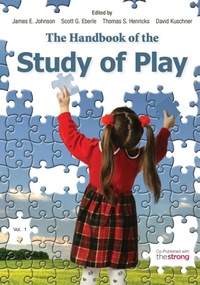
The Handbook of the Study of Play
2 Volumes
Published on 5. February 2015
552 pages
978-1-4758-0796-7 (ISBN)
Description

The Handbook of the Study of Play brings together in two volumes thinkers whose diverse interests at the leading edge of scholarship and practice define the current field. Because play is an activity that humans have shared across time, place, and culture and in their personal developmental timelines-and because this behavior stretches deep into the evolutionary past-no single discipline can lay claim to exclusive rights to study the subject. Thus this handbook features the thinking of evolutionary psychologists; ethologists and biologists; neuroscientists; developmental psychologists; psychotherapists and play therapists; historians; sociologists and anthropologists; cultural psychologists; philosophers; theorists of music, performance, and dance; specialists in learning and language acquisition; and playground designers.
Together, but out of their varied understandings, the incisive contributions to The Handbook take on vital questions of educational policy, of literacy, of fitness, of the role of play in brain development, of spontaneity and pleasure, of well-being and happiness, of fairness, and of the fuller realization of the self. These volumes also comprise an intellectual history, retrospective looks at the great thinkers who have made possible the modern study of play.
Together, but out of their varied understandings, the incisive contributions to The Handbook take on vital questions of educational policy, of literacy, of fitness, of the role of play in brain development, of spontaneity and pleasure, of well-being and happiness, of fairness, and of the fuller realization of the self. These volumes also comprise an intellectual history, retrospective looks at the great thinkers who have made possible the modern study of play.
More details
Language
English
Place of publication
New York
United States
Publishing group
Bloomsbury Publishing Plc
Target group
Professional and scholarly
File size
1,52 MB
ISBN-13
978-1-4758-0796-7 (9781475807967)
Copyright in bibliographic data and cover images is held by Nielsen Book Services Limited or by the publishers or by their respective licensors: all rights reserved.
Schweitzer Classification
Other editions
Additional editions

James E. Johnson | Scott G. Eberle | Thomas S. Henricks
The Handbook of the Study of Play
Book
03/2015
Rowman & Littlefield Publishers
€245.12
Article exhausted; check different version
Persons
James E. Johnson is professor of education and program coordinator of Early Childhood Education at The Pennsylvania State University at University Park. Series Editor of Play & Culture Studies, Past President of The Association for the Study of Play, and on the editorial board of the International Journal of Play, he has coauthored or coedited Play and Early Childhood Development, Approaches to Early Childhood Education, Play, Development, and Early Education, and Children's Play in Diverse Cultures.
Thomas S. Henricks is Distinguished University Professor at Elon University. His interests as a sociologist include social theory, modernization and change, popular culture, social stratification, race and ethnic relations, and, particularly, play and sports. His numerous publications include Disputed Pleasures: Sport and Society in Preindustrial England; Play Reconsidered: Sociological Perspectives on Human Pleasure; and Selves, Societies, and Emotions: Understanding the Pathways of Experience.
David Kuschner is associate professor emeritus at the University of Cincinnati. His research interests include the history and philosophy of early childhood education, child development, and the role of play in the early childhood curriculum. He is coauthor of The Child's Construction of Knowledge: Piaget for Teaching Children; editor of From Children to Red Hatters: Diverse Images and Issues of Play; and a coeditor of International Perspectives on Children's Play. He is the 2014 recipient of the Brian Sutton-Smith Play Scholar Award from The Association for the Study of Play (TASP).
Scott G. Eberle is vice president for Play Studies at The Strong and Editor of the American Journal of Play. Trained in intellectual history, he has developed dozens of exhibits for The Strong's National Museum of Play, lectured widely on historical interpretation, and contributed to the Journal of Museum Education, Death Studies, History News, and the American Journal of Play. He is the author, coauthor, and coeditor of four books, including Classic Toys of the National Toy Hall of Fame: A Celebration of the Greatest Toys of All Time! He regularly contributes blogs to Psychology Today.
Thomas S. Henricks is Distinguished University Professor at Elon University. His interests as a sociologist include social theory, modernization and change, popular culture, social stratification, race and ethnic relations, and, particularly, play and sports. His numerous publications include Disputed Pleasures: Sport and Society in Preindustrial England; Play Reconsidered: Sociological Perspectives on Human Pleasure; and Selves, Societies, and Emotions: Understanding the Pathways of Experience.
David Kuschner is associate professor emeritus at the University of Cincinnati. His research interests include the history and philosophy of early childhood education, child development, and the role of play in the early childhood curriculum. He is coauthor of The Child's Construction of Knowledge: Piaget for Teaching Children; editor of From Children to Red Hatters: Diverse Images and Issues of Play; and a coeditor of International Perspectives on Children's Play. He is the 2014 recipient of the Brian Sutton-Smith Play Scholar Award from The Association for the Study of Play (TASP).
Scott G. Eberle is vice president for Play Studies at The Strong and Editor of the American Journal of Play. Trained in intellectual history, he has developed dozens of exhibits for The Strong's National Museum of Play, lectured widely on historical interpretation, and contributed to the Journal of Museum Education, Death Studies, History News, and the American Journal of Play. He is the author, coauthor, and coeditor of four books, including Classic Toys of the National Toy Hall of Fame: A Celebration of the Greatest Toys of All Time! He regularly contributes blogs to Psychology Today.
Content
Acknowledgments
Introduction-James E. Johnson
Overview: Play as Self Realization: Towards a General Theory of Play, Thomas Henricks
Part 1: Theory and Research
Section I: Disciplines
Chapter 1: Integrative Approaches to the Biological Study of Play, Gordon Burghardt
Chapter 2: Play in America: An Historical Overview, Jon-Paul C. Dyson
Chapter 3: Psychological Approaches to the Study of Play, Doris Bergen
Chapter 4: Anthropology and the Study of Play, Garry Chick
Chapter 5: Parent-Child Play Across Cultures: Theoretical Considerations and Suggestions for Advancing Play Research, Jaipaul L. Roopnarine and Kimberly Davidson
Chapter 6: Sociological Perspectives on Play, Thomas S. Henricks
Chapter 7: Contributions of Humanistic and Positive Psychology to the Understanding of Play, Peter Gray
Chapter 8: Philosophizing Play, Wendy Russell and Emily Ryall
Section II: Influential Minds
Chapter 9: Classical Theories of Play, Thomas S. Henricks
Chapter 10: Modern Theorists of Play: Huizinga, Caillois, Goffman, and Henricks, Thomas S. Henricks
Chapter 11: The Interpretation of Play: Psychoanalysis and Beyond, Stephen P. Demanchick
Chapter 12: Standing 'A Head Taller than Himself': Vygotskian and Post-Vygotskian Views on Children's Play, Elena Bodrova and Deborah Leong
Chapter 13: Play through a Bakhtinian Lens, Lynn E. Cohen
Chapter 14: Piaget's Sympathetic But Unromantic Account of Children's Play, Richard DeLisi
Chapter 15: Play Theory: A Personal Journey and New Thoughts, Brian Sutton-Smith
Part 2: Applications, Challenges, and Directions
Section III: Applications
Chapter 16: Games Psychotherapists Play: Hide and Seek in the Therapeutic Dialog, Terry Marks-Tarlow
Chapter 17: Play and Early Childhood Education, David Kuschner
Chapter 18: Recess and Learning: Research on the Effects of Recess on Children and Teachers, Olga S. Jarrett
Chapter 19: The Principles of Playwork, Fraser Brown
Chapter 20: "Jamming Together" as Musical Play, Patricia A. St. John
Chapter 21: Performance, Theatre, and Improvisation: Bringing Play and Development into New Arenas, Carrie Lobman
Chapter 22: Play Interventions and Therapy, Cindy Dell Clark
Section IV: Challenges
Chapter 23: Where are we Now?: Challenges to the Study of Play, Thomas S. Henricks
Chapter 24: A Student's Guide for Understanding Play Through the Theories of Brian Sutton-Smith, Alice M. Meckley
Chapter 25: Play Therapy on the Edge: Understanding Definitions and Change Mechanisms, Stephen P. Demanchick and Mary Anne Peabody
Chapter 26: How Does Play Contribute to Literacy?, James F. Christie and Kathleen A. Roskos
Chapter 27: Designing and Creating Playgrounds: The Future is Now, Joe L. Frost
Chapter 28: Mapping the Landscape of Children's Play, David Lancy
Chapter 29: Challenges to Research on Play: Mending the Methodological Mistakes, Angeline S. Lillard, Rebecca A. Dore, Emily J. Hopkins, and Eric D. Smith
Chapter 30: Does Play have to be Playful?, Lynn A. Barnett and Megan H. Owens
Chapter 31: Play Fighting and Real Fighting, Peter Smith
Chapter 32: Playing nicely together: Integrating Studies of Well-being and Play, Gwen Gordon
Chapter 33: Give Play a Chance: The Psychobiology of PLAY and the Benefits of Social Playfulness, Jaak Panksepp
Epilogue: What's Not Play?, Scott Eberle
Index
About the Editors
About the Contributors
Introduction-James E. Johnson
Overview: Play as Self Realization: Towards a General Theory of Play, Thomas Henricks
Part 1: Theory and Research
Section I: Disciplines
Chapter 1: Integrative Approaches to the Biological Study of Play, Gordon Burghardt
Chapter 2: Play in America: An Historical Overview, Jon-Paul C. Dyson
Chapter 3: Psychological Approaches to the Study of Play, Doris Bergen
Chapter 4: Anthropology and the Study of Play, Garry Chick
Chapter 5: Parent-Child Play Across Cultures: Theoretical Considerations and Suggestions for Advancing Play Research, Jaipaul L. Roopnarine and Kimberly Davidson
Chapter 6: Sociological Perspectives on Play, Thomas S. Henricks
Chapter 7: Contributions of Humanistic and Positive Psychology to the Understanding of Play, Peter Gray
Chapter 8: Philosophizing Play, Wendy Russell and Emily Ryall
Section II: Influential Minds
Chapter 9: Classical Theories of Play, Thomas S. Henricks
Chapter 10: Modern Theorists of Play: Huizinga, Caillois, Goffman, and Henricks, Thomas S. Henricks
Chapter 11: The Interpretation of Play: Psychoanalysis and Beyond, Stephen P. Demanchick
Chapter 12: Standing 'A Head Taller than Himself': Vygotskian and Post-Vygotskian Views on Children's Play, Elena Bodrova and Deborah Leong
Chapter 13: Play through a Bakhtinian Lens, Lynn E. Cohen
Chapter 14: Piaget's Sympathetic But Unromantic Account of Children's Play, Richard DeLisi
Chapter 15: Play Theory: A Personal Journey and New Thoughts, Brian Sutton-Smith
Part 2: Applications, Challenges, and Directions
Section III: Applications
Chapter 16: Games Psychotherapists Play: Hide and Seek in the Therapeutic Dialog, Terry Marks-Tarlow
Chapter 17: Play and Early Childhood Education, David Kuschner
Chapter 18: Recess and Learning: Research on the Effects of Recess on Children and Teachers, Olga S. Jarrett
Chapter 19: The Principles of Playwork, Fraser Brown
Chapter 20: "Jamming Together" as Musical Play, Patricia A. St. John
Chapter 21: Performance, Theatre, and Improvisation: Bringing Play and Development into New Arenas, Carrie Lobman
Chapter 22: Play Interventions and Therapy, Cindy Dell Clark
Section IV: Challenges
Chapter 23: Where are we Now?: Challenges to the Study of Play, Thomas S. Henricks
Chapter 24: A Student's Guide for Understanding Play Through the Theories of Brian Sutton-Smith, Alice M. Meckley
Chapter 25: Play Therapy on the Edge: Understanding Definitions and Change Mechanisms, Stephen P. Demanchick and Mary Anne Peabody
Chapter 26: How Does Play Contribute to Literacy?, James F. Christie and Kathleen A. Roskos
Chapter 27: Designing and Creating Playgrounds: The Future is Now, Joe L. Frost
Chapter 28: Mapping the Landscape of Children's Play, David Lancy
Chapter 29: Challenges to Research on Play: Mending the Methodological Mistakes, Angeline S. Lillard, Rebecca A. Dore, Emily J. Hopkins, and Eric D. Smith
Chapter 30: Does Play have to be Playful?, Lynn A. Barnett and Megan H. Owens
Chapter 31: Play Fighting and Real Fighting, Peter Smith
Chapter 32: Playing nicely together: Integrating Studies of Well-being and Play, Gwen Gordon
Chapter 33: Give Play a Chance: The Psychobiology of PLAY and the Benefits of Social Playfulness, Jaak Panksepp
Epilogue: What's Not Play?, Scott Eberle
Index
About the Editors
About the Contributors
