

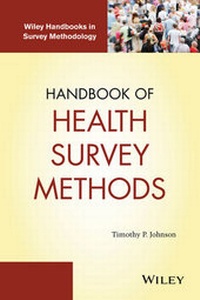
Handbook of Health Survey Methods
Description

Reviews / Votes
"The extensive and analytical coverage will make the book an extremely valuable resource: the new handbook will certainly emerge as essential reading for anyone deals with health surveys." (Ann Ist Super Sanità, 1 October 2015)More details
Other editions
Additional editions
Person
Content
List of Contributors xvii
Preface xxi
Acknowledgments xxiii
1 Origins and Development of Health Survey Methods 1 Timothy P. Johnson
1.1 Introduction 1
1.2 Precursors of Modern Health Surveys 1
1.3 The First Modern Health Surveys 4
1.4 The Emergence of National Health Surveys 5
1.5 Post-WWII Advances 6
1.6 Current Developments 7
References 9
Online Resources 17
Part I Design and Sampling Issues 2 Sampling For Community Health Surveys 21 Michael P. Battaglia
2.1 Introduction 21
2.2 Background 22
2.3 Theory and Applications 24
2.4 Subpopulation Surveys 30
2.5 Sample Size Considerations 32
2.6 Summary 32
References 33
Online Resources 34
3 Developing a Survey Sample Design for Population-Based Case-Control Studies 37 Ralph DiGaetano
3.1 Introduction 37
3.2 A "Classic" Sample Design for a Population-Based Case-Control Study 39
3.3 Sample Design Concepts and Issues Related to Case-Control Studies 40
3.4 Basic Sample Design Considerations 49
3.5 Sample Selection of Cases 56
3.6 Sample Selection of Controls 57
3.7 Sample Weighting for Population-Based Case-Control Studies 62
3.8 The Need to Account for Analytic Plans When Developing a Sample Design: An Example 65
3.9 Sample Designs for Population-Based Case-Control Studies: When Unweighted Analyses Are Planned 66
3.10 Mimicking the Classic Design Using RDD-Based Sampling of Population-Based Controls 66
3.11 Examples of the Development of Complex Sample Designs for Population-Based Case-Control Studies Using Weighted Analyses Where Cases Serve as the Reference Population and Variance Estimates Reflect the Sample Design 69
3.12 Summary 71
References 71
Online Resources 75
4 Sampling Rare Populations 77 James Wagner and Sunghee Lee
4.1 Introduction 77
4.2 Traditional Probability Sampling Approaches 80
4.3 Nontraditional and Nonprobability Sampling Approaches 84
4.4 Conclusion 95
References 97
Online Resources 103
Part II Design and Measurement Issues
5 Assessing Physical Health 107 Todd Rockwood
5.1 Introduction 107
5.2 Assessing Health: Response Formation and Accuracy 110
5.3 Conceptual Framework for Developing and Assessing Health 118
5.4 Measurement Theory 124
5.5 Error and Methodology 129
5.6 Conclusion 132
References 134
Online Resources 141
6 Developing and Selecting Mental Health Measures 143 Ronald C. Kessler and Beth-Ellen Pennell
6.1 Introduction 143
6.2 Historical Background 144
6.3 Fully Structured Diagnostic Interviews 147
6.4 Dimensional Measures of Symptom Severity 148
6.5 Emerging Issues in Survey Assessments of Mental Disorders 156
6.6 Conclusion 159
References 159
Online Resources 169
7 Developing Measures of Health Behavior and Health Service Utilization 171 Paul Beatty
7.1 Introduction 171
7.2 The Conceptual Phase of Questionnaire Development 172
7.3 Development of Particular Questions 173
7.4 Overall Questionnaire Construction 184
7.5 Questionnaire Testing and Evaluation 186
7.6 Using Questions from Previously Administered Questionnaires 187
7.7 Conclusion 187
References 188
Online Resources 190
8 Self-Rated Health in Health Surveys 193 Sunghee Lee
8.1 Introduction 193
8.2 Utility of Self-Rated Health 195
8.3 Theoretical Evidence: Cognitive Processes Pertinent to Responding to SRH in Surveys 198
8.4 Measurement Issues for Self-Rated Health 201
8.5 Conclusion 206
References 207
Online Resources 216
9 Pretesting of Health Survey Questionnaires: Cognitive Interviewing Usability Testing and Behavior Coding 217 Gordon Willis
9.1 Introduction 217
9.2 Historical Background and Theory of Pretesting 218
9.3 Cognitive Interviewing 220
9.4 Usability Testing 229
9.5 Behavior Coding 232
9.6 Summary 236
References 238
Online Resources 241
10 Cross-Cultural Considerations in Health Surveys 243 Brad Edwards
10.1 Introduction 243
10.2 Theory and Practice 255
10.3 Conclusion 266
References 266
Online Resources 274
11 Survey Methods for Social Network Research 275 Benjamin Cornwell and Emily Hoagland
11.1 Introduction 275
11.2 Respondents as Social Network Informants 277
11.3 Whole, Egocentric, and Mixed Designs 277
11.4 Name Generators 282
11.5 Free Versus Fixed Choice 286
11.6 Name Interpreters 287
11.7 Social Network Measures 288
11.8 Other Approaches to Collecting Network-Like Data 292
11.9 Modes of Data Collection and Survey Logistics 295
11.10 Avoiding Endogeneity in Survey-Based Network Data 296
11.11 Selection Issues 300
11.12 New Directions: Measuring Social Network Dynamics 301
11.13 Further Reading 304
References 304
Online Resources 312
12 New Technologies for Health Survey Research 315 Joe Murphy, Elizabeth Dean, Craig A. Hill, and Ashley Richards
12.1 Introduction 315
12.2 Background 316
12.3 Theory and Applications 318
12.4 Summary 329
References 331
Online Resources 337
Part III Field Issues
13 Using Survey Data to Improve Health: Community Outreach and Collaboration 341 Steven Whitman, Ami M. Shah, Maureen R. Benjamins, and Joseph West
13.1 Introduction 341
13.2 Our Motivation 342
13.3 Our Process 343
13.4 A Few Findings 344
13.5 Case Studies of Community Engagement 349
13.6 Some Lessons Learned 361
References 363
Online Resources 365
14 Proxy Reporting in Health Surveys 367 Joseph W. Sakshaug
14.1 Introduction 367
14.2 Background 367
14.3 Proxy Interviews for Children 370
14.4 Proxy Interviews for the Elderly 372
14.5 Proxy Interviews for the Disabled 374
14.6 Summary 375
References 376
Online Resources 381
15 The Collection of Biospecimens in Health Surveys 383 Joseph W. Sakshaug, Mary Beth, Ofstedal Heidi Guyer, and Timothy J. Beebe
15.1 Introduction 383
15.2 Background 384
15.3 Biomeasure Selection 387
15.4 Methodological and Operational Considerations 397
15.5 Quality Control 402
15.6 Ethical and Legal Considerations 408
15.7 Methods of Data Dissemination 411
15.8 Summary 412
References 413
Online Resources 419
16 Collecting Contextual Health Survey Data Using Systematic Observation 421 Shannon N. Zenk, Sandy Slater, and Safa Rashid
16.1 Introduction 421
16.2 Background 423
16.3 Data Collection 426
16.4 Reliability and Validity Assessment 429
16.5 Data Analysis 432
16.6 Theory and Applications 432
16.7 BTG-COMP: Evaluating the Impact of the Built Environment on Adolescent Obesity 432
16.8 Evaluating the Impact of a Policy Change on the Retail Fruit and Vegetable Supply 436
16.9 Summary 440
References 441
Online Resources 445
17 Collecting Survey Data on Sensitive Topics: Substance Use 447 Joe Gfroerer and Joel Kennet
17.1 Introduction 447
17.2 Background 448
17.3 Theory and Applications 450
17.4 Validation 463
17.5 Alternative Estimation Methods 464
17.6 Summary 466
References 467
Online Resources 472
18 Collecting Survey Data on Sensitive Topics: Sexual Behavior 473 Tom W. Smith
18.1 Introduction 473
18.2 Sampling 474
18.3 Nonobservation 475
18.4 Observation/Measurement Error 475
18.5 Summary 479
References 479
Online Resources 485
19 Ethical Considerations in Collecting Health Survey Data 487 Emily E. Anderson
19.1 Introduction 487
19.2 Background: Ethical Principles and Federal Regulations for Research 488
19.3 Defining, Evaluating, and Minimizing Risk 491
19.4 Ethical Review of Health Survey Research 497
19.5 Informed Consent for Survey Participation 500
19.6 Considerations for Data Collection 504
19.7 Summary 505
References 506
Online Resources 510
Part IV Health Surveys of Special Populations
20 Surveys of Physicians 515 Jonathan B. VanGeest, Timothy J. Beebe, and Timothy P. Johnson
20.1 Introduction 515
20.2 Why Physicians do not Respond 517
20.3 Theory and Applications: Improving Physician Participation 518
20.4 Sampling 518
20.5 Design-Based Interventions to Improve Response 523
20.6 Incentive-Based Interventions 530
20.7 Supporting Evidence from Other Health Professions 532
20.8 Conclusion 533
References 534
Online Resources 543
21 Surveys of Health Care Organizations 545 John D. Loft, Joe Murphy, and Craig A. Hill
21.1 Introduction 545
21.2 Examples of Health Care Organizations Surveys 548
21.3 Surveys of Health Care Organizations as Establishment Surveys 548
21.4 Conclusions 556
References 558
Online Resources 560
22 Surveys of Patient Populations 561 Francis Fullam and Jonathan B. VanGeest
22.1 Introduction 561
22.2 Patients and Care Settings 563
22.3 Overview of Common Patient Survey Methodologies 564
22.4 Key Issues in Patient Survey Design and Administration 565
22.5 Strategies for Developing Effective Patient Surveys 570
22.6 Conclusion 573
References 574
Online Resources 583
23 Surveying Sexual and Gender Minorities 585 Melissa A. Clark, Samantha Rosenthal, and Ulrike Boehmer
23.1 Introduction 585
23.2 Prevalence Estimates of Sexual and Gender Minorities 592
23.3 Sampling and Recruitment 597
23.4 Data Collection 606
23.5 Conclusions 608
References 609
Online Resources 617
24 Surveying People with Disabilities: Moving Toward Better Practices and Policies 619 Rooshey Hasnain, Carmit-Noa Shpigelman, Mike Scott, Jon R. Gunderson, Hadi B. Rangin, Ashmeet Oberoi, and Liam McKeever
24.1 Introduction 620
24.2 Setting a Foundation:The Importance of Inclusion for Web-Based Surveys 623
24.3 Promoting Participation with Web Accessibility 624
24.4 Testing the Accessibility of Some Web-Based Survey Tools 626
24.5 Ensuring Web Accessibility at Various Levels of Disability 629
24.6 Problems Posed By Inaccessible Web-Based Surveys for People with Disabilities 633
24.7 Applications: How to Ensure that Web-Based Surveys are Accessible 634
24.8 Summary and Conclusions 637
References 638
Online Resources 641
Part V Data Management and Analysis
25 Assessing the Quality of Health Survey Data Through Modern Test Theory 645 Adam C. Carle
25.1 Introduction 645
25.2 Internal Validity and Dimensionality 647
25.3 Dimensionality and Bifactor Model Example 650
25.4 Dimensionality Discussion 652
25.5 Measurement Bias 653
25.6 Multiple Group Multiple Indicator Multiple Cause Models 655
25.7 Additional Challenges to Health Survey Data Quality 664
25.8 Overall Conclusion 664
References 665
Online Resources 667
26 Sample Weighting for Health Surveys 669 Kennon R. Copeland and Nadarajasundaram Ganesh
26.1 Objectives of Sample Weighting 669
26.2 Sample Weighting Stages (Probability Sample Designs) 670
26.3 Calculating Base Weights 671
26.4 Accounting for Noncontact and Nonresponse 672
26.5 Adjusting to Independent Population Controls 677
26.6 SampleWeighting for Nonprobability Sample Designs 680
26.7 Issues in Sample Weighting 680
26.8 Estimation 682
26.9 Variance Estimation 683
26.10 Special Topics 683
26.11 Example: Weighting for the 2010 National Immunization Survey 685
26.12 Summary 692
References 692
Online Resources 694
27 Merging Survey Data with Administrative Data for Health Research Purposes 695 Michael Davern Marc Roemer and Wendy Thomas
27.1 Introduction 695
27.2 Potential Uses of Linked Data 696
27.3 Limitations and Strengths of Survey Data 699
27.4 Limitations and Strengths of Administrative Data 700
27.5 A Research Agenda into Linked Data File Quality 701
27.6 Conclusions 712
References 713
Online Resources 716
28 Merging Survey Data with Aggregate Data from Other Sources: Opportunities and Challenges 717 Jarvis T. Chen
28.1 Background 717
28.2 Geocoding and Linkage to Area-Based Data 719
28.3 Geographic Levels of Aggregation 720
28.4 Types of Area-Level Measures 723
28.5 Sources of Aggregated Data 724
28.6 Aggregate Data Measures as Proxies for Individual Data 730
28.7 Aggregate Measures as Contextual Variables 731
28.8 The Components of Ecological Bias 732
28.9 Analytic Approaches to the Analysis of Survey Data with Linked Area-Based Measures 742
28.10 Summary 746
References 748
Online Resources 754
29 Analysis of Complex Health Survey Data 755 Stanislav Kolenikov and Jeff Pitblado
29.1 Introduction 755
29.2 Inference with Complex Survey Data 760
29.3 Substantive Analyses 784
29.4 Quality Control Analyses 795
29.5 Discussion 798
References 798
Online Resources 804
Index 805
Chapter One
Origins and Development of Health Survey Methods
Timothy P. Johnson
Survey Research Laboratory, College of Urban Planning and Public Affairs, University of Illinois at Chicago, Illinois, USA
1.1 Introduction
The health survey methodologies considered in this handbook have been under continuous development for the past 150 years. The story of their emergence has been one of tools and ideas borrowed from many disciplines, such as demography, economics, medicine, nursing, psychology, public health, social work, sociology, and statistics, to address the concerns of social reformers, health care providers, community advocates, business interests, government planners, policy makers, and academic modelers. Indeed, the statistics derived from health surveys have served multiple purposes and multiple audiences. This chapter provides a brief overview of their origins and development.
1.2 Precursors of Modern Health Surveys
The first recognizable health surveys are no doubt lost to history. It is known, however, that public health problems associated with early industrialization and rapid urbanization during the nineteenth century motivated some of the earliest empirical inquiries that exhibited characteristics not greatly unlike what is now considered modern health survey research (Ackerknecht 1948, Elesh 1972, Rosen 1955). The efforts of Kay (1832) and Booth (1889-1902) to examine poverty conditions in the British cities of Manchester and London, respectively, were in fact early applications of survey methodology to address health-related problems. Booth's Life and Labour of the People of London, in particular, was noted for the development of poverty maps, which provided graphical representations of the geographic distribution of poverty indicators across London (Pfautz 1967). Similar efforts were conducted by Villermé (1840), who investigated health conditions among factory workers in France in his volume Survey of the Physical and Moral Condition of Workers Employed in Cotton, Wool and Silk Factories, and Johann Peter Frank, who conducted crude surveys of health and social conditions in several Italian provinces in 1786 (Frank 1941). The focus of these early studies on relationships among health, environment, and socioeconomic status became a recurrent and often dominant theme over subsequent decades as health survey tools continued to be developed and refined (cf. Ciocco et al. 1954, Krieger 2011, Sydenstricker 1933a).
Later poverty studies by Rowntree (1910) in York and Bowley and Burnett-Hurst (1915) in Reading and several other English cities each made independent methodological contributions. Rowntree may have been the first to employ a staff of survey interviewers to collect data. Possibly the earliest reported use of systematic random sampling was during the survey conducted in Reading by Bowley, who also included a detailed assessment of the accuracy of his findings that considered each of the sources of error now commonly recognized as part of the total survey error model. Following in the British tradition, poverty surveys, each linking adverse health events with the onset of poverty, were conducted in the U.S. cities of Buffalo in 1887 (Warner 1930), New York City in 1905 (Frankel 1906-1907), and Baltimore in 1916-1917 (Ciocco and Perrott 1957). In none of these efforts, however, were health conditions the central focus of the research but rather one of many factors crudely measured because of their perceived association with poverty and economic status.
Other nineteenth century research focused on urban sanitary conditions and their relationship to population health. One of the earliest such efforts that relied in part on empirical observations was Chadwick's (1842) Report on the Sanitary Condition of the Labouring Population of Great Britain, which led to new public health legislation (Rosen 1958). Sanitary research similar to Chadwick's was also undertaken by public health practitioners in the United States concerned with emerging epidemics in rapidly expanding American cities (Bulmer et al. 1991, Peterson 1983, Rosenberg 1962). Most notable were the sanitary surveys conducted in Boston by Shattuck (1850) and in New York by Griscom (1845) and subsequently in numerous other cities. Several such surveys were sponsored by the Russell Sage Foundation, which also supported other early health-related surveys in dozens of communities in the United States and Canada (Department of Surveys and Exhibits 1915). One of the more well-known and comprehensive of these was conducted in Springfield, Illinois, in 1910 (Palmer 1912, Schneider 1915). Sanitary surveys also were conducted by the U.S. Public Health Service, which was reorganized and renamed (formerly known as the Public Health and Marine Hospital Service) in 1912 and charged with conducting field research into human disease and public sanitation (Furman and Williams 1973). Between 1914 and 1916, a series of these surveys were conducted by the Public Health Service in rural areas across the nation (Lumsden 1918). The methodologies employed in conducting sanitary surveys were varied, involving numerous approaches to evaluating community conditions. As such, there was at best only partial overlap with what we now consider to be modern health survey research.1 Although crude approximations by today's standards and widely criticized at the time (Elmer 1914, Schneider 1917), these efforts nonetheless demonstrated the value and importance of systematic observation for the study of health, environment, and related social conditions and contributed to dramatic improvements in public health in the United States and many other nations.
Similar to sanitary surveys in their diversity of methods and focus on action research-but more broadly framed-were the studies conducted as part of the social survey movement in the early years of the twentieth century (Burgess 1916). Covering topics such as housing, adult and child labor, immigration, economics, and criminal justice, in addition to health, these studies perhaps were most accurately described as "social inventories" of communities (Harrison 1912). As with the early sanitary surveys, a variety of practical methods in addition to, or in some cases instead of, household interviews were employed.2 Perhaps the most well known of these was the Pittsburgh Social Survey, conducted from 1907-1908 (Greenwald and Anderson 1996). Several other important social surveys focused their investigations on specific racial or ethnic groups, including Blacks in Philadelphia (DuBois 1899) and the Polish in Buffalo (Kellogg 1912). Eaton and Harrison (1930) cataloged the vast numbers of social surveys conducted in the first several decades of the last century. Although more broad in their coverage, health remained an important topic in these social surveys; in fact, many of them employed questionnaires to collect health information from respondents. The Pittsburgh social survey, for example, reported on the costs of illness in terms of lost wages, medical bills, medications, hospitalization, and so on (Kellogg 1912), and a survey conducted of residences in the Chicago Stockyards District in 1909-1910 reported information regarding family medical expenditures (Kennedy 1914).
Possibly the first studies specifically designed to collect national health data in the United States were the decennial Censuses of 1880 and 1890, which collected household information regarding persons who were currently "sick or temporarily disabled," "blind," "deaf and dumb," "idiotic," "insane," and "maimed, chrippled [sic], bedridden, or otherwise disabled" (Department of the Interior, Census Office 1888 1895).3 Late in the nineteenth century, the U.S. Bureau of Labor also collected illness data as part of economic canvassing surveys conducted in urban slum areas of four large cities: Baltimore, Chicago, New York, and Philadelphia. This Special Investigation of the Slums of Great Cities concluded that rates of sickness were unexpectedly low, given the "wretched conditions" in which these populations lived (Osborn 1895). The Chicago part of the field work for this study was conducted by the noted social activist Florence Kelley under the auspices of Jane Addams' Hull House. Conducting analyses of the Chicago data independently of the Bureau of Labor's official report, Kelley and colleagues developed detailed social and economic maps for slum sections of Chicago similar to Booth's earlier work in London (Holbrook 1895) and consistent with the soon-to-be-popular social survey movement discussed earlier.
1.3 The First Modern Health Surveys
Early in the twentieth century, increases in life expectancy and associated declines in mortality rates also began to render traditional vital statistics less useful for evaluating population health, leading to increased interest in developing methods for assessing population morbidity (National Center for Health Statistics 1981). Research studies for the first time focused on health topics. An early pioneer in this effort was Edward Sydenstricker of the U.S. Public Health Service, who applied survey research methodology to numerous health-related problems (Kasius 1974). An economist by training, Sydenstricker first employed the survey method to collect health information on a periodic basis from employees of cotton mills in seven South Carolina villages (Sydenstricker et al. 1918) and...
