

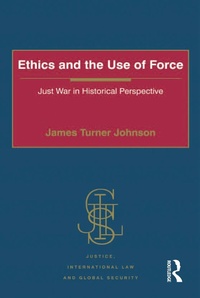
Ethics and the Use of Force
Just War in Historical Perspective
Published on 13. May 2016
182 pages
978-1-317-14119-8 (ISBN)
Description

Highlighting the just war tradition in historical perspective, this valuable study looks at contemporary implications drawn out in the context of several important contemporary debates: within the field of religion, including both Christian and Islamic thought; within the field of debate related to the international law of armed conflicts; within the field of policy relating to the use of armed force where the issue is just war thinking vs. realism; and debates over pressing contemporary issues in the ethics of war which cross disciplinary lines. James Turner Johnson has been writing on just war tradition since 1975, developing the historical understanding of just war and seeking to draw out its implications for contemporary armed conflict. He is frequently asked to lecture on topics drawn from his work. This current book brings together a number of essays which reflect his recent thinking on understanding how and why just war tradition coalesced in the first place, how and why it has developed as it has, and relating contemporary just war reasoning to the historical tradition of just war.
Reviews / Votes
'This work represents James Turner Johnson's current thinking about the just war tradition. As he acknowledges the great variety present in contemporary discourse, Johnson teaches us to evaluate claims and counterclaims in light of historic precedents. The work is clear, insightful, and compelling. A masterful job.' John Kelsay, Florida State University, USA 'James Turner Johnson is rightly regarded as a giant of contemporary just war thinking. In this important new book, Johnson deftly examines some of the principal theoretical and practical challenges confronting the tradition today and provides a powerful defence, demonstrating its continued value as a guide to how wars might be justly waged to serve the cause of peace. This book is an exemplary and important contribution to contemporary thought and practice that will be valued by academics, students, soldiers and all those who think seriously about the moral dilemmas associated with war.' Alex Bellamy, University of Queensland, Australia 'James Turner Johnson brings the wealth of his historical erudition to bear on the uses and misuses of the Just War tradition in contemporary debates about legitimate uses of military force. He provides an invaluable guide to applying the tradition to provide guidance to morally serious practitioners. He also provides an invaluable corrective to some contemporary misuses of the tradition.' Martin L. Cook, United States Naval War College, USA 'Religious ethicist Johnson (Rutgers) is the leading historian of the just war tradition, and a formidable defender of its classical core against modern and contemporary alternatives. Ethics and the Use of Force collects essays that represent the full range of Johnson's scholarship, but it can serve as an advanced introduction to the just war tradition on its own... the collection brings focus to Johnson's extensive contributions to the field and represents his latest thinking on the issues. Summing Up: Recommended. Upper-level underMore details
Series
Language
English
Place of publication
London
United Kingdom
Publishing group
Taylor & Francis Ltd
Target group
College/higher education
File size
1,10 MB
ISBN-13
978-1-317-14119-8 (9781317141198)
Copyright in bibliographic data and cover images is held by Nielsen Book Services Limited or by the publishers or by their respective licensors: all rights reserved.
Schweitzer Classification
Other editions
Additional editions
Book
09/2016
1st Edition
Routledge
€83.10
Shipment within 10-20 days
Book
04/2011
1st Edition
Routledge
€231.30
Shipment within 10-20 days
Person
James Turner Johnson is a Distinguished Professor, Department of Religion, Rutgers University-The State University of New Jersey, USA
Content
Introduction The Use of History for Thinking About Morality and War; Part I Two Moral Traditions on the Use of Armed Force; Chapter 1 The Just War Idea in Historical Tradition and Current Debate; Chapter 2 Just War; Chapter 3 Just War and Jihad; Chapter 4 Tracing the Contours of the Jihad of Individual Duty in Islamic Juristic Tradition; Part II Just War and International Law; Chapter 5 Grotius' Use of History and Charity in the Modern Transformation of the Just War Idea; Chapter 6 Looking Back as a Way of Going Forward; Part III Just War and Political Realism; Chapter 7 Moral Judgment in International Affairs; Chapter 8 Reinhold Niebuhr's Christian Realism and the Idea of Just War; Part IV Pressing Contemporary Problems; Chapter 9 The Idea of Defense in Historical and Contemporary Thinking about Just War; Chapter 10 Contemporary Warfare and the Challenge to Efforts at Restraint; Chapter 11 The Use of Armed Force and the Goal of Peace;
